


JEE Mains · Chemistry · STD 11 - Organic chemistry reaction mechanism
- JEE Mains 2026
- Medium
- MCQ
For the given molecule, "\(x\)", the preferred site for the attack of the electrophile is :
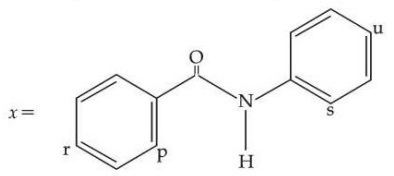
Pick an option to check your answer.
Answer & Solution
Correct Answer
(D) Predominantly at "u"
Step-by-step Solution
Detailed explanation
The given molecule, benzanilide, contains two phenyl rings with different reactivities towards electrophilic aromatic substitution.
The left phenyl ring is attached to the carbonyl carbon of the amide group (\(-C(=O)NHPh\)). The carbonyl group is electron-withdrawing due to its \(-M\) and \(-I\) effects, which deactivates this ring towards electrophilic attack.
The right phenyl ring is attached to the nitrogen atom of the amide group (\(-NHC(=O)Ph\)). The nitrogen atom possesses a lone pair of electrons that can delocalize into the ring via resonance (\(+M\) effect). This electron donation activates the right ring, making it significantly more reactive than the left ring.
The \(-NHC(=O)Ph\) group is an ortho/para directing group. The possible sites for electrophilic attack on the activated ring are the ortho position ('s') and the para position ('u').
Due to the large steric bulk of the \(-NHC(=O)Ph\) group, the ortho position ('s') experiences significant steric hindrance. Therefore, the electrophile will preferentially attack the less hindered para position.
Thus, the preferred site for the attack of the electrophile is predominantly at 'u'.
Answer: Predominantly at "u"
More questions from Chemistry
- The energy of first (lowest) Balmer line of H atom is x J. The energy (in J) of second Balmer line of H atom is:JEE Mains 2026 Medium
- Given,
(A) \(n = 5, m_l = -1\)
(B) \(n = 3, l = 2, m_l = -1, m_s = +\frac{1}{2}\)
The maximum number of electron(s) in an atom that can have the quantum numbers as given in (A) and (B) respectively are:JEE Mains 2026 Medium - Manganese \((VI)\) has ability to disproportionate in acidic solution. The difference in oxidation states of two ions it forms in acidic solution is \(...... .\)JEE Mains 2022 Medium
- For the given reaction, choose the correct expression of \(\mathrm{K}_{\mathrm{C}}\) from the following :- \(\mathrm{Fe}_{(\mathrm{aq})}^{3+}+\mathrm{SCN}_{(\mathrm{aq})}^{-} \rightleftharpoons(\mathrm{FeSCN})_{(\mathrm{aq})}^{2+}\)JEE Mains 2024 Hard
- The increasing order of the reactivity of the following halides for the \(S_N1\) reaction is \((I)\,\begin{array}{*{20}{c}}
{C{H_3}CHC{H_2}C{H_3}} \\
{|\,\,\,\,\,\,\,\,\,\,\,} \\
{Cl\,\,\,\,\,\,\,\,\,}
\end{array}\) \((II)\,CH_3CH_2CH_2Cl\) \((III)\,H_3CO-C_6H_4-CH_2Cl\)JEE Mains 2017 Hard - Given below are two statements: Statement- \(I\): Along the period, the chemical reactivity of the element gradually increases from group \(1\) to group \(18\). Statement - \(II\): The nature of oxides formed by group \(1\) element is basic while that of group \(17\) elements is acidic.In the the light above statements, choose the most appropriate from the questions given below:JEE Mains 2024 Hard
More PYQs from JEE Mains
- Lattice enthalpy and enthalpy of solution of \(NaCl\) are \(788\, kJ mol ^{-1}\) and \(4\, kJ\, mol ^{-1}\) respectively. The hydration enthalpy of \(NaCl\) .......\(\, kJ\, mol ^{-1}\)JEE Mains 2020 Medium
- Which one among the following chemical tests is used to distinguish monosaccharide from disaccharide?JEE Mains 2021 Easy
- A body of mass \(2\, kg\) is driven by an engine delivering a constant 10.Power \(1\, J / s\). The body starts from rest and moves in a straight line. After \(9\) seconds, the body has moved a distance (in \(m )\)
 JEE Mains 2020 Hard
- Three small identical bubbles of water having same charge on each coalesce to form a bigger bubble. Then the ratio of the potentials on one initial bubble and that on the resultant bigger bubble is:JEE Mains 2026 Hard
- A sample contains \(10^{-2}\, kg\) each of two substances A and \(B\) with half lives \(4 \,s\) and \(8 \,s\) respectively. The ratio of then atomic weights is \(1: 2\) The ratio of the amounts of \(A\) and \(B\) after \(16 \,s\) is \(\frac{x}{100}\). the value of \(x\) is........JEE Mains 2022 Medium
- Identify the metal ions among \(Co ^{2+}, Ni ^{2+}, Fe ^{2+}, V ^{3+}\) and \(Ti ^{2+}\) having a spin-only magnetic moment value more than 3.0 BM . The sum of unpaired electrons present in the high spin octahedral complexes formed by those metal ions is ______.JEE Mains 2026 Medium