


JEE Mains · Chemistry · STD 11 - Organic chemistry reaction mechanism
- JEE Mains 2026
- Easy
- MCQ
Increasing order of electron withdrawing power of following functional groups is:
a. \(-CN\)
b. \(-COOH\)
c. \(-NO_2\)
d. \(-I\)
Pick an option to check your answer.
Answer & Solution
Correct Answer
(C) \(d < b < a < c\)
Step-by-step Solution
Detailed explanation
The electron withdrawing power (\(-I\) effect) of various functional groups follows the standard experimental order:
\(-NO_2 > -CN > -COOH > -F > -Cl > -Br > -I\)
Based on this series, the increasing order of electron withdrawing power for the given groups is:
\(-I < -COOH < -CN < -NO_2\)
This corresponds to the sequence \(d < b < a < c\).
Answer: \(d < b < a < c\)
More questions from Chemistry
- Given below are some nitrogen containing compounds
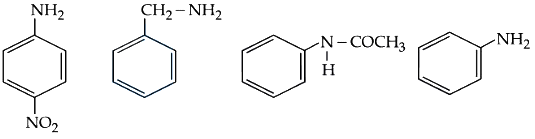
Each of them is treated with HCl separately. 1.0 g of the most basic compound will consume _______ mg of HCl.
(Given molar mass in \(\mathrm{g} \mathrm{mol}^{-1} \mathrm{C}: 12, \mathrm{H}: 1, \mathrm{O}: 16, \mathrm{Cl}: 35.5\))JEE Mains 2025 Medium - Match the LIST-I with LIST-II
Choose the correct answer from the options given belowList-I
ReagentsList-II
Name of Reaction involving carbonyl compoundA. \(NH _2- NH _2, KOH\) I. Tollen's Test B. \(Ag \left( NH _3\right)_2 OH\) II. Clemmensen Reduction C. Aq. \(CuSO _4\), Sodium Potassium tartarate, KOH III. Wolff-Kishner Reduction D. \(Zn - Hg , HCl\) Iv. Fehling's Test JEE Mains 2026 Medium - The gas phase reaction \(2 A ( g ) \rightleftharpoons A _{2}( g )\) at \(400\, K\) has \(\Delta G ^{\circ}=+25.2\, kJ mol ^{-1}\). The equilibrium constant \(K _{ C }\) for this reaction is \(...... \times 10^{-2}\). (Round off to the Nearest integ \(\left[\right.\) Use \(: R=8.3\, J mol ^{-1} K ^{-1}, \ln 10=2.3\) \(\left.\log _{10} 2=0.30,1\, atm =1\, bar \right]\) \([\) antilog \((-0.3)=0.501]\)JEE Mains 2021 Medium
- Match List - I with List - II.
Choose the correct answer from the options given below :List - I (Test) List - II (Identification) (A) Bayer's test (I) Phenol (B) Ceric ammonium nitrate test (II) Aldehyde (C) Phthalein dye test (III) Alcoholic-OH group (D) Schiff's test (IV) Unsaturation JEE Mains 2024 Medium - Correct order of stability of carbanion is _______.
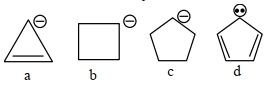 JEE Mains 2024 Medium
- Which of the following will have maximum stabilization due to crystal field?JEE Mains 2022 Easy
More PYQs from JEE Mains
- The number of possible tripeptides formed involving alanine (ala), glycine (gly) and valine (val), where no amino acid has been used more than once is :JEE Mains 2026 Hard
- If the potential barrier across a \(p - n\) junction is \(0.6\,V\). Then the electric field intensity, in the depletion region having the width of \(6 \times 10^{-6} m\), will be \(......\times 10^{5} N / C\).JEE Mains 2022 Easy
- A compound \((x)\) with molar mass \(108 \mathrm{~g} \mathrm{~mol}^{-1}\) undergoes acetylation to give product with molar mass \(192 \mathrm{~g} \mathrm{~mol}^{-1}\). The number of amino groups in the compound \((\mathrm{x})\) is _______.JEE Mains 2024 Hard
- A standing wave is formed by the superposition of two waves travelling in opposite directions. The transverse displacement is given by \(y\left( {x,t} \right) = 0.5\sin\, \left( {\frac{{5\pi }}{4}x} \right)\,\cos\, \left( {200\,\pi t} \right)\). What is the speed of the travelling wave moving in the positive \(x\) direction .... \(m/s\) ? (\(x\) and \(t\) are in meter and second, respectively.)JEE Mains 2017 Hard
- The pressure \(P_{1}\) and density \(d_{1}\) of diatomic gas \(\left(\gamma=\frac{7}{5}\right)\) changes suddenly to \(P _{2}\left(> P _{1}\right)\) and \(d _{2}\) respectively during an adiabatic process. The temperature of the gas increases and becomes \(......\) times of its initial temperature.\(\left(\right.\) given \(\left.\frac{ d _{2}}{ d _{1}}=32\right)\)JEE Mains 2022 Medium
- A uniform rod of length \('l'\) is pivoted at one of its ends on a vertical shaft of negligible radius When the shaft rotates at angular speed \(\omega\) the rod makes an angle \(\theta\) with it (see figure). To find \(\theta\) equate the rate of change of angular momentum (direction going into the paper ) \(\frac{ m \ell^{2}}{12} \omega^{2} \sin \theta \cos \theta\) about the centre of mass \((CM)\) to the torque provided by the horizontal and vertical forces \(F_{H}\) and \(F_{V}\) about the CM. The value of \(\theta\) is then such that:
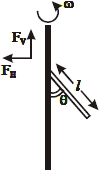 JEE Mains 2020 Hard