


JEE Mains · Chemistry · STD 11 - Organic chemistry reaction mechanism
- JEE Mains 2026
- Hard
- MCQ
Consider the three aromatic molecules (P, Q and R) whose structures have been given below :
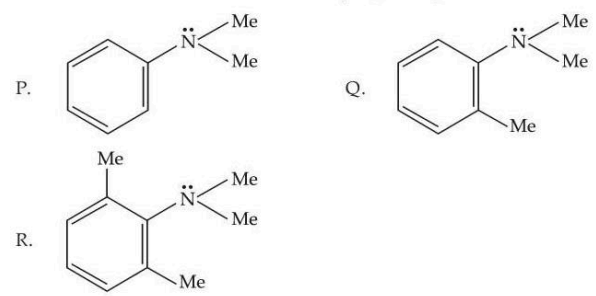
The correct order regarding the reactivity of these compounds with \(Ph-N\equiv NCl^{(-)}_{(+)}\) under optimum but slightly acidic medium is :
Pick an option to check your answer.
Answer & Solution
Correct Answer
(A) \(P > Q > R\)
Step-by-step Solution
Detailed explanation
The reaction of the given aromatic compounds with benzenediazonium chloride (\(Ph-N_2^+ Cl^-\)) is an azo coupling reaction, which is a type of electrophilic aromatic substitution.
The electrophile, the diazonium ion (\(Ph-N_2^+\)), is a weak electrophile and requires a strongly activated aromatic ring to undergo coupling. The reactivity of the ring depends on its electron density, which is enhanced by the \(+M\) (mesomeric) effect of the \(-NMe_2\) group.
1. In molecule P (N,N-dimethylaniline), the \(-NMe_2\) group is coplanar with the benzene ring. The lone pair on the nitrogen atom is fully delocalized into the ring, providing a strong \(+M\) effect and making the ring highly electron-rich and reactive.
2. In molecule Q, there is one methyl group at the ortho position to the \(-NMe_2\) group. This causes steric hindrance, forcing the \(-NMe_2\) group slightly out of the plane of the benzene ring. This phenomenon is known as Steric Inhibition of Resonance (SIR). As a result, the delocalization of the nitrogen lone pair into the ring is reduced, decreasing the \(+M\) effect and making it less reactive than P.
3. In molecule R, there are two methyl groups at the ortho positions. This causes severe steric repulsion, forcing the \(-NMe_2\) group almost completely out of the plane of the ring. The \(+M\) effect is minimized because the lone pair can no longer effectively overlap with the \(\pi\)-system of the ring. Consequently, the ring is the least activated among the three.
Therefore, the electron density on the aromatic ring and the reactivity towards electrophilic substitution follow the order: P \(>\) Q \(>\) R.
Answer: \(P > Q > R\)
More questions from Chemistry
- The quantity of electricity in Faraday needed reduce \(1\, mol\) of \(Cr _{2} O _{7}^{2-}\) to \(Cr ^{3+}\) is ....JEE Mains 2022 Medium
- Arrange the following compounds in increasing order of their dipole moment : \(\mathrm{HBr}, \mathrm{H}_2 \mathrm{~S}, \mathrm{NF}_3\) and \(\mathrm{CHCl}_3\)JEE Mains 2025 Easy
- Which of the following is a set of green house gases ?JEE Mains 2017 Hard
- Within each pair of elements of \(F\;and \;Cl\) , \(S\;and \;Se\), and \(Li\;and \;Na\), respectively, the elements that release more energy upon an electron gain areJEE Mains 2020 Hard
- Which of the following statements are not correct?
A. For water, magnitude of \(K_b\) is more than the magnitude of \(K_f\).
B. The elevation in boiling point of water when a non-volatile solute is added to it is larger in magnitude than its depression in freezing point.
C. Osmotic pressure measurement is preferred over any other colligative property to determine molar mass of proteins and polymers.
D. The dimerised form of benzoic acid in benzene is \(C_6H_5-\underset{O}{\overset{O}{\|}}C-OH \cdots\cdots O=\underset{OH}{\overset{|}{C}}-C_6H_5\)
Choose the correct answer from the options given below:JEE Mains 2026 Hard - A \(2.0 \,g\) sample containing \(MnO _{2}\) is treated with \(HCl\) liberating \(Cl _{2}\). The \(Cl _{2}\) gas is passed into a solution of \(KI\) and \(60.0\, mL\) of \(0.1\, M\, Na _{2} S _{2} O_{3}\) is required to titrate the liberated iodine. The percentage of \(MnO _{2}\) in the sample is \(.....\) (Nearest integer) [Atomic masses (in \(u\)) \(Mn =55 ; Cl =35.5 ; O =16, I =127, Na =23, K =39, S =32]\)JEE Mains 2022 Hard
More PYQs from JEE Mains
- Considering the Bohr model of hydrogen like atoms, the ratio of the ratio of the radius \(5^{\text {th}}\) orbit of the electron in \(\mathrm{Li}^{2+}\) and \(\mathrm{He}^{+}\) is _______.JEE Mains 2025 Easy
- Amongst \(SF _{4}, XeF _{4}, CF _{4}\) and \(H _{2} O\), the number of species with two lone pairs of electrons ..... .JEE Mains 2022 Easy
- The incorrect statements regarding geometrical isomerism are :
(A) Propene shows geometrical isomerism.
(B) Trans isomer has identical atoms/groups on the opposite sides of the double bond.
(C) Cis-but-2-ene has higher dipole moment than trans-but-2-ene.
(D) 2-methylbut-2-ene shows two geometrical isomers.
(E) Trans-isomer has lower melting point than cis isomer.
Choose the correct answer from the options given below :JEE Mains 2025 Hard - Which statements are True?
A. In Hoffmann bromamide degradation, \(4\) moles of NaOH and \(2\) moles of Br\(_2\) are consumed per mole of an amide
B. Hoffmann bromamide reaction is not given by alkyl amides.
C. Primary amines can be synthesized by Hoffmann bromamide degradation.
D. Secondary amide on reaction with Br\(_2\) and NaOH will give secondary amine.
E. The by-products of Hoffmann degradation are Na\(_2\)CO\(_3\), NaBr and H\(_2\)O.
Choose the correct answer from the options given below:JEE Mains 2026 Medium - The type of oxide formed by the element among \(\mathrm{Li}, \mathrm{Na}, \mathrm{Be}, \mathrm{Mg}, \mathrm{B}\) and Al that has the least atomic radius is :JEE Mains 2025 Hard
- A spherical body of mass \(2\,kg\) starting from rest acquires a kinetic energy of \(10000\,J\) at the end of \(5^{\text {th }}\) second. The force acted on the body is \(.....N\)JEE Mains 2023 Medium