


JEE Mains · Chemistry · STD 11 - 6.2. Equilibrium - II (icon Equilibrium)
Arrange the following resultant mixtures in increasing order of their pH values
A. \(10\) mL \(0.2\) M Ca(OH)\(_2\) + \(25\) mL \(0.1\) M HCl
B. \(10\) mL \(0.01\) M H\(_2\)SO\(_4\) + \(10\) mL \(0.01\) M Ca(OH)\(_2\)
C. \(10\) mL \(0.1\) M H\(_2\)SO\(_4\) + \(10\) mL \(0.1\) M KOH
Choose the correct answer from the options given below:
- A \(B < C < A\)
- B \(C < A < B\)
- C \(C < B < A\)
- D \(A < C < B\)
Answer & Solution
Correct Answer
(C) \(C < B < A\)
Step-by-step Solution
Detailed explanation
For mixture A: Millimoles of OH\(^{-}\) = \(10 \times 0.2 \times 2 = 4\) Millimoles of H\(^{+}\) = \(25 \times 0.1 \times 1 = 2.5\) Remaining OH\(^{-}\) = \(4 - 2.5 = 1.5\) mmol The solution is basic, so pH \(> 7\). For mixture B: Millimoles of H\(^{+}\) =…
See the Complete Solution
Get step-by-step explanations for this and 2.5 Lakh+ more JEE, NEET & CET questions.
- Unlock all solutions
- Practice the full chapter
- Track accuracy across PYQs
4.8 rated on Google Play · 14,000+ reviews
More questions from Chemistry
- Presence of which reagent will affect the reversibility of the following reaction, and change it to a irreversible reaction: \(\mathrm{CH}_{4}+\mathrm{I}_{2} \underset{\text { Reversible }}{\stackrel{\mathrm{hv}}{\longrightarrow}} \mathrm{CH}_{3}-\mathrm{I}+\mathrm{HI}\)JEE Mains 2021 Medium
- The photoelectric current from Na (work function, \(\left. w _{0}=2.3\, eV \right)\) is stopped by the output voltage of the cell \(Pt ( s )\left| H _{2}( g , 1 bar )\right| HCl ( aq \cdot, pH =1)| AgCl ( s )| Ag ( s )\) The \(pH\) of aq. HCl required to stop the photoelectric current from \(K \left( w _{0}=2.25 eV \right),\) all other conditions remaining the same, is..........\(\times 10^{-2}\) (to the nearest integer). Given, \(2.303 \frac{ RT }{ F }=0.06 V ; E _{ AgC1|Ag|C ^{-}}^{0}=0.22\, V\)JEE Mains 2020 Hard
- Quantitative analysis of an organic compound (X) shows following % composition.
C : \(14.5 \%\)
Cl : 64.46%
H: 1.8 %
(Empirical formula mass of the compound \((\mathrm{X})\) is __________ \(\times 10^{-1}\)
(Given molar mass in \(\mathrm{g} \mathrm{mol}^{-1}\) of \(\mathrm{C}: 12, \mathrm{H}: 1, \mathrm{O}: 16, \mathrm{Cl}: 35.5\))JEE Mains 2025 Medium - One of the commonly used electrode is calomel electrode. Under which of the following categories calomel electrode comes?JEE Mains 2024 Medium
- Match List\(-I\) with List\(-II.\)
Choose the correct answer from the options given belowList\(-I\) (Oxide) List\(-II\) (Nature) \((A)\) \(Cl _{2} O _{7}\) \((I)\) Amphoteric \((B)\) \(Na _{2} O\) \((II)\) Basic \((C)\) \(Al _{2} O _{3}\) \((III)\) Neutral \((D)\) \(N _{2} O\) \((IV)\) Acidic JEE Mains 2022 Medium - An excess of AgNO\(_3\) is added to \(100\) mL of a \(0.05\) M solution of tetraaquadichloridochromium (III) chloride. The number of moles of AgCl precipitated will be __________ \(\times 10^{-3}\). (Nearest integer)JEE Mains 2026 Medium
More PYQs from JEE Mains
- The maximum area of a triangle whose one vertex is at \((0,0)\) and the other two vertices lie on the curve \(y=-2 x^2+54\) at points \((x, y)\) and \((-x, y)\) where \(\mathrm{y}>0\) is :JEE Mains 2024 Hard
- The number of solutions of the equation \(\cos \left(x+\frac{\pi}{3}\right) \cos \left(\frac{\pi}{3}-x\right)=\frac{1}{4} \cos ^{2} 2 x, x \in[-3 \pi\) \(3 \pi]\) isJEE Mains 2022 Hard
- Four particles \(A, B, C\) and \(D\) with masses \(m_A=m, m_B=2m, m_C=3m\) and \(m_D=4m\) are at the corners of a square. They have accelerations of equal magnitude with directions as shown. The acceleration of the centre of mass of the particles is
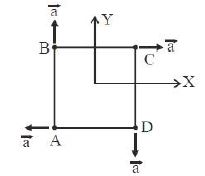 JEE Mains 2019 Hard
 - Let \(\left\{a_{n}\right\}_{n=0}^{\infty}\) be a sequence such that \(a_{0}=a_{1}=0\) and \(a_{ n +2}=3 a_{ n +1}-2 a_{ n }+1, \forall n \geq 0\).Then \(a_{25} a_{23}-2 a_{25} a_{22}-2 a_{23} a_{24}+4 a_{22} a_{24}\) is equal to.JEE Mains 2022 Hard
- A parallel plate capacitor with plates of area \(1\,m^2\) each, are at a separation of \(0.1\,m.\) If the electric field between the plates is \(100\,N/C,\) the magnitude of charge on each plateJEE Mains 2019 Medium
- If the standard electrode potential for a cell is \(2\,V\) at \(300\,K,\) the equilibrium constant \((K)\) for the reaction \(Zn\,(s)\,\, + \,\,C{u^{2 + }}\,(aq)\, \rightleftharpoons \,Z{n^{2 + \,}}\,(aq)\, + Cu\,(s)\) At \(300\,K\) is approximately \((R = 8 \,JK^{-1}\,mol^{-1},\, F = 96000\,C\,mol^{-1})\)JEE Mains 2019 Hard