


All Chemical bonding and molecular structure questions
Newest firstShowing 51–100 of 179 questions
- 51. Number of molecules from the following which can exhibit hydrogen bonding is _______. (nearest integer)
 2024 Medium
- (A) 5
- (B) 10
- (C) 15
- (D) 20
Show answer and solution
Correct Answer: (A)
Following molecule will show H-bonding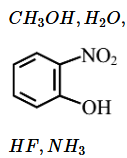
-
- (A) \(1\)
- (B) \(2\)
- (C) \(5\)
- (D) \(8\)
Show answer and solution
Correct Answer: (B)
\(\left(12 \mathrm{e}^{-}\right): \sigma 1 \mathrm{~s}^2, \sigma^* 1 \mathrm{~s}^2, \sigma 2 \mathrm{~s}^2, \sigma^* 2 \mathrm{~s}^2\left[\pi 2 \mathrm{p}_{\mathrm{x}}^2=\pi 2 \mathrm{p}_{\mathrm{y}}^2\right]\)\(\text { B.O. }=\frac{8-4}{2}=2\)
\(\mathrm{O}_2\)
\(\left(16 \mathrm{e}^{-}\right): \sigma 1 \mathrm{~s}^2, \sigma^* 1 \mathrm{~s}^2, \sigma 2 \mathrm{~s}^2, \sigma^* 2 \mathrm{~s}^2, \sigma 2 \mathrm{pz}^2\)
\({\left[\pi 2 \mathrm{p}_{\mathrm{x}}^2=\pi 2 \mathrm{p}_{\mathrm{y}}^2\right]\left[\pi^* 2 \mathrm{p}_{\mathrm{x}}^1=\pi^* 2 \mathrm{p}_{\mathrm{y}}^1\right]}\)
\(\text { B.O. }=\frac{10-6}{2}=2\)
\(\mathrm{Be}_2\)
\(\left(8 \mathrm{e}^{-}\right): \sigma 1 \mathrm{~s}^2, \sigma^* 1 \mathrm{~s}^2, \sigma 2 \mathrm{~s}^2, \sigma^* 2 \mathrm{~s}^2\)
\(\text { B.O. }=\frac{4-4}{2}=0\)
\(\text {Li}_2\)
\(\left(6 \mathrm{e}^{-}\right): \sigma 1 \mathrm{~s}^2, \sigma^* 1 \mathrm{~s}^2, \sigma 2 \mathrm{~s}^2\)
-
- (A) \(1\)
- (B) \(2\)
- (C) \(3\)
- (D) \(4\)
Show answer and solution
Correct Answer: (B)
According to \(M.O.T.\)\(\mathrm{O}_2 \rightarrow\) no. of unpaired electrons \(=2\)
\(\mathrm{O}_2^{-} \rightarrow\) no. of unpaired electron \(=1\)
NO \(\rightarrow\) no. of unparred electron \(=1\)
\(\mathrm{CN}^{-} \rightarrow\) no. of unparred electron \(=0\)
\(\mathrm{O}_2^{2-} \rightarrow\) no. of unpaired electron \(=0\)
- 54. Select the compound from the following that will show intramolecular hydrogen bonding. 2024 Hard
- (A) \(\mathrm{H}_2 \mathrm{O}\)
- (B) \(\mathrm{NH}_3\)
- (C) \(\mathrm{C}_2 \mathrm{H}_5 \mathrm{OH}\)
Show answer and solution
Correct Answer: (D)
\(\mathrm{H}_2 \mathrm{O}, \mathrm{NH}_3, \mathrm{C}_2 \mathrm{H}_5 \mathrm{OH} \Rightarrow\) Intermolecular \(\mathrm{H}\)-Bonding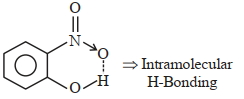
-
- (A) \(6\)
- (B) \(7\)
- (C) \(5\)
- (D) \(96\)
Show answer and solution
Correct Answer: (A)
\(\mathrm{CO} \Rightarrow\ \ \overline{\mathrm{C}} \equiv \stackrel{+}{\mathrm{O}} \ \ : \mathrm{BO}=3 \)\(\mathrm{NO}^{+} \Rightarrow\ \ \mathrm{N} \equiv \mathrm{O}^{+} \ \ : \mathrm{BO}=3\)
- 56. The correct increasing order for bond angles among \(\mathrm{BF}_3, \mathrm{PF}_3\) and \(\mathrm{C} l \mathrm{F}_3\) is _______. 2024 Medium
- (A) \(\mathrm{PF}_3<\mathrm{BF}_3<\mathrm{C} l\mathrm{F}_3\)
- (B) \(\mathrm{BF}_3<\mathrm{PF}_3<\mathrm{C} l \mathrm{F}_3\)
- (C) \(\mathrm{C} l \mathrm{F}_3<\mathrm{PF}_3<\mathrm{BF}_3\)
- (D) \(\mathrm{BF}_3=\mathrm{PF}_3<\mathrm{C} l\mathrm{F}_3\)
Show answer and solution
Correct Answer: (C)
Order of bond angle is
\(\mathrm{ClF}_3<\mathrm{PF}_3<\mathrm{BF}_3\)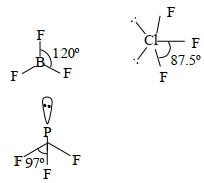
-
- (A) \(A\) only
- (B) \(A, D, E\) only
- (C) \(A, B, D\) only
- (D) \(A, B, C\) only
Show answer and solution
Correct Answer: (B)
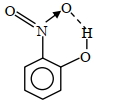
\((A)\) Generally hydrogen bonding exists when \(\mathrm{H}\) is covalently bonded to the highly electronegative atom like \(\mathrm{F}, \mathrm{O}, \mathrm{N}\).\((B)\) Intramolecular \(\mathrm{H}\) bonding is present in
(Image)
\((C)\) Intermolecular Hydrogen bonding is present in \(\mathrm{HF}\)
\((D)\) The magnitude has Hydrogen bonding in solid state is greater than liquid state.
\((E)\) Hydrogen bonding has powerfull effect on the structure & properties of compound like melting point, boiling point, density etc.
-
- (A) \(A, B, C\) only
- (B) \(A\) and \(C\) only
- (C) \(B, C, D\) only
- (D) \(B\) and \(D\) only
Show answer and solution
Correct Answer: (B)
* Molecular orbital should have maximum overlap.* Symmetry about the molecular axis should be similar.
-
- (A) \(\left[\mathrm{Ni}(\mathrm{CN})_4\right]^{2-}\)
- (B) \(\mathrm{PCl}_5\)
- (C) \(\mathrm{BrF}_5\)
- (D) \(\mathrm{PF}_5\)
Show answer and solution
Correct Answer: (C)
\(\mathrm{BrF}_5\) Square Pyramidal.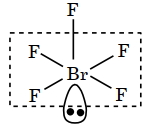
-
- (A) \(3\)
- (B) \(4\)
- (C) \(5\)
- (D) \(6\)
Show answer and solution
Correct Answer: (A)
\(\mathrm{PF}_5, \mathrm{PCl}_5, \mathrm{Fe}(\mathrm{CO})_5\); Trigonal bipyramidal \(\mathrm{BrF}_3\); square pyramidal \(\left[\mathrm{PtCl}_4\right]^{-2}\); square planar \(\mathrm{BF}_3\); Trigonal planar -
- (A) \(8\)
- (B) \(4\)
- (C) \(9\)
- (D) \(2\)
Show answer and solution
Correct Answer: (B)
The non-polar molecules are \(\mathrm{CO}_2, \mathrm{H}_2, \mathrm{CH}_4\) and \(\mathrm{BF}_3\) -
- (A) \(4\)
- (B) \(10\)
- (C) \(15\)
- (D) \(5\)
Show answer and solution
Correct Answer: (A)
\(\mathrm{NH}_3 \rightarrow \mathrm{sp}^3\)\(\mathrm{SO}_2 \rightarrow \mathrm{sp}^2\)
\(\mathrm{SiO}_2 \rightarrow \mathrm{sp}^3\)
\(\mathrm{BeCl}_2 \rightarrow \mathrm{sp}\)
\(\mathrm{CO}_2 \rightarrow \mathrm{sp}\)
\(\mathrm{H}_2 \mathrm{O} \rightarrow \mathrm{sp}^3\)
\(\mathrm{CH}_4 \rightarrow \mathrm{sp}^3\)
\(\mathrm{BF}_3 \rightarrow \mathrm{sp}^2\)
-
- (A) \(3\)
- (B) \(7\)
- (C) \(6\)
- (D) \(1\)
Show answer and solution
Correct Answer: (D)
Magnetic behaviour Bond order \(\mathrm{H}_2\) Diamagnetic \(2\) \(\mathrm{He}\) Paramagnetic \(0.5\) \(\mathrm{O}_2^{+}\) Paramagnetic \(0.5\) \(\mathrm{N}_2^{2-}\) Paramagnetic \(2.5\) \(\mathrm{O}_2^{2-}\) Diamagnetic \(2\) \(\mathrm{F}_2\) Diamagnetic \(1\) \(\mathrm{Ne}_2^{+}\) Paramagnetic \(1\) \(\mathrm{B}_2\) Paramagnetic \(0.5\) -
- (A) \(4\)
- (B) \(12\)
- (C) \(6\)
- (D) \(7\)
Show answer and solution
Correct Answer: (A)
Antibonding molecular orbital from \(2 \mathrm{s}=1\)Antibonding molecular orbital from \(2 p=3\)
Total \(=4\)
-
- (A) \(08\)
- (B) \(07\)
- (C) \(06\)
- (D) \(09\)
Show answer and solution
Correct Answer: (A)
Two molecular orbitals \(\sigma 2 \mathrm{~s}\) and \(\sigma * 2 \mathrm{~s}\).Six molecular orbitals \(\sigma 2 \mathrm{p}_\iota\) and \(\sigma * 2 \mathrm{p}_\iota\). \(\pi 2 \mathrm{p}_{\mathrm{x}}, \pi 2 \mathrm{p}_{\mathrm{y}}\)
\(\pi * 2 \mathrm{p}_{\mathrm{x}}, \pi^* 2 \mathrm{p}_{\mathrm{y}}\)
-
- (A) \(1\)
- (B) \(3\)
- (C) \(5\)
- (D) \(6\)
Show answer and solution
Correct Answer: (B)
Molecules with zero dipole moment \(=\mathrm{CO}_2, \mathrm{CH}_4\), \(\mathrm{BF}_3\) -
- (A) \(2\)
- (B) \(3\)
- (C) \(4\)
- (D) \(8\)
Show answer and solution
Correct Answer: (C)
One unpaired \(\mathrm{e}^{-}\)is present in : \(\mathrm{C}_2^{-} ; \mathrm{O}_2^{-} ; \mathrm{H}_2^{+} ; \mathrm{He}_2^{+}\) -
- (A) \(6\)
- (B) \(7\)
- (C) \(9\)
- (D) \(10\)
Show answer and solution
Correct Answer: (A)
\( \mathrm{O}_2(16 \mathrm{e}):\left(\sigma_{1 \mathrm{~s}}\right)^2\left(\sigma_{1 \mathrm{~s}}^*\right)^2\left(\sigma_{2 \mathrm{~s}}\right)^2\left(\sigma_{2 \mathrm{~s}}^*\right)^2 \)\( \left(\sigma_{2 \mathrm{p}}\right)^2\left[\left(\pi_{2 \mathrm{p}}\right)^2=\left(\pi_{2 \mathrm{p}}\right)^2\right],\left[\left(\pi_{2 \mathrm{p}}^*\right)^1=\left(\pi_{2 \mathrm{p}}^*\right)^1\right]\)
Number of \(\mathrm{e}^{-}\)present in \(\left(\pi^*\right)\) of \(\mathrm{O}_2=2\)
Number of \(\mathrm{e}^{-}\)present in \(\left(\pi^*\right)\) of \(\mathrm{O}_2^{+}=1\)
Number of \(\mathrm{e}^{-}\)present in \(\left(\pi^*\right)\) of \(\mathrm{O}_2^{-}=3\)
So total \(\mathrm{e}^{-}\)in \(\left(\pi^*\right)=2+1+3=6\)
-
- (A) \(7\)
- (B) \(5\)
- (C) \(6\)
- (D) \(8\)
Show answer and solution
Correct Answer: (C)
Central atom utilising \(\mathrm{sp}^2\) hybrid orbitals\(\mathrm{SO}_2, \mathrm{C}_2 \mathrm{H}_4, \mathrm{BCl}_3, \mathrm{HCHO}, \mathrm{C}_6 \mathrm{H}_6, \mathrm{BF}_3\)
- 70. When \(\psi_{\mathrm{A}}\) and \(\psi_{\mathrm{B}}\) are the wave functions of atomic orbitals, then \(\sigma^*\) is represented by _______. 2024 Medium
- (A) \(\psi_A-2 \psi_B\)
- (B) \(\psi_A-\psi_B\)
- (C) \(\psi_A+2 \psi_B\)
- (D) \(\psi_A+\psi_B\)
Show answer and solution
Correct Answer: (B)
Antibonding molecular orbitals are formed by destructive interference of wave functions.\((\mathrm{ABMO}) \sigma^*=\psi_{\mathrm{A}}-\psi_{\mathrm{B}}\)
-
- (A) \(\mathrm{BaCl}_2\)
- (B) \(\mathrm{AgCl}\)
- (C) \(\mathrm{KCl}\)
- (D) \(\mathrm{CoCl}_2\)
Show answer and solution
Correct Answer: (B)
\(\mathrm{AgCl}<\mathrm{CoCl}_2<\mathrm{BaCl}_2<\mathrm{KCl}\) (ionic character)Reason: \(\mathrm{Ag}^{+}\)has pseudo inert gas configuration.
-
- (A) \(\mathrm{NF}_3\)
- (B) \(\mathrm{CH}_4\)
- (C) \(\mathrm{NH}_3\)
- (D) \(\mathrm{PF}_5\)
Show answer and solution
Correct Answer: (C)
\(\mathrm{CH}_4 \& \mathrm{PF}_5, \mu_{\text {pet }}=0\) (non polar)
- 73. According to \(MO\) theory the bond orders for \(O _2{ }^{2-}\), \(CO\) and \(NO ^{+}\)respectively, are 2023 Medium
- (A) \(1,3\) and \(3\)
- (B) \(1, 3\) and \(2\)
- (C) \(1,2\) and \(3\)
- (D) \(2,3\) and \(3\)
Show answer and solution
Correct Answer: (A)
Theory based. -
- (A) \((A)\) and \((D)\) are correct
- (B) \((C)\) and \((D)\) are correct
- (C) \((A)\) and \((B)\) are correct
- (D) \((B)\) and \((C)\) are correct
Show answer and solution
Correct Answer: (D)
\((A)\) \(NF _3\) has trigonal pyramidal shape.\((B)\) Bond order \(\Rightarrow N _2 > O _2\)
\((D)\) Dipole moment \(H _2 O > H _2 S\)
Due to Electronegativity difference.
-
- (A) A = B > C
- (B) B > A > C
- (C) C > B > A
- (D) A > B > C
Show answer and solution
Correct Answer: (B)
Ice > Liquid water > Impure water
Due to impurity extent of H-Bonding decreases. -
- (A) Both Statement \(I\) and Statement \(II\) are correct
- (B) Statement \(I\) is correct but Statement \(II\) is incorrect
- (C) Both Statement \(I\) and Statement \(II\) are incorrect
- (D) Statement \(I\) is incorrect but Statement \(II\) is correct
Show answer and solution
Correct Answer: (B)
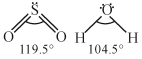
Both are bent in shape.Bond angle of \(SO _2\left( sp ^2\right)\) is greater than that of \(H _2 O\) \(\left( sp ^3\right)\) due to higher repulsion of multiple bonds.
- 77. In which of the following processes, the bond order increases and paramagnetic character changes to diamagnetic one? 2023 Medium
- (A) \(O _2 \rightarrow O _2^{2-}\)
- (B) \(NO \rightarrow NO ^{+}\)
- (C) \(N _2 \rightarrow N _2^{+}\)
- (D) \(O _2 \rightarrow O _2^{+}\)
Show answer and solution
Correct Answer: (B)
\(NO\) is paramagnetic with \(BO =2.5, NO ^{+}\)is diamagnetic with \(BO =3\) -
- (A) \(A - II, B - III, C - IV, D - I\)
- (B) \(A - IV, B - III, C - II, D - I\)
- (C) \(A - II, B - I, C - IV, D - III\)
- (D) \(A - IV, B - I, C - II, D - III\)
Show answer and solution
Correct Answer: (B)
\(IF _7 \quad\) zero lone pair\(ICl _4^{-} \quad\) two lone pair
\(XeF _6\) one lone pair
\(XeF _2 \quad\) three lone pair
-
- (A) \(C, E\) only
- (B) \(B, C\) only
- (C) \(B, C\), \(E\) only
- (D) \(A, B\) only
Show answer and solution
Correct Answer: (C)
According to Fajan's Rule,\(A.\) \(KF > KI - False ; LiF > KF -\) True
\(B.\) \(KF < KI -\) True; \(LiF > KF -\) True
\(C.\) \(SnCl _4 > SnCl _2\) - True; \(CuCl > NaCl\) - True
\(D.\) \(LiF > KF\) - True; \(CuCl < NaCl - False\)
\(E.\) \(KF < KI -\) True; \(CuCl > NaCl -\) True
-
- (A) Both Statement \(I\) and Statement \(II\) are correct.
- (B) Statement \(I\) is incorrect but Statement \(II\) is correct.
- (C) Both Statement \(I\) and Statement \(II\) are incorrect.
- (D) Statement \(I\) is correct but Statement \(II\) is incorrect.
Show answer and solution
Correct Answer: (B)
Explanation:
1. Evaluation of Statement I:
In chemistry, by standard convention, the dipole moment is represented by a crossed arrow (\(\mapsto\)) placed over the Lewis structure of a molecule. The cross is situated at the positive (less electronegative) center, and the arrowhead points toward the negative (more electronegative) center. Since Statement I states that the tail is on the negative center and the head points towards the positive center, it is factually incorrect.
2. Evaluation of Statement II:
The crossed arrow representation explicitly symbolizes the direction of the shift of electron density (separation of partial charges) towards the more electronegative atom in the covalent bond. Therefore, Statement II is factually correct.
Hence, Option B is the correct choice. - 81. The bond order and magnetic property of acetylide ion are same as that of \(........\). 2023 Medium
- (A) \(NO ^{+}\)
- (B) \(O _2^{+}\)
- (C) \(O _2^{-}\)
- (D) \(N _2^{+}\)
Show answer and solution
Correct Answer: (A)
Acetylide ion \(\rightarrow C _2^{2-}(\overline{ C } \equiv \overline{ C })\)Bond order \(=3\) and Diamagnetic
\(NO ^{+} 14 e ^{-} \rightarrow\) Bond order \(=3\) and Diamagnetic
- 82. The covalency and oxidation state respectively of boron in \(\left[ BF _4\right]^{-}\), are 2023 Medium
- (A) \(4\) and \(3\)
- (B) \(4\) and \(4\)
- (C) \(3\) and \(4\)
- (D) \(3\) and \(5\)
Show answer and solution
Correct Answer: (A)
Number of covalent bond formed by Boron is \(4\)Oxidation number of fluorine is \(-1\),
Oxidation number of \(B +4 \times(-1)=-1\),
Thus, Oxidation number of \(B =+3\)

- 83. The number of bent-shaped molecule/s from the following is \(.....\). \(N _3^{-}, NO _2^{-}, I _3^{-}, O _3, SO _2\) 2023 Medium
- (A) \(2\)
- (B) \(3\)
- (C) \(1\)
- (D) \(5\)
Show answer and solution
Correct Answer: (B)
\(N _3^{-}\)linear\(NO _2^{-}\)bent
\(I _3^{-}\)linear
\(O _3\) bent
\(SO _2\) bent
-
- (A) \(4\)
- (B) \(3\)
- (C) \(2\)
- (D) \(1\)
Show answer and solution
Correct Answer: (B)
\((a),(b)\) and \((c)\) are factors which affect the percent covalent character of the ionic bond according to Fajan's rule -
- (A) \(2.00\)
- (B) \(2.5\)
- (C) \(6.00\)
- (D) \(5\)
Show answer and solution
Correct Answer: (D)
\(p _{ x }, p _{ y }, p _{ z }, d _{ z ^2}\) and \(d _{ x ^2- y ^2}\) are axial orbitals. -
- (A) \(3\)
- (B) \(5\)
- (C) \(4\)
- (D) \(1\)
Show answer and solution
Correct Answer: (A)
\(ICl _4^{-}, BrF _3\) and \(NO _2^{+}\)do not have odd number of \(e^{-}\) - 87. The total number of lone pairs of electrons on oxygen atoms of ozone is \(...........\). 2023 Medium
- (A) \(5\)
- (B) \(6\)
- (C) \(4\)
- (D) \(3\)
Show answer and solution
Correct Answer: (B)
(Total no, of lone pairs on oxygen atoms \(=6\)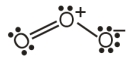
-
- (A) \(0,1,2,1\)
- (B) \(2,1,2,1\)
- (C) \(0,1,0,1\)
- (D) \(2,1,0,1\)
Show answer and solution
Correct Answer: (A)
\(N _2\)\(\sigma 1 s ^2 \sigma^* 1 s ^2 \sigma 2 s ^2 \sigma^* 2 s ^2 \pi 2 p _{ x }^2=\pi 2 p _y^2 \frac{\sigma 2 p _z^2}{\text { HOMO }}\)
\(N _2^{+}-\sigma 1 s ^2 \sigma^* 1 s ^2 \sigma^* 2 s ^2 \sigma^* 2 s ^2 \pi 2 p _{ x }^2=\pi 2 p _{ y }^2 \frac{\sigma 2 p _z^1}{\text { HOMO }}\)
\(O _2-\sigma 1 s ^2 \sigma^* 1 s ^2 \sigma 2 s ^2 \sigma^* 2 s ^2 \sigma 2 p _z^2\)
\(\pi 2 p _{ x }^2=\pi 2 p _{ y }^2\)
\(\pi^* 2 p _{ x }^1=\pi^* 2 p _{ y }^1( HOMO )\)
\(O _2^{+}-\sigma 1 s ^2 \sigma * 1 s ^2 \sigma 2 s ^2 \sigma * 2 s ^2 \sigma 2 p _z^2 \pi 2 p _{ x }^2=\pi 2 p _y^2\)
\(\pi^* 2 p _{ x }^1=\pi^* 2 p _{ y }^0( HOMO )\)
\(N _2 \Rightarrow 0 \text { unpaired } e ^{-} \text {in HOMO }\)
\(N _2^{+} \Rightarrow 1 \text { unpaired } e ^{-} \text {in HOMO }\)
\(O _2 \Rightarrow 2 \text { unpaired } e ^{-} \text {in HOMO }\)
\(O _2^{+} \Rightarrow 1 \text { unpaired } e ^{-} \text {in HOMO }\)
-
- (A) \(SO _2( s ), NH _3( s )\)
- (B) \(SO _2( s ), CO _2( s )\)
- (C) \(HCl ( s ), AlN ( s )\)
- (D) \(MgO ( s ), SO _2( s )\)
Show answer and solution
Correct Answer: (A)
\(SO _2\) and \(NH _3\) are polar molecules. They are constituent particles of polar molecular solids. -
- (A) \(2\)
- (B) \(3\)
- (C) \(4\)
- (D) \(5\)
Show answer and solution
Correct Answer: (B)
\(CN ^{-}, NO ^{+}, O _{2}^{2+}\) have bond order \(=3\) -
- (A) \(4\)
- (B) \(1\)
- (C) \(2\)
- (D) \(3\)
Show answer and solution
Correct Answer: (C)
Diamagnetic species are: \(N _{2}, O _{2}{ }^{2-}\) -
- (A) \(3\)
- (B) \(2\)
- (C) \(1\)
- (D) \(4\)
Show answer and solution
Correct Answer: (A)
\(BeF _{2}, BF _{3}\) and \(CCl _{4} \Rightarrow \mu_{\text {net }}=0\)\(H _{2} O , NH _{3}\) and \(HCl \Rightarrow \mu_{\text {net }} \neq 0\)
- 93. Amongst \(SF _{4}, XeF _{4}, CF _{4}\) and \(H _{2} O\), the number of species with two lone pairs of electrons ..... . 2022 Easy
- (A) \(2\)
- (B) \(10\)
- (C) \(3\)
- (D) \(4\)
Show answer and solution
Correct Answer: (A)
The species with 2 lone pairs are XeF 4 and H 2 O . Therefore, the number of species with two lone pairs of electrons is \(2 .\)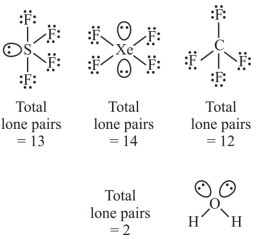
-
- (A) \(B < A < C < D\)
- (B) \(A < B < C < D\)
- (C) \(A < B < D < C\)
- (D) \(A < C < B < D\)
Show answer and solution
Correct Answer: (B)
According to Fajan's rule,Covalent character \(\propto\) size of Anion -
- (A) \(O _{2}^{2-}< O _{2}^{-}< O _{2}< O _{2}^{+}\)
- (B) \(O _{2}^{-}< O _{2}^{2-}< O _{2}< O _{2}^{+}\)
- (C) \(O _{2}^{-}< O _{2}^{2-}< O _{2}^{+}< O _{2}\)
- (D) \(O _{2}^{-}< O _{2}^{+}< O _{2}^{2-}< O _{2}\)
Show answer and solution
Correct Answer: (A)
Bond order \(O _{2}{ }^{2-}< O _{2}{ }^{-}< O _{2}< O _{2}{ }^{+}\)ion/molecule Number of \(e^{-}\) BMO Number of \(e^{-}\) in ABMO Bond order \(O _{2}{ }^{+}\) \(10\) \(5\) \(2.5\) \(O _{2}{ }\) \(10\) \(6\) \(2\) \(O _{2}{ }^{-}\) \(10\) \(7\) \(1.5\) \(O _{2}{ }^{-2}\) \(10\) \(8\) \(1\) - 96. Consider the species \(CH _{4}, NH _{4}^{+}\)and \(BH _{4}^{-}\). Choose the correct option with respect to the there species .... . 2022 Medium
- (A) They are isoelectronic and only two have tetrahedral structures
- (B) They are isoelectronic and all have tetrahedral structures
- (C) Only two are isoelectronic and all have tetrahedral structures
- (D) Only two are isoelectronic and only two have tetrahedral structures
Show answer and solution
Correct Answer: (B)
All are tetrahedral and each have \(10\) electrons.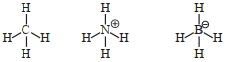
-
- (A) equatorial position and there are two lone pairbond pair repulsions at \(90^{\circ}\)
- (B) equatorial position and there are three lone pair-bond pair repulsions at \(90^{\circ}\)
- (C) axial position and there are three lone pair bond pair repulsion at \(90^{\circ}\).
- (D) axial position and there are two lone pair bond pair repulsion at \(90^{\circ}\).
Show answer and solution
Correct Answer: (A)
\(sp ^{3} d\), See-Saw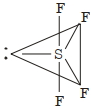
-
- (A) \((A)-(II), (B)-(I), (C)-(IV), (D)-(III)\)
- (B) \((A)-(III), (B)-(IV), (C)-(I), (D)-(II)\)
- (C) \((A)-(III), (B)-(I), (C)-(IV), (D)-(II)\)
- (D) \((A)-(III), (B)-(IV), (C)-(II), (D)-(I)\)
Show answer and solution
Correct Answer: (C)
\((A)\) \(\psi_{M O}=\psi_{A}-\psi_{B}\) \((III)\,ABMO\)\((B)\) \(\mu= Q \times r\) \((I)\) Dipole moment
\((C)\) \(\frac{ N _{b}- N _{2}}{2}\) \((IV)\) Bond order
\((D)\) \(\psi_{M O}=\psi_{A}+\psi_{B}\) \((II)\) \(BMO\)
-
- (A) \(0\)
- (B) \(1\)
- (C) \(2\)
- (D) \(3\)
Show answer and solution
Correct Answer: (C)
Electron deficient species have less than \(8\) electrons (or two electrons for \(H\) ) in their valence (incomplete octet)\(B _{2} H _{6}, BCl _{3}\) have incomplete octet.
- 100. Number of lone pair (s) of electrons on central atom and the shape of \(BrF _{3}\) molecule respectively, are ..... . 2022 Medium
- (A) \(0 ,\) triangular planar
- (B) \(1,\) pyramidal.
- (C) \(2,\) bent \(T-\)shape.
- (D) \(1,\) bent \(T-\)shape
Show answer and solution
Correct Answer: (C)
Steric no. \(=5\left( sp ^{3} d \right)\), lone pair \(=2\)Bent \(T\) shape.

No questions on this page match these filters.