


- JEE Mains 2018
- Hard
- MCQ
A proton of mass \(m\) collides elastically with a particle of unknown mass at rest. After the collision, the proton and the unknown particle are seen moving at an angle of \(90^o\) with respect to each other. The mass of unknown particle is
Answer & Solution
(D) \(m\)
Step-by-step Solution
Detailed explanation
\(mu=mv_1\) \(\cos {45^ \circ } + M{v_2}\cos {45^ \circ }\)
\(mu = \frac{1}{{\sqrt 2 }}\left( {m{v_1} + M{v_2}} \right)\,\,\,\,\,\,\,\,\,\,\,\,\,\,\,\,\,\,\,...\left( i \right)\)
Along \(y-direction,\)
\(0 = m{v_1}\sin {45^ \circ } - M{v_2}\sin {45^ \circ }\)
\(0 = \left( {m{v_1} - M{v_2}} \right)\frac{1}{{\sqrt 2 }}\,\,\,\,\,\,\,\,\,\,\,\,\,\,\,\,\,\,\,\,...\left( {ii} \right)\)
\(m,{u_1} = u\,\,\,\,\,\,M,{u_2} = 0\)
proton Unknown mass After collision
Beforce collision
Coefficient of restution \(e = 1\)
\(\begin{gathered}
= {v_2} - {v_1}\,\cos 90 \hfill \\
\,\,\,\,\,u\,\cos \,45 \hfill \\
\end{gathered} \)
(\(\because \) coillsion is elastic)
\(\begin{gathered}
\Rightarrow \,\frac{{{v_2}}}{{\frac{u}{{\sqrt 2 }}}} = 1 \hfill \\
\Rightarrow \,u = \sqrt 2 {v_{2\,}}\,\,\,\,\,\,\,\,\,\,\,\,\,\,\,\,\,\,\,\,\,\,\,\,\,\,\,\,\,\,\,\,...\left( {iii} \right) \hfill \\
\end{gathered} \)
Solving eqn\( (i) ,(ii) \& (iii),\) we get mass of unknown patricle, \(M=m\)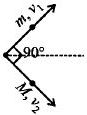
More questions from Physics
- Potential energy (V) versus distance (x) is given by the graph, Rank various regions as per the magnitudes of the force (F) acting on a particle from high to low.
 JEE Mains 2026 Hard
- A series combination of resistor of resistance \(100\,\Omega\), inductor of inductance \(1\,H\) and capacitor of capacitance \(6.25\,\mu F\) is connected to an ac source. The quality factor of the circuit will be \(.............\).JEE Mains 2023 Medium
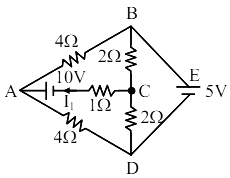
- The current flowing through the \(1 \Omega\) resistor is \(\frac{\mathrm{n}}{10} \ A.\) The value of \(n\) is _______.
 JEE Mains 2024 Hard
- The following bodies are made to roll up (without slipping) the same inclined plane from a horizontal place: \((i)\) a ring of radius \(R,\,(ii)\) a solid cylinder of radius \(\frac {R}{2}\) nd \((iii)\) a solid sphere of radius \(\frac {R}{4}.\) If, in each case, the speed of the center of mass at bottom of the incline is same, the ratio of the maximum heights they climb isJEE Mains 2019 Hard
- A cylinder with fixed capacity of \(67.2\, lit\) contains helium gas at \(STP\). The amount of heat needed to raise the temperature of the gas by \(20\,^oC\) is ..... \(J\) [Given that \(R = 8.31\, J\, mol^{-1}\, K^{-1}\)]JEE Mains 2019 Medium
- The velocity of a particle is given as \(\vec{v} = -x\hat{i} + 2y\hat{j} - z\hat{k}\) m/s. The magnitude of acceleration at point \((1, 2, 4)\) is _______ m/s\(^2\).JEE Mains 2026 Hard
More PYQs from JEE Mains
- The displacement of a particle, executing simple harmonic motion with time period \(T\), is expressed as \(x(t)= A \sin \omega t\), where \(A\) is the amplitude. The maximum value of potential energy of this oscillator is found at \(t=T / 2 \beta\). The value of \(\beta\) is ___________.JEE Mains 2026 Medium
- A radioactive nuclei with decay constant \(0.5/s\) is being produced at a constant rate of \(100\, nuclei/s\). If at \(t\, = 0\) there were no nuclei, the time when there are \(50\, nuclei\) isJEE Mains 2014 Hard
- A toy-car, blowing its horn, is moving with a steady speed of \(5\, m/s\) , away from a wall. An observer, towards whom the toy car is moving, is able to hear \(5\, beats\) per second. If the velocity of sound in air is \(340\, m/s\), the frequency of the horn of the toy car is close to ... \(Hz\)JEE Mains 2016 Medium
- A particle executes simple harmonic motion with an amplitude of \(4 \mathrm{~cm}\). At the mean position, velocity of the particle is \(10 \mathrm{~cm} / \mathrm{s}\). The distance of the particle from the mean position when its speed becomes \(5 \mathrm{~cm} / \mathrm{s}\) is \(\sqrt{\alpha} \mathrm{cm}\), where \(\alpha=\)____________.JEE Mains 2024 Hard
- Two electric dipoles of dipole moments \(1.2 \times 10^{-30}\,cm\) and \(2.4 \times 10^{-30}\,cm\) are placed in two difference uniform electric fields of strengths \(5 \times 10^{4}\,NC ^{-1}\) and \(15 \times 10^{4}\,NC ^{-1}\) respectively. The ratio of maximum torque experienced by the electric dipoles will be \(\frac{1}{ x }\). The value of \(x\) is \(.....\)JEE Mains 2022 Medium