


JEE Mains · Physics · STD 12 - 4. Moving charges and magnetism
Proton with kinetic energy of \(1\;MeV\) moves from south to north. It gets an acceleration of \(10^{12}\; \mathrm{m} / \mathrm{s}^{2}\) by an applied magnetic field (west to east). The value of magnetic field :.......\(mT\) (Rest mass of proton is \(1.6 \times 10^{-27} \;\mathrm{kg}\) )
- A \(71\)
- B \(7.1\)
- C \(0.071\)
- D \(0.71\)
Answer & Solution
Correct Answer
(D) \(0.71\)
Step-by-step Solution
Detailed explanation
\(\mathrm{a}=\frac{\mathrm{qvB}}{\mathrm{m}}\) \(\mathrm{B}=\frac{\mathrm{ma}}{\mathrm{qv}}=\frac{\mathrm{ma} \sqrt{\mathrm{m}}}{\sqrt{2 \mathrm{k}}}\)…
See the Complete Solution
Get step-by-step explanations for this and 2.5 Lakh+ more JEE, NEET & CET questions.
- Unlock all solutions
- Practice the full chapter
- Track accuracy across PYQs
4.8 rated on Google Play · 14,000+ reviews
More questions from Physics
- In Young's double slit experiment, light from two identical sources are superimposing on a screen. The path difference between the two lights reaching at a point on the screen is \(\frac{7 \lambda}{4}\). The ratio of intensity of fringe at this point with respect to the maximum intensity of the fringe is _______.JEE Mains 2024 Hard
- A body of mass \(m\) is moving in a circular orbit of radius \(R\) about a planet of mass \(M\). At some instant, it splits into two equal masses. The first mass moves in a circular orbit of radius \(\frac{R}{2}\) , and the other mass, in a circular orbit of radius \(\frac{3R}{2}\). The difference between the final and initial total energies isJEE Mains 2018 Hard
- A particle starts from origin \(O\) from rest and moves with a uniform acceleration along the positive \(x -\) axis. Identify all figures that correctly represent the motion qualitatively. (\(a =\) acceleration, \(v =\) velocity, \(x =\) displacement, \(t =\) time)
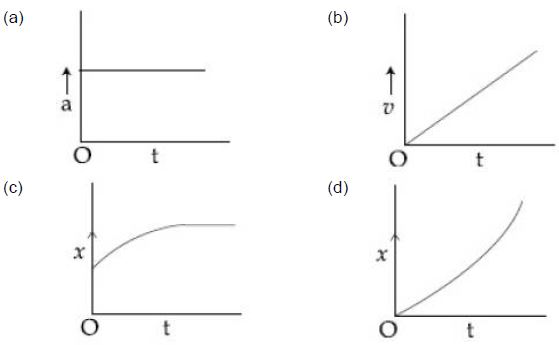 JEE Mains 2019 Hard
 - At which temperature the r.m.s. velocity of a hydrogen molecule equal to that of an oxygen molecule at \(47^{\circ} \mathrm{C}\) ?JEE Mains 2024 Hard
- The frequency \((v)\) of an oscillating liquid drop may depend upon radius \((r)\) of the drop, density \((\rho)\) of liquid and the surface tension \((s)\) of the liquid as : \(v=r^{ a } \rho^{ b } s ^{ c }\). The values of \(a , b\) and \(c\) respectively areJEE Mains 2023 Medium
- A small particle moves to position \(5 \hat{i}-2 \hat{j}+\hat{k}\) from its initial position \(2 \hat{i}+3 \hat{j}-4 \hat{k}\) under the action of force \(5 \hat{i}+2 \hat{j}+7 \hat{k} N\). The value of work done will be \(............J\).JEE Mains 2023 Easy
More PYQs from JEE Mains
- The stopping potential in the context of photoelectric effect depends on the following property of incident electromagnetic radiationJEE Mains 2021 Easy
- In \(1^{\text {st }}\) case, Carnot engine operates between temperatures \(300\,K\) and \(100\,K\). In \(2^{\text {nd }}\) case, as shown in the figure, a combination of two engines is used. The efficiency of this combination (in \(2^{\text {ad }}\) case) will be.
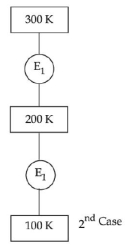 JEE Mains 2022 Medium
 - Match List\(-I\) with List\(-II:\)
Choose the correct answer from the options given below:List\(-I\) List\(-II\) \((A)\) \(3\) Translational degrees of freedom \((I)\) Monoatomic gases \((B)\) \(3\) Translational,\(2\) rotational degrees of freedoms \((II)\) Polyatomic gases \((C)\) \(3\) Translational,\(2\) rotational and \(1\) vibrational degrees of freedom \((III)\) Rigid diatomic gases \((D)\) \(3\) Translational,\(3\) rotational and more than one vibrational degrees of freedom \((IV)\) Nonrigid diatomic gases JEE Mains 2023 Medium - In the Young's double slit experiment the intensity produced by each one of the individual slits is \(I_0\). The distance between two slits is 2 mm . The distance of screen from slits is 10 m . The wavelength of light is \(6000\) Å. The intensity of light on the screen in front of one of the slits is _________ .JEE Mains 2026 Medium
- The sum of all the real values of \(x\) satisfying the equation \({2^{\left( {x - 1} \right)\left( {{x^2} + 5x - 50} \right)}} = 1\) isJEE Mains 2017 Hard
- A gas molecule of mass \(M\) at the surface of the Earth has kinetic energy equivalent to \(0\,^oC\). If it were to go up straight without colliding with any other molecules, how high it would rise? Assume that the height attained is much less than radius of the earth. (\(k_B\) is Boltzmann constant)JEE Mains 2014 Medium