


JEE Mains · Chemistry · STD 12 - Co-ordination chemistry
- JEE Mains 2014
- Hard
- MCQ
Which one of the following complexes will most likely absorb visible light?
(At nos. \(Sc = 21 , Ti = 22, V = 23, Zn = 30\))
Pick an option to check your answer.
Answer & Solution
Correct Answer
(C) \({[V{(N{H_3})_6}]^{3 + }}\)
Step-by-step Solution
Detailed explanation
The absorption of visible light and hence coloured nature of the transition metal cation is due to the promotion of one or more unpaired \(-\,d\,-\) electron from a lower to higher will be the number of unpaired electron higher will be the absorption in visible light.
The electronic configuration of the given elements is
\(S{c^{3 + }}(18)\, = \,1{s^2}\,2{s^2}\,2{p^6}\,3{s^2}\,3{p^6}\,3{d^0}\,4{s^0}\) no unpaired \(e^-\)
\(T{i^{4 + }}(18)\, = \,1{s^2}\,2{s^2}\,2{p^6}\,3{s^2}\,3{p^6}\,3{d^0}\,4{s^0}\) no unpaired \(e^-\)
\({V^{3 + }}(18)\, = \,1{s^2}\,2{s^2}\,2{p^6}\,3{s^2}\,3{p^6}\,3{d^2}\,4{s^0}\) - Two unpaired \(e^-\).
\(Z{n^{2 + }}(28)\, = \,1{s^2}\,2{s^2}\,2{p^6}\,3{s^2}\,3{p^6}\,3{d^{10}}\,4{s^0}\) no unpaired \(e^-\)
hence \([V(NH_3)_6]^{3+}\) will moost likely absorb visible light.
More questions from Chemistry
- \(1.46 \,\mathrm{~g}\) of a biopolymer dissolved in a \(100\, \mathrm{~mL}\) water at \(300\, \mathrm{~K}\) exerted an osmotic pressure of \(2.42 \times 10^{-3}\) \(bar.\) The molar mass of the biopolymer is \(.....\,\times 10^{4} \,\mathrm{~g}\,\mathrm{~mol}^{-1}\). (Round off to the Nearest Integer) [Use : \(\mathrm{R}=0.083\, \mathrm{~L}\, bar \,\mathrm{mol}^{-1} \,\mathrm{~K}^{-1}\) ]JEE Mains 2021 Hard
- Given below are two statements :
Statement I : A mixture of C\(_{12}\)H\(_{22}\)O\(_{11}\) (sugar) and NaCl can be separated by dissolving sugar in alcohol, due to differential solubility.
Statement II : Rose essence from rose petals is seperated by steam distillation due to its high volatility and insolubility in H\(_2\)O.
In the light of the above statements, choose the correct answer from the options given below :JEE Mains 2026 Medium - \(Pt ( s ) H _2( g )(1 bar )\left| H ^{+}( aq )(1 M )\right|\left| M ^{3+}( aq ), M ^{+}( aq )\right| Pt ( s )\) The \(E _{\text {ceil }}\) for the given cell is \(0.1115\,V\) at \(298\,K\) when \(\frac{\left[ M ^{+}( aq )\right]}{\left[ M ^{3+}( aq )\right]}=10^{ a }\) The value of a is Given : \(E _{ M ^{3+} / M ^{+}}=0.2\,V\) \(\frac{2.303 RT }{ F }=0.059\,V\)JEE Mains 2023 Hard
- Which of the following oxidation reactions are carried out by both \(\mathrm{K}_2 \mathrm{Cr}_2 \mathrm{O}_7\) and \(\mathrm{KMnO}_4\) in acidic medium?
A. \(\Gamma^{-} \rightarrow \mathrm{I}_2\)
B. \(S^{2-} \rightarrow S\)
C. \(\mathrm{Fe}^{2+} \rightarrow \mathrm{Fe}^{3+}\)
D. \(\Gamma^{-} \rightarrow \mathrm{IO}_3{ }^{-}\)
E. \(\mathrm{S}_2 \mathrm{O}_3{ }^{2-} \rightarrow \mathrm{SO}_4{ }^{2-}\)
Choose the correct answer from the options given below:JEE Mains 2025 Medium - The number of species having non-pyramidal shape among the following is \((A)\) \({SO}_{3}\) \((B)\) \({NO}_{3}^{-}\) \((C)\) \({PCl}_{3}\) \((D)\) \({CO}_{3}^{2-}\)JEE Mains 2021 Easy
- Which one of the lanthanoids given below is the most stable in divalent form?JEE Mains 2022 Medium
More PYQs from JEE Mains
- When \(9.65\) ampere current was passed for \(1 .0\) hour into nitrobenzene in acidic medium, the amount of \(p-\) amino-phenol produced is .............. \(\mathrm{g}\)JEE Mains 2018 Hard
- Given below are two statements:
Statement I: The conversion proceeds well in the less polar medium.
\(\mathrm{CH}_3-\mathrm{CH}_2-\mathrm{CH}_2-\mathrm{CH}_2-\mathrm{Cl} \xrightarrow{\mathrm{HO}^{-}} \mathrm{CH}_3-\mathrm{CH}_2-\mathrm{CH}_2-\mathrm{CH}_2-\mathrm{OH}+\mathrm{Cl}^{(-)}\)
Statement II: The conversion proceeds well in the more polar medium.
In the light of the above statements, choose the correct answer from the options given belowJEE Mains 2025 Easy - For the reaction \(\mathrm{A} \rightarrow\) products.
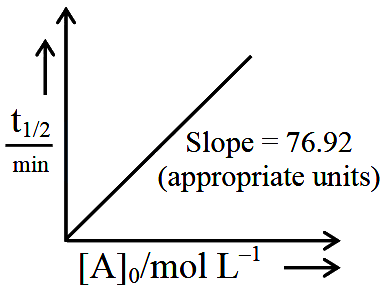
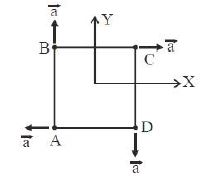
The concentration of A at 10 minutes is _______ \(\times 10^{-3} \mathrm{~mol} \mathrm{~L}^{-1}\) (nearest integer). The reaction was started with \(2.5 \mathrm{~mol} \mathrm{~L}^{-1}\) of A.JEE Mains 2025 Medium - Four particles \(A, B, C\) and \(D\) with masses \(m_A=m, m_B=2m, m_C=3m\) and \(m_D=4m\) are at the corners of a square. They have accelerations of equal magnitude with directions as shown. The acceleration of the centre of mass of the particles is
 JEE Mains 2019 Hard
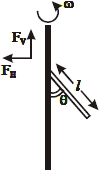
- A uniform rod of length \('l'\) is pivoted at one of its ends on a vertical shaft of negligible radius When the shaft rotates at angular speed \(\omega\) the rod makes an angle \(\theta\) with it (see figure). To find \(\theta\) equate the rate of change of angular momentum (direction going into the paper ) \(\frac{ m \ell^{2}}{12} \omega^{2} \sin \theta \cos \theta\) about the centre of mass \((CM)\) to the torque provided by the horizontal and vertical forces \(F_{H}\) and \(F_{V}\) about the CM. The value of \(\theta\) is then such that:
 JEE Mains 2020 Hard
- During an adiabatic process, if the pressure of a gas is found to be proportional to the cube of its absolute temperature, then the ratio of \(\frac{C_p}{C_V}\) for the gas is _______.JEE Mains 2024 Hard