


JEE Mains · Chemistry · STD 12 - 2. Electrochemistry
Given \(F{e^{ + 3}}\left( {aq} \right) + {e^ - } \to F{e^{2 + }}\left( {aq} \right);{E^o} = + 0.77\,V\) \(A{l^{ + 3}}\left( {aq} \right) + 3{e^ - } \to Al\left( s \right);{E^o} = - 1.66\,V\) \(B{r_2}\left( {aq} \right) + 2{e^ - } \to 2B{r^ - };{E^o} = + 1.09\,V\) Considering the electrode potentials, which of the following represents the correct order of reducing power?
- A \(Fe^{2+} < Al < Br^-\)
- B \(Br^- < Fe^{2+} < Al\)
- C \(Al < Br^- < Fe^{2+}\)
- D \(Al < Fe^{2+} < Br^-\)
Answer & Solution
Correct Answer
(D) \(Al < Fe^{2+} < Br^-\)
Step-by-step Solution
Detailed explanation
A negative \(E^o\) means that the redox couple is a stronger reducing agent. Hence, we can say that Aluminium is strongest reducing agent. Reducing character decreases down the series. Hence the correct order is \(Al < Fe^{2+} < Br^-\)
See the Complete Solution
Get step-by-step explanations for this and 2.5 Lakh+ more JEE, NEET & CET questions.
- Unlock all solutions
- Practice the full chapter
- Track accuracy across PYQs
4.8 rated on Google Play · 14,000+ reviews
More questions from Chemistry
- In the sulphur estimation, 0.20 g of a pure organic compound gave 0.40 g of barium sulphate. The percentage of sulphur in the compound is ______ \(\times 10^{-1} \%\).
(Molar mass : \(\mathrm{O}=16, \mathrm{~S}=32, \mathrm{Ba}=137\) in \(\mathrm{g} \mathrm{mol}^{-1}\) )JEE Mains 2025 Medium - Gaseous cyclobutene isomerizes to butadiene in a first order process which has a \('k'\) value of \(3.3 \times 10^{-4} s ^{-1}\) at \(153^{\circ} C\). The time in minutes it takes for the isomerization to proceed \(40 \%\) to completion at this temperature is .......... (Rounded off to the nearest integer)JEE Mains 2021 Medium
- Consider the following elements \(\mathrm{In}, \mathrm{Tl}, \mathrm{Al}, \mathrm{Pb}, \mathrm{Sn}\) and Ge .
The most stable oxidation states of elements with highest and lowest first ionisation enthalpies, respectively are _______.JEE Mains 2025 Medium - Which of the following statements is not true about sucrose?JEE Mains 2019 Hard
- A solution of phenol in chloroform when treated with aqueous \(NaOH\) gives compound \(P\) as a major product. The mass percentage of carbon in \(P\) is..............(to the nearest integer) (Atomic mass : \(C =12 ; H =1 ; O =16\) )JEE Mains 2020 Medium
- \(A _2+ B _2 \rightarrow 2 AB \cdot \Delta H _{ l }^0=-200\,kJmol ^{-1}\) \(AB , A _2\) and \(B _2\) are diatomic molecule. If the bond enthalpies of \(A _2, B _2\) and \(AB\) are in the ratio \(1: 0.5: 1\), then the bond enthalpy of \(A_2\) is \(......\,kJ\,mol ^{-1}\) (Nearest integer)JEE Mains 2023 Hard
More PYQs from JEE Mains
- Two sources of light emit X-rays of wavelength \(1\, nm\) and visible light of wavelength \(500\, nm ,\) respectively. Both the sources emit light of the same power \(200\, W\). The ratio of the number density of photons of X-rays to the number densitty of photons of the visible light of the given wavelengths isJEE Mains 2020 Medium
- The freezing point of diluted milk sample is found to be \(-\,0.2\,^oC,\) while it should have been \(\,0.5\,^oC,\) for pure milk. How much water been added to pure milk to make the diluted sample?JEE Mains 2019 Hard
- The wave numbers of three spectral lines of H atom are considered. Identify the set of spectral lines belonging to Balmer series. (R = Rydberg constant)JEE Mains 2026 Medium
- pH of water is 7 at \(25^{\circ} \mathrm{C}\). If water is heated to \(80^{\circ} \mathrm{C}\)., it's pH will :JEE Mains 2025 Easy
- A light cylindrical vessel is kept on a horizontal surface. Area of base is A. A hole of crosssectional area \('a'\) is made just at its bottom side. The minimum coefficient of friction necessary to prevent sliding the vessel due to the impact force of the emerging liquid is \((a\,<\,<\,A)\)
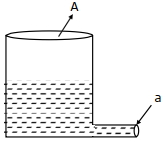 JEE Mains 2021 Hard
 - Equation of a plane at a distance \(\sqrt{\frac{2}{21}}\) from the origin, which contains the line of intersection of the planes \(x-y-z-1=0\) and \(2 x+y-3 z+4=0\) is :JEE Mains 2021 Hard