


Questions
Newest firstShowing 51–64 of 64 questions
-
- (A) linear symmetrical \(\mathrm{Cr}-\mathrm{O}-\mathrm{Cr}\) bond.
- (B) non-linear symmetrical \(\mathrm{Cr}-\mathrm{O}-\mathrm{Cr}\) bond.
- (C) linear unsymmetrical \(\mathrm{Cr}-\mathrm{O}-\mathrm{Cr}\) bond.
- (D) non-linear unsymmetrical \(\mathrm{Cr}-\mathrm{O}-\mathrm{Cr}\) bond.
Show answer and solution
Correct Answer: (B)
dichromate ion contain non-linear symmetrical \(\mathrm{Cr}-\mathrm{O}-\mathrm{Cr}\) Bond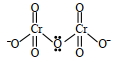
-
- (A) \(X = SO _{2}, Y = Cr _{2} O _{3}\)
- (B) \(X = SO _{3}, Y = Cr _{2} O _{3}\)
- (C) \(X = SO _{2}, Y = Cr _{2}\left( SO _{4}\right)_{3}\)
- (D) \(X = SO _{3}, Y = Cr _{2}\left( SO _{4}\right)_{3}\)
Show answer and solution
Correct Answer: (C)
\(SO _{2}+ dil H _{2} SO _{4} \longrightarrow SO _{3}( g )\)\(Cr _{2}\left( SO _{4}\right)_{3}\)
- 53. Potassium permanganate on heating at \(513\, \mathrm{~K}\) gives a product which is : 2021 Medium
- (A) paramagnetic and colourless
- (B) diamagnetic and green
- (C) diamagnetic and colourless
- (D) paramagnetic and green
Show answer and solution
Correct Answer: (D)
\(2 \mathrm{KMnO}_{4} \xrightarrow[200^{o}C]{\Delta} \mathrm{K}_{2} \mathrm{MnO}_{4}+{+\mathrm{MnO}_{2}}+\mathrm{O}_{2}\)\(\quad \quad \quad \quad \quad \quad \quad Green\quad \quad \quad Black\)
In \(\mathrm{K}_{2} \mathrm{MnO}_{4}\), manganese oxidation state is \(+6\) and hence it has one unpaired \(\mathrm{e}^{-}\).
-
- (A) \(\mathrm{X}=\) basic \(\quad \mathrm{Y}=\) amphoteric
- (B) \(\mathrm{X}=\) amphoteric \(\quad \mathrm{Y}=\) basic
- (C) \(\mathrm{X}=\) acidic \(\quad \mathrm{Y}=\) acidic
- (D) \(\mathrm{X}=\) basic \(\quad \mathrm{Y}=\) basic
Show answer and solution
Correct Answer: (D)
\(\mathrm{V}_{2} \mathrm{O}_{3}-\) basic\(CrO-\) basic
-
- (A) \(Fe\)
- (B) \(\mathrm{Mn}\)
- (C) \(\mathrm{Cr}\)
- (D) \(Co\)
Show answer and solution
Correct Answer: (C)
Elements of group \(7,8,9\) do not form hydrides thus \(\mathrm{Cr}\) will only form hydride among the given elements \((Fe, \mathrm{Mn}, \mathrm{Co})\) -
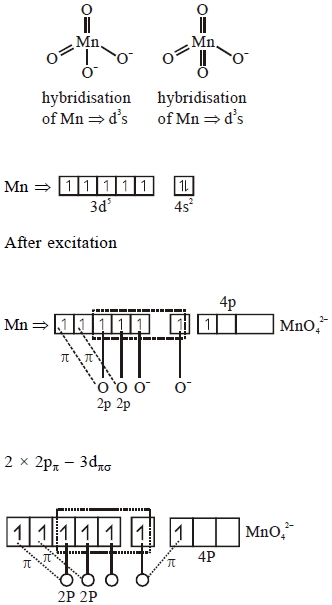
- (A) In manganate and permanganate ions, the \(\pi\) \(-\)bonding takes place by overlap of \(p-\)orbitals of oxygen and \(d-\)orbitals of manganese
- (B) Manganate ion is green in colour and permanganate ion in purple in colour
- (C) Manganate and permanganate ions are paramagnetic
- (D) Manganate and permanganate ions are tetrahedral
Show answer and solution
Correct Answer: (C)
Option \(1)\) Manganate \(\Rightarrow MnO _{4}^{2-}\)Permanganate \(\Rightarrow MnO _{4}^{-}\)
\(2 \times 2 P _{\pi}-3 d _{\pi}\)
\(1 \times 2 P _{\pi}-4 P _{\pi}\)
\((2)\) \(MnO _{4}^{2-} \Rightarrow\) green
\(MnO _{\stackrel -4} \Rightarrow\) purple/violet
\((3)\) Manganate contains \(1\) unpaired electron hence it is paramagnetic
where as permanganetic contains no unpaired electrons hence it is diamagnetic.
\((4)\) Both have d's hybridisation hence both have tetrahedral geometry.
-
- (A) \(KI\) and \(KMnO_4\)
- (B) \(MnO_2\) and \(KIO_3\)
- (C) \(KIO_3\) and \(MnO_2\)
- (D) \(KI\) and \(K_2MnO_4\)
Show answer and solution
Correct Answer: (B)
\(Mn{O_2}\,\xrightarrow{{4KOH,\,{O_2}}}\mathop {2{K_2}Mn{O_4}}\limits_{(Green)} \, + \,2{H_2}O\)\(3{K_2}Mn{O_4}\,\xrightarrow{{4\,HCl}}\mathop {2KMn{O_4}}\limits_{(purple)} \, + \,Mn{O_2}\, + \,2{H_2}O\)
\(2KMn{O_4}\,\xrightarrow{{{H_2}O,\,KI}}2Mn{O_2}\, + \,2KOH\, + \,KI{O_3}\)
-
- (A) \(K_2MnO_4, KMnO_4\) and \(SO_2\)
- (B) \(K_3MnO_4, K_2MnO_4\) and \(Cl_2\)
- (C) \(K_2MnO_4, KMnO_4\) and \(Cl_2\)
- (D) \(KMnO_4, K_2MnO_4\) and \(Cl_2\)
Show answer and solution
Correct Answer: (D)
\(\mathop {2KMn{O_4}\,}\limits_{(X)} \xrightarrow[\Delta ]{{513\,\,K}}\,\mathop {{K_2}Mn{O_4}}\limits_{(Y)} \, + \,Mn{O_2}\, + {O_{2(g)}}\)\(Mn{O_2}\, + \,4NaCl\, + 4{H_2}S{O_4}\, \to \) \(MnC{{l}_{2}}\,+\,4NaHS{{O}_{4}}\,+\,2{{H}_{2}}O\,+\underset{\begin{smallmatrix}
(Z) \\
pungent
\\
gas
\end{smallmatrix}}{\mathop{\,C{{l}_{2(g)}}}}\,\) -
- (A) \(Mn\)
- (B) \(Cr\)
- (C) \(V\)
- (D) \(Ti\)
Show answer and solution
Correct Answer: (A)
\(Mn{O_2} + KOH + KN{O_3} \to \mathop {{K_2}Mn{O_4}}\limits_{(dark\,\,green)} + KN{O_2} + {H_2}O\)\(MnO_4^{2 - } + 4{H^ + }\xrightarrow[{tionation}]{{dispropor}}\mathop {2MnO_4^ - }\limits_{(dark\,purple)} + Mn{O_2} + 2{H_2}O\)
-
- (A) \(L\to M\) charge transfer transition
- (B) \(\sigma - \sigma ^*\) transition
- (C) \(M\to L\) charge transfer transition
- (D) \(d - d\) transition
Show answer and solution
Correct Answer: (A)
\(K M n O_{4} \rightarrow K^{+}+M n O_{4}^{-}\)\(\therefore \ln M n O_{4}^{-},\) Mn has \(+7\) oxidation state having no electron in d-orbitals. It ts considered that higher the oxidation state of metal, greater is the tendency to occur \(L \rightarrow M\) charge transfer,
because ligand is able to donate the electron into the vacant ( - orbital of metal.
since, charge transfer is laporate as well as spin allowed, therefore, it shows colour
-
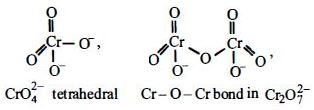
- (A) \(Na_2Cr_2O_7\) is less soluble than \(K_2Cr_2O_7\)
- (B) \(Na_2Cr_2O_7\) is primary standard in volumetry
- (C) \(CrO_4^{2-}\) is tetrahedral in shape
- (D) \(CrO_7^{2-}\) has a \(Cr- O- Cr\) bond
Show answer and solution
Correct Answer: (A)
\(Na_2Cr_2O_7\) is used as primary standard in volumetryHydration energy of \(Na^+\) is greater then \(K^+\). Because of smaller size of \(Na^+\) , \(Na_2Cr_2O_7\) is more soluble than \(K_2Cr_2O_7\).
- 62. Which of the following is not formed when \(H_2S\) reacts with acidic \(K_2Cr_2O_7\) solution ? 2014 Medium
- (A) \(CrSO_4\)
- (B) \(Cr_2(SO_4)_3\)
- (C) \(K_2SO_4\)
- (D) \(S\)
Show answer and solution
Correct Answer: (A)
\(K_2Cr_2O_7+ 4H_2SO_4+ 3H_2S\) \(\longrightarrow\) \(K_2SO_4 + Cr_2 (SO_4)_3 + 7H_2O + 3S\) - 63. Potassium dichromate when heated with concentrated sulphuric acid and a soluble chloride, gives brown-red vapours of: 2013 Hard
- (A) \(CrO3\)
- (B) \(CrCl_3\)
- (C) \(CrO_2Cl_2\)
- (D) \(Cr_2O_3\)
Show answer and solution
Correct Answer: (C)
Solid potassium dichromate when heated with concentrated sulphuric acid and a soluble chloride gives orange red vapours of a volatile oily liquid \(Cr{O_2}C{l_2}\)\(K_2Cr_2O_7 + 4NaCl + 6H_2SO_4\) \(\longrightarrow\)
\(\begin{array}{l}
2KHS{O_4} + 4NaHS{O_4} + 2Cr{O_2}C{l_2}\\
\,\,\,\,\,\,\,\,\,\,\,\,\,\,\,\,\,\,\,\,\,\,\,\,\,\,\,\,\,\,\,\,\,\,\,\,\,\,\,\,\,\,\,\,\,\,\,{\rm{chromyl \,chloride}}
\end{array}\) -
- (A) \(MnSO_4\)
- (B) \(Mn_2O_7\)
- (C) \(MnO_2\)
- (D) \(Mn_2O_3\)
Show answer and solution
Correct Answer: (B)
\(KMnO_4\) reacts with \(H_2SO_4\) to form \(Mn_2O_7\) which is highly explosive substance\(2KMn{O_4} + {H_2}S{O_4} \to {K_2}S{O_4} + M{n_2}{O_7} + {H_2}O\)
No questions on this page match these filters.