


Questions
22 questionsShowing 1–22 of 22 questions
-
- (A) \(1.28 \times 10^{-18}\, {N}\)
- (B) \(1.28 \times 10^{-21}\, {N}\)
- (C) \(12.8 \times 10^{-17} \,{N}\)
- (D) \(12.8 \times 10^{-18} \,{N}\)
Show answer and solution
Correct Answer: (D)
\(\frac{{E}_{0}}{{C}}={B}_{0}\)\({F}_{\max }={eB}_{0} {V}\)
\(=1.6 \times 10^{-19} \times \frac{800}{3 \times 10^{8}} \times 3 \times 10^{7}\)
\(=12.8 \times 10^{-18}\, {N}\)
-
- (A) The wavelength is \(5.4\, {m}\)
- (B) The frequency of electromagnetic wave is \(54 \times 10^{4}\, {Hz}\).
- (C) The transmitted wave will be \(3.1 \cos \left[(1.8) z-\left(5.4 \times 10^{6}\right) {t}\right] \hat{i}\, {N} / {C}\)
- (D) The reflected wave will be \(3.1 \cos \left[(1.8) {z}+\left(5.4 \times 10^{6}\right) {t}\right] \hat{{i}}\, {N} / {C}\)
Show answer and solution
Correct Answer: (D)
Reflected wave will have direction opposite to incident wave. -
- (A) \(0.6 \hat{j}\, V / m\)
- (B) \(6.0 \hat{ k }\, V / m\)
- (C) \(6.0 \hat{ j }\, V / m\)
- (D) \(0.6 \hat{ k }\, V / m\)
Show answer and solution
Correct Answer: (C)
\(E = BC =6\)(Dir. of wave) \(\|(\overrightarrow{ E } \times \overrightarrow{ B })\)
\(\hat{ i }=\hat{ j } \times \hat{ k }\)
\(\overrightarrow{ E }=6 \hat{ j } V / m\)
-
- (A) \(-24 \hat{ x }\, V / m\)
- (B) \(2.6 \hat{ x }\, V / m\)
- (C) \(24 \hat{ x }\, V / m\)
- (D) \(-2.6 \hat{ y }\, V / m\)
Show answer and solution
Correct Answer: (A)
\(f =5 \times 10^{8} Hz\)EM wave is travelling towards \(+\hat{j}\)
\(\overrightarrow{ B }=8.0 \times 10^{-8} \hat{ z } T\)
\(\overrightarrow{ E }=\overrightarrow{ B } \times \overrightarrow{ C }=\left(8 \times 10^{-8} \hat{ z }\right) \times\left(3 \times 10^{8} \hat{ y }\right)\)
\(=-24 \hat{ x } V / m\)
-
- (A) \(E_{y}, B_{y}\) or \(E_{z}, B_{z}\)
- (B) \(E _{ y }, B _{ x }\) or \(E _{ x }, B _{ y }\)
- (C) \(E _{ x }, B _{ z }\) or \(E _{ z }, B _{ x }\)
- (D) \(E _{ x }, B _{ y }\) or \(E _{ y }, B _{ x }\)
Show answer and solution
Correct Answer: (C)
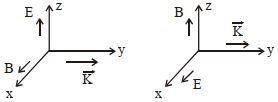
\(\,\)
-
- (A) \(1\)
- (B) \(2\)
- (C) \(4\)
- (D) \(20\)
Show answer and solution
Correct Answer: (B)
\(|B|=\frac{|E|}{C}=\frac{6}{3 \times 10^{8}}\)\(=2 \times 10^{-8} {T}\)
\(\therefore x=2\)
-
- (A) \(137\)
- (B) \(149\)
- (C) \(164\)
- (D) \(121\)
Show answer and solution
Correct Answer: (A)
\(I _{ avg }=\frac{1}{2} \varepsilon_{0} E _{0}^{2} C\)\(\frac{1.25}{100} \times \frac{1000}{4 \pi(2)^{2}}=\frac{1}{2} \times 8.85 \times 10^{-12} \times 3\times 10^{8} \times E _{0}^{2}\)
\(E _{0}^{2}=187.4\)
\(\therefore E _{0}=13.689 V / m\)
\(=136.89 \times 10^{-1} V / m\)
\(\therefore x =136.89\)
Rounding off to nearest integer \(x =137\)
-
- (A) \(21.14\)
- (B) \(83.57\)
- (C) \(55.58\)
- (D) \(27.79\)
Show answer and solution
Correct Answer: (D)
From the given information,\({C}=\frac{\epsilon_{0} {A}}{{d}}={k} \frac{\epsilon_{0} \times 1}{2 \times 10^{-3}} {F}\)
\(\therefore {X}_{{c}}=\frac{1}{\omega {C}}=\frac{2 \times 10^{-3}}{2 \times 50 \pi {\epsilon}_{0}}=\frac{2 \times 10^{-3}}{25 \times 4 \pi \epsilon_{0}} \Omega\)
\(\therefore {X}_{{c}}=\frac{2 \times 10^{-3}}{25} \times 9 \times 10^{9}=\frac{18}{25} \times 10^{6} \Omega\)
\(\therefore {i}_{0}=\frac{{V}_{0}}{{X}_{{c}}}=\frac{20 \times 25}{18} \times 10^{-6} {A}=27.47 \mu {A}\)
The value of amplitude of displacement current will be same as value of amplitude of conventional current.
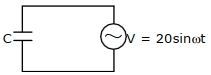
-
- (A) \(667\)
- (B) \(577\)
- (C) \(627\)
- (D) \(747\)
Show answer and solution
Correct Answer: (A)
\(\lambda\) in vacuum \(=\frac{c}{f}=\frac{3 \times 10^{8}}{3 \times 10^{9}}=0.1\, m\)\(\therefore \lambda\) in medium \(=\frac{0.1}{\mu}\)
Where refractive index
\(\mu=\sqrt{\mu_{z} \varepsilon_{z}}\)
Assuming non-magnetic material \(\mu_{ r }=1\)
\(\therefore \quad \mu=\sqrt{2.25}=1.5\)
\(\lambda_{ m }=\frac{0.1}{1.5}=\frac{1}{15} m =6.67 \,cm\)
\(=667 \times 10^{-2}\, cm\)
-
- (A) \(12\)
- (B) \(18\)
- (C) \(15\)
- (D) \(20\)
Show answer and solution
Correct Answer: (C)
Given : Frequency of wave \(f =5 GHz\)\(=5 \times 10^{9} Hz\)
Relative permittivity, \(\epsilon_{ r }=2\)
and Relative permeability, \(\mu_{ r }=2\)
Since speed of light in a medium is given by,
\(v =\frac{1}{\sqrt{\mu \in}}=\frac{1}{\sqrt{\mu_{ s } \mu_{0} \cdot \epsilon_{ s } \epsilon_{0}}}\)
\(v =\frac{1}{\sqrt{\mu_{ s } \epsilon_{ x }}} \frac{1}{\sqrt{\mu_{0} \epsilon_{0}}}=\frac{ C }{\sqrt{\mu_{ s } \epsilon_{ r }}}\)
Where \(C\) is speed of light is vacuum.
\(\therefore v =\frac{3 \times 10^{8}}{\sqrt{4}}=\frac{30 \times 10^{7}}{2} m / s\)
\(=15 \times 10^{7} m / s\)
\(\therefore\) Ans. is \(15\)
-
- (A) \(\frac{3}{2} {C}\)
- (B) \(C\)
- (C) \(\frac{2}{3} C\)
- (D) \(\frac{{C}}{2}\)
Show answer and solution
Correct Answer: (C)
\({V}=\frac{\omega}{{K}}=\frac{10 \times 10^{10}}{500}=2 \times 10^{8}\)\(V=\frac{2 {C}}{3}\)
-
- (A) \(9\)
- (B) \(2\)
- (C) \(\frac{1}{3}\)
- (D) \(3\)
Show answer and solution
Correct Answer: (A)
Speed of wave \(=\frac{2 \times 10^{10}}{200}=10^{8}\, {m} / {s}\)Refractive index \(=\frac{3 \times 10^{8}}{10^{8}}=3\)
Now refractive index \(=\sqrt{\varepsilon_{{r}} \mu_{{r}}}\)
\(3=\sqrt{\varepsilon_{{r}}(1)}\)
\(\Rightarrow \varepsilon_{{r}}=9\)
-
- (A) \(U _{ e }= U _{ m }\)
- (B) \(U _{ e }> U _{ m }\)
- (C) \(U _{ e }< U _{ m }\)
- (D) \(U _{ e } \neq U _{ m }\)
Show answer and solution
Correct Answer: (A)
In \(EMW\), Average energy density due to electric \(\left( U _{ e }\right)\) and magnetic \(\left( U _{ m }\right)\) fields is same. -
- (A) \(\hat{j}\)
- (B) \((\hat{k})\)
- (C) \((-\hat{k})\)
- (D) \((-\hat{j})\)
Show answer and solution
Correct Answer: (D)
Direct of propagation \(=\vec{E} \times \vec{B}=\hat{i} \times \hat{k}=-\hat{j}\) -
- (A) \(8.31\, {T}\)
- (B) \(5.88 \,{T}\)
- (C) \(1.96 \,\times 10^{-8} {T}\)
- (D) \(2.77 \,\times 10^{-8} {T}\)
Show answer and solution
Correct Answer: (D)
\(I_{\text {avg }}=\frac{B_{0}^{2} C}{2 \mu_{0}} \& \frac{1}{\mu_{0}}=\epsilon_{0} C^{2}\)\(I=\frac{B_{0}^{2}}{2} \in_{0} C^{3}\)
\(B_{0}=\sqrt{\frac{2 I}{\epsilon_{0} C^{3}}}\)
\(B_{0}=2.77 \times 10^{-8}\, {T}\)
-
- (A) \((a)-(iv), (b)-(iii), (c)-(ii), (d)-(i)\)
- (B) \((a)-(i), (b)-(iv), (c)-(iii), (d)-(ii)\)
- (C) \((a)-(iii), (b)-(ii), (c)-(i), (d)-(iv)\)
- (D) \((a)-(ii), (b)-(i), (c)-(iv), (d)-(iii)\)
Show answer and solution
Correct Answer: (A)
Order of atmosphere stratification from bottom Troposphere, stralospherre, Mesosphre, Thermosphere\((a)\) \(\rightarrow\) \((iv)\)
\((b)\) \(\rightarrow\) \((iii)\)
\((c)\) \(\rightarrow\) \((ii)\)
\((d)\) \(\rightarrow\) \((i)\)
-
- (A) \((a)-(vi), (b)-(iv), (c)-(i), (d)-(v)\)
- (B) \((a)-(vi), (b)-(v), (c)-(i), (d)-(iv)\)
- (C) \((a)-(ii), (b)-(iv), (c)-(vi), (d)-(iii)\)
- (D) \((a)-(ii), (b)-(iv), (c)-(i), (d)-(iii)\)
Show answer and solution
Correct Answer: (D)
\((a)\) Source of microwave frequency is magnetron.\((b)\) Source of infrared frequency is vibration of atoms and molecules.
\((c)\) Source of Gamma rays is radioactive decay of nucleus
\((d)\) Source of X-rays inner shell electron transition.
-
- (A) Different frequencies and different wavelengths
- (B) Different frequencies and same wavelengths
- (C) Same frequencies and same wavelengths
- (D) Same frequencies and different wavelengths
Show answer and solution
Correct Answer: (A)
Red light and blue light have different wavelength and different frequency. -
- (A) \(12\)
- (B) \(8\)
- (C) \(9\)
- (D) \(6\)
Show answer and solution
Correct Answer: (D)
\(J _{ c }=\frac{ E }{\rho}=\frac{ V }{\rho d }\)\(J _{ d }=\frac{1}{ A } \frac{ dq }{ dt }\)
\(=\frac{ C V _{ c }}{ d } dt\)
\(\Rightarrow \frac{ V _{0} \sin 2 \pi ft }{\rho d }=10^{ x } \times \frac{80 \varepsilon_{0}}{ d } V _{0}(2 \pi f ) \cos 2 \pi ft\)
\(\tan \left(2 \pi \times \frac{900}{800}\right)=10^{ x } \times \frac{40}{9 \times 10^{9}} \times 900\)
\(= x =6\)
-
- (A) \(254\)
- (B) \(354\)
- (C) \(154\)
- (D) \(54\)
Show answer and solution
Correct Answer: (B)
\({E}_{0}=200\)\({I}=\frac{1}{2} \varepsilon_{0} {E}_{0}^{2} \cdot {C}\)
Radiation pressure
\(P=\frac{2 I}{C}\)
\(=\left(\frac{2}{C}\right)\left(\frac{1}{2} \varepsilon_{0} E_{0}^{2} C\right)\)
\(=\varepsilon_{0} E_{0}^{2}\)
\(=8.85 \times 10^{-12} \times 200^{2}\)
\(=8.85 \times 10^{-8} \times 4\)
\(=\frac{354}{10^{9}}\)
Ans. \(354.0\)
-
- (A) \(5000\)
- (B) \(1500\)
- (C) \(500\)
- (D) \(100\)
Show answer and solution
Correct Answer: (C)
\({E}=50 \sin \left(\omega {t}-\frac{\omega}{{c}} \cdot {x}\right)\)Energy density \(=\frac{1}{2} \in_{0} {E}_{0}^{2}\)
Energy for volume \({V}=\frac{1}{2} \in_{0} {E}_{0}^{2} \cdot {V}=5.5 \times 10^{-12}\)
\(\frac{1}{2} 8.8 \times 10^{-12} \times 2500 {V}=5.5 \times 10^{-12}\)
\({V}=\frac{5.5 \times 2}{2500 \times 8.8}=.0005\, {m}^{3}\)
\(=.0005 \times 10^{6}\,({c} . {m})^{3}\)
\(=500({c} \, \cdot {m})^{3}\)
-
- (A) \(2 \sqrt{2}: 1\)
- (B) \(1: \sqrt{2}\)
- (C) \(2: 1\)
- (D) \(\sqrt{2}: 1\)
Show answer and solution
Correct Answer: (C)
\(\overrightarrow{{F}}={q}(\overrightarrow{{V}} \times \overrightarrow{{B}})\)\(\overrightarrow{{F}}_{1}=4 \pi\left[0.5\,c \hat{{i}} \times {B}_{0}\left(\frac{\hat{{i}}+\hat{{j}}}{2}\right) \cos \left({K} \cdot \frac{\pi}{{K}}-0\right)\right]\)
\(\overrightarrow{{F}}_{2}=2 \pi\left[0.5 {c} \hat{{i}} \times {B}_{0}\left(\frac{\hat{{i}}+\hat{{j}}}{2}\right) \cos \left({K} \cdot \frac{3 \pi}{{K}}-0\right)\right]\)
\(\cos \pi=-1, \quad \cos 3 \pi=-1\)
\(\therefore \frac{{F}_{1}}{{F}_{2}}=2\)
No questions on this page match these filters.