


Questions
13 questionsShowing 1–13 of 13 questions
-
- (A) \(2.880 \times 10^{3}\, J \,T ^{-1}\)
- (B) \(2.880 \times 10^{2}\, J\, T ^{-1}\)
- (C) \(2.880\, J\, T ^{-1}\)
- (D) \(28.80\, J\, T ^{-1}\)
Show answer and solution
Correct Answer: (C)
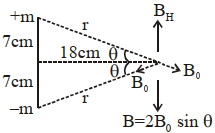
i.e. \(\frac{2 \mu_{0}}{4 \pi} \frac{ m }{ r ^{2}} \times \frac{7}{ r }=0.4 \times 10^{-4}\)\(\Rightarrow 2 \times 10^{-7} \times \frac{ m \times 7}{\left(7^{2}+18^{2}\right)^{3 / 2}} \times 10^{4}\)
\(=0.4 \times 10^{-4}\)
\(m =\frac{4 \times 10^{-2} \times(373)^{3 / 2}}{14}\)
\(M = m \times 14 cm = m \times \frac{14}{100}\)
\(=\frac{0.04 \times(373)^{3 / 2}}{14} \times \frac{14}{100}\)
\(=4 \times 10^{-4} \times 7203.82=2.88 J / T\)
-
- (A) \(500\)
- (B) \(2.5\)
- (C) \(25\)
- (D) \(250\)
Show answer and solution
Correct Answer: (D)
\(\frac{\Delta {M}}{{M}}=\frac{\Delta \mu}{\mu}=\frac{250}{500}=\frac{1}{2}\)\(\frac{1}{2}=\frac{{x}}{499} \Rightarrow {x} \simeq 250\)
- 3. A soft ferromagnetic material is placed in an external magnetic field. The magnetic domains: 2021 Medium
- (A) increase in size but no change in orientation.
- (B) have no relation with external magnetic field.
- (C) decrease in size and changes orientation.
- (D) may increase or decrease in size and change its orientation.
Show answer and solution
Correct Answer: (D)
Soft ferromagnetic materials are materials which can be easily magnetised and demagnetised by external magnetic field. When external field is applied, the domains experiences a net torque hence change its orientation. - 4. At an angle of \(30^{\circ}\) to the magnetic meridian, the apparent dip is \(45^{\circ} .\) Find the true dip : 2021 Medium
- (A) \(\tan ^{-1} \frac{1}{\sqrt{3}}\)
- (B) \(\tan ^{-1} \frac{\sqrt{3}}{2}\)
- (C) \(\tan ^{-1} \sqrt{3}\)
- (D) \(\tan ^{-1} \frac{2}{\sqrt{3}}\)
Show answer and solution
Correct Answer: (B)
\(A \tan \delta=\tan \delta^{\prime} \cos \theta\)\(=\tan 45^{\circ} \cos 30^{\circ}\)
\(\tan \delta=1 \times \frac{\sqrt{3}}{2}\)
\(\delta=\tan ^{-1}\left(\frac{\sqrt{3}}{2}\right)\)
-
- (A) True dip is not mathematically related to apparent dip.
- (B) True dip is less than apparent dip.
- (C) True dip is always greater than the apparent dip.
- (D) True dip is always equal to apparent dip.
Show answer and solution
Correct Answer: (B)
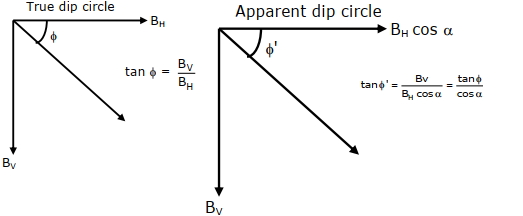
If apparent dip circle is at an angle \(\alpha\) with true dip circle thenTrue dip circle
\([Image]\)
Apparent dip circle
\([Image]\)
As \(\cos \alpha\,<1\)
Hence true \(\operatorname{dip}(\phi)\) is less than apparent \(\operatorname{dip}\left(\phi^{\prime}\right)\)
-
- (A) \((a), (c)\)
- (B) \(({a}),({d})\)
- (C) \(({b}),({d})\)
- (D) \(({b}),({c})\)
Show answer and solution
Correct Answer: (A)
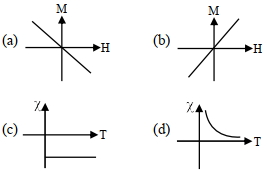
Conceptual question -
- (A) a macroscopic region with zero magnetization.
- (B) a macroscopic region with consecutive magnetic dipoles oriented in opposite direction.
- (C) a macroscopic region with randomly oriented magnetic dipoles.
- (D) a macroscopic region with saturation magnetization.
Show answer and solution
Correct Answer: (D)
conceptual -
- (A) \(8\)
- (B) \(10\)
- (C) \(12\)
- (D) \(14\)
Show answer and solution
Correct Answer: (A)
\(T =2 \pi \sqrt{\frac{ I }{ MB }}\)\(\frac{5}{10} =2 \pi \sqrt{\frac{5 \times 10^{-6}}{9.85 \times 10^{-2} \times B}}\)
\(B =8 \times 10^{-3} T\)
-
- (A) Statement \(I\) is true but Statement \(II\) is false
- (B) Both Statement \(I\) and Statement \(II\) are true
- (C) Both Statement \(I\) and Statement \(II\) are false
- (D) Statement \(I\) is false but Statement \(II\) is true
Show answer and solution
Correct Answer: (A)
As temperature increases, domains disintegrate so ferromagnetism decreases and above curie temperature it become paramagnet. -
- (A) \(4\)
- (B) \(1\)
- (C) \(2\)
- (D) \(3\)
Show answer and solution
Correct Answer: (C)
\(\mu=\mu_{o}\left(1+x_{m}\right)\)\(=4 \pi \times 10^{-7} \times 500\)
\(=2 \pi \times 10^{-4} \,{H} / {m}\)
-
- (A) \(22\)
- (B) \(44\)
- (C) \(66\)
- (D) \(2\)
Show answer and solution
Correct Answer: (A)
\(B=\mu .(H+I)\)\(B=\mu . H\left(1+\frac{I}{H}\right)\)
\(B=B_{0}(1+\chi )\)
\(B-B_{0}=B_{0} \chi\)
\(\frac{B-B_{0}}{B_{0}}=\chi\)
\(\frac{B-B_{0}}{B_{0}} \times 100=100 \chi\)
\(=2.2 \times 10^{-3}=\frac{22}{10^{4}}\)
-
- (A) \(1\)
- (B) \(5\)
- (C) \(7\)
- (D) \(8\)
Show answer and solution
Correct Answer: (A)
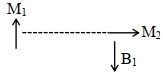
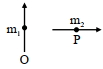
\(\vec{\tau}=\overrightarrow{{M}}_{2} \times \overrightarrow{{B}}_{1}\)\(\tau={M}_{2} {B}_{1} \sin 90^{\circ}\)
\(=1 \times \frac{\mu_{0}}{4 \pi} \frac{{M}_{1}}{(1)^{3}} 1\)
\(=10^{-7} {N} \cdot {m}\)
-
- (A) \((C)\) and \((E)\) only
- (B) \((B)\) and \((D)\) only
- (C) \((A)\) and \((B)\) only
- (D) \((B)\) and \((C)\) only
Show answer and solution
Correct Answer: (A)
Statement \(( C )\) is correct because, the magnetic field outside the toroid is zero and they form closed loops inside the toroid itself.Statement \(( E )\) is correct because we know that super conductors are materials inside which the net magnetic field is always zero and they are perfect diamagnetic.
\(\mu_{ r }=1+\chi\)
\(\chi=-1\)
\(\mu_{ r }=0\)
For superconductors.
No questions on this page match these filters.