


JEE Mains · Chemistry · STD 12 -Solution and colligative properties
- JEE Mains 2019
- Hard
- MCQ
\(1\,g\) of non-volatile non-electrolyte solute is dissolved in \(100\,g\) of two different solvents \(A\) and \(B\) whose ebullioscopic constants are in the ratio of \(1 : 5.\) The ratio of the elevation in their boiling points, \(\frac{{\Delta \,{T_b}\,(A)}}{{\Delta \,{T_b}\,(B)}}\) is
Pick an option to check your answer.
Answer & Solution
Correct Answer
(C) \(1:5\)
Step-by-step Solution
Detailed explanation
\(\Delta \,{T_b}\, = \,{K_b}\, \times \,m\)
\(\therefore \,\,\frac{{\Delta {T_{b\,(A)}}}}{{\Delta {T_{b\,(B)}}}}\, = \,\frac{{{K_{b(A)}}}}{{{K_{b(B)}}}}\) as \({m_A}\, = \,{m_B}\)
\(\therefore \,\,\frac{{\Delta {T_{b\,(A)}}}}{{\Delta {T_{b\,(B)}}}}\, = \frac{1}{5}\)
More questions from Chemistry
- For the following reaction at \(50°\)C and at \(2\) atm pressure,
\(2N_2O_5(g) \rightleftharpoons 2N_2O_4(g)+O_2(g)\)
\(N_2O_5\) is \(50\%\) dissociated.
The magnitude of standard free energy change at this temperature is \(x\).
\(x=\) ______ J mol\(^{-1}\) [Nearest integer].
Given: \(R=8.314\) J mol\(^{-1}\) K\(^{-1}\), \(\log 2=0.30\), \(\log 3=0.48\), \(\ln 10=2.303\), \(°C+273=K\)JEE Mains 2026 Hard - The increasing order of the following compounds towards \(HCN\) addition is
 JEE Mains 2020 Medium
- When \(10\, \mathrm{~mL}\) of an aqueous solution of \(\mathrm{KMnO}_{4}\) was titrated in acidic medium, equal volume of \(0.1\) \(\mathrm{M}\) of an aqueous solution of ferrous sulphate was required for complete discharge of colour. The strength of \(\mathrm{KMnO}_{4}\) in grams per litre is \(......\,\times 10^{-2} .\) (Nearest integer) Atomic mass of \(\mathrm{K}=39, \mathrm{Mn}=55, \mathrm{O}=16]\)JEE Mains 2021 Medium
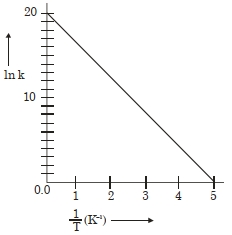
- For a reaction, given below is the graph of \(\ln k\,v s \frac{1}{ T }\). The activation energy for the reaction is equal to \(......cal\) \(mol ^{-1}\). (Nearest integer). (Given : \(R =2\,cal\,K ^{-1}\,mol ^{-1}\) )
 JEE Mains 2022 Medium
- The quantum number of four electrons are given below \(I. n = 4,l = 2,m_l = -2, m_s = -1/ 2\)
\(II. n = 3,l = 2, m_l = 1,m_s = +1/ 2\)
\(III. n = 4,l = 1, m_l = 0, m_s = +1/ 2\)
\(IV. n = 3,l = 1, m_l = 1; m_s = -1/ 2\)
The correct order of their increasing energies will beJEE Mains 2019 Hard - The increase of pressure on ice \(\rightleftharpoons\) water system at constant temperature will lead toJEE Mains 2015 Medium
More PYQs from JEE Mains
- The reason for "drug induced poisoning" isJEE Mains 2017 Hard
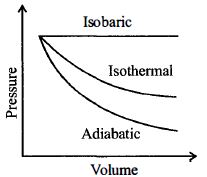
- A sample of gas expands from \(V_1\) to \(V _2\). In which of the following, the work done will be greatest ?
 JEE Mains 2013 Medium
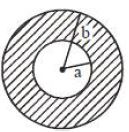
- A circular disc of radius \(b\) has a hole of radius \(a\) at its centre (see figure). If the mass per unit area of the disc varies as \(\left( {\frac{{{\sigma _0}}}{r}} \right)\), then the radius of gyration of the disc about its axis passing through the centre is
 JEE Mains 2019 Hard
- A block of mass \(100 \mathrm{~kg}\) slides over a distance of \(10 \mathrm{~m}\) on a horizontal surface. If the co-efficient of friction between the surfaces is \(0.4\) , then the work done against friction (in \(\mathrm{J}\) ) is :JEE Mains 2024 Hard
- Total number of molecules/species from following which will be paramagnetic is
\(\mathrm{O}_2, \mathrm{O}_2^{+}, \mathrm{O}_2^{-}, \mathrm{NO}, \mathrm{NO}_2, \mathrm{CO}, \mathrm{K}_2[\mathrm{NiCl}_4],[\mathrm{Co}(\mathrm{NH}_3)_6] \mathrm{Cl}_3,\)\(\mathrm{~K}_2[\mathrm{Ni}(\mathrm{CN})_4]\)JEE Mains 2025 Medium - A copper wire of length \(1.0\, m\) and a steel wire of length \(0.5\, m\) having equal cross-sectional areas are joined end to end. The composite wire is stretched by a certain load which stretches the copper wire by \(1\, mm\). If the Young's modulii of copper and steel are respectively \(1.0\times10^{11}\, Nm^{-2}\) and \(2.0\times10^{11}\, Nm^{- 2}\), the total extension of the composite wire is ........ \(mm\)JEE Mains 2013 Medium