


All P -Block elements - ll questions
Newest firstShowing 151–160 of 160 questions
-
- (A) Chlorine
- (B) Nitrogen
- (C) Fluorine
- (D) Sulphur
Show answer and solution
Correct Answer: (C)
Flourine is the most electronegative element and has least tendency to form double bonds. -
- (A) \(H_4P_2O_5\)
- (B) \((HPO_3)_3\)
- (C) \(H_4P_2O_6\)
- (D) \(H_4P_2O_7\)
Show answer and solution
Correct Answer: (C)
\(H_4P_2O_6\) has \(P-P\) linkage\(\begin{array}{*{20}{c}}
{\begin{array}{*{20}{c}}
{\,\,O\,\,\,\,\,\,\,\,O\,} \\
{\,||\,\,\,\,\,\,\,\,\,||}
\end{array}} \\
{HO - P - P - OH} \\
{|\,\,\,\,\,\,\,\,\,|\,} \\
{\,\,\,\,OH\,\,\,OH}
\end{array}\) -
- (A) \(Kr\)
- (B) \(Xe\)
- (C) \(He\)
- (D) \(Ne\)
Show answer and solution
Correct Answer: (B)
As we move down the group, the melting and boiling points show a regular increase due to corresponding increase in the magnitude of their van der waal forces of attraction as the size of the atom increases. -
- (A) \(H_2O_2 + 2H^++ 2e^- \rightarrow 2H_2O\)
- (B) \(H_2O_2 +2e^-\rightarrow O_2 +2H^+\)
- (C) \(H_2O_2 +2e^-\rightarrow 2OH^-\)
- (D) \(H_2O_2+2OH^- \, -2e^- \rightarrow O_2+2H_2O\)
Show answer and solution
Correct Answer: (D)
\(\mathrm{H}_{2} \mathrm{O}_{2}+2 \mathrm{OH}^{-}-2 \mathrm{e} \rightarrow \mathrm{O}_{2}+2 \mathrm{H}_{2} \mathrm{O}\) A molecule of \(\mathrm{H}_{2} \mathrm{O}_{2}\) loses hydrogen and is oxidized. - 155. Shapes of certain interhalogen compounds are stated below. Which one of them is not correctly stated? 2014 Hard
- (A) \(IF_7\) : pentagonal bipyramid
- (B) \(BrF_5\) : trigonal bipyramid
- (C) \(BrF_3\) : planar \(T-\) shaped
- (D) \(ICl_3\) : planar dimeric
Show answer and solution
Correct Answer: (B)
The molecular geometry of \(BrF_5\) is square pyramidal with asymmetric charge distribution on the central atom.
-
- (A) It is a covalent molecule.
- (B) It contains \(Cs^+\) and \(I_3^-\) ions.
- (C) It contains \(Cs^{+3}\) and \(I^-\) ions.
- (D) It contains \(Cs^+, I^-\) and lattice \(I_2\) molecule.
Show answer and solution
Correct Answer: (B)
\(C s l_{3}\) dissociates as\(C s l_{3} \rightarrow C s^{+}+I_{3}\)
- 157. Which of the following xenon-oxo compounds may not be obtained by hydrolysis of xenon fluorides? 2014 Hard
- (A) \(Xe{O_2}{F_2}\)
- (B) \(XeO{F_4}\)
- (C) \(XeO_3\)
- (D) \(XeO_4\)
Show answer and solution
Correct Answer: (D)
\(Xe{F_6}\, + \,{H_2}O\,\xrightarrow{{partial}}XeO{F_4}\, + \,2HF\)\(Xe{F_6}\, + \,2{H_2}O\,\xrightarrow{{partial}}Xe{O_2}{F_2}\, + \,4HF\)
\(Xe{F_6}\, + \,3{H_2}O\,\xrightarrow{{compute}}Xe{O_3}\, + \,6HF\)
-
- (A) It is diamagnetic in gaseous state
- (B) It is neutral oxide
- (C) It combines with oxygen to form nitrogen dioxide
- (D) It's bond order is \(2.5\)
Show answer and solution
Correct Answer: (A)
Nittic oxide is paramagnetic in the gaseous state because of the presence of one unpaired electron in its outermost shell.\({\text { The electronic configuration of } N O \text { is }}\)
\({\sigma_{1 s}^{2} \sigma_{1 s}^{* 2} \sigma_{2 s}^{2} \sigma_{2 s}^{o 2} \sigma_{2 p r s}^{2} \pi_{2 p r}^{2}}\)
\(=\pi_{2 p_{y}}^{2} \pi_{2 p_{z}}^{* 1}\)
- 159. The order of increasing sizes of atomic radii among the elements \(O , S, Se\) and \(As\) is 2013 Hard
- (A) \(As < S < O < Se\)
- (B) \(Se < S < As < O\)
- (C) \(O < S < Se < As\)
- (D) \(O < S < As < Se\)
Show answer and solution
Correct Answer: (C)
On moving down in a group atomic radii increases due to successive addition of extra shell hence \(O < S < Se\)Further As is in group \(15\) having one less electron in its \(p\) orbital hence have higher atomic radii than group \(16\) elements. \(i.e.,\,\,O < S < Se< As\)
-
- (A) \(XeOF_2\)
- (B) \(XeO_3F_2\)
- (C) \(FXeOSO_2F\)
- (D) \([XeF_8]^{2-}\)
Show answer and solution
Correct Answer: (B)
The hybridization of \(XeO_3F_2\) is \(sp^3d\) and its structure is trigonal bipyramidal in which oxygen atoms are situated on the plane and the fluoride atoms are on the top and bottom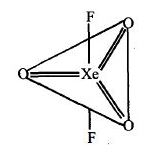
No questions on this page match these filters.