


JEE Mains · Chemistry · STD 12 - p -Block elements - ll
Given below are two statements:
Statement I: The covalency of oxygen is generally two but it can exceed upto four. The oxidation state of oxygen in \(SO_2\) is \(-2\) and in \(OF_2\) it is \(+2\).
Statement II: The anomalous behaviour of oxygen when compared to the other elements of group \(16\) is due to its small size and high electronegativity.
In the light of the above statements, choose the correct answer from the options given below
- A Both Statement I and Statement II are true
- B Both Statement I and Statement II are false
- C Statement I is true but Statement II is false
- D Statement I is false but Statement II is true
Answer & Solution
Correct Answer
(A) Both Statement I and Statement II are true
Step-by-step Solution
Detailed explanation
Statement I: The electronic configuration of oxygen is \(1s^{2} 2s^{2} 2p^{4}\). Due to the absence of d-orbitals, its maximum covalency is limited to four (using one 2s and three 2p orbitals). Its covalency is generally two, but it can exceed two and go up to four in certain…
See the Complete Solution
Get step-by-step explanations for this and 2.5 Lakh+ more JEE, NEET & CET questions.
- Unlock all solutions
- Practice the full chapter
- Track accuracy across PYQs
4.8 rated on Google Play · 14,000+ reviews
More questions from Chemistry
- Which of the following statements regarding the energy of the stationary state is true in the following one-electron system ?JEE Mains 2026 Easy
- Match the LIST-I with LIST-II
LIST-I (Molecules/ion) LIST-II (Hybridisation of central atom) A. \(PF _5\) I. \(dsp ^2\) B. \(SF _6\) II. \(sp ^3 d\) C. \(Ni ( CO )_4\) III. \(sp ^3 d^2\) D. \(\left[ PtCl _4\right]^{2-}\) IV. \(sp ^3\)
Choose the correct answer from the options given belowJEE Mains 2025 Medium - In the above chemical reaction sequence " \(\mathrm{A}\) " and " \(\mathrm{B}\) " respectively are :
 JEE Mains 2024 Medium
 - Number of complexes from the following with even number of unpaired "\(d\)" electrons is _______. \({\left[\mathrm{V}\left(\mathrm{H}_2 \mathrm{O}\right)_6\right]^{3+}, \quad\left[\mathrm{Cr}\left(\mathrm{H}_2 \mathrm{O}\right)_6\right]^{2+}, \quad\left[\mathrm{Fe}\left(\mathrm{H}_2 \mathrm{O}\right)_6\right]^{3+},}\) \({\left[\mathrm{Ni}\left(\mathrm{H}_2 \mathrm{O}\right)_6\right]^{3+},\left[\mathrm{Cu}\left(\mathrm{H}_2 \mathrm{O}\right)_6\right]^{2+}}\) [Given atomic numbers: \(\mathrm{V}=23, \mathrm{Cr}=24, \mathrm{Fe}=26\), \(\mathrm{Ni}=28, \mathrm{Cu}=29]\)JEE Mains 2024 Medium
- Consider the following sequence of reactions:
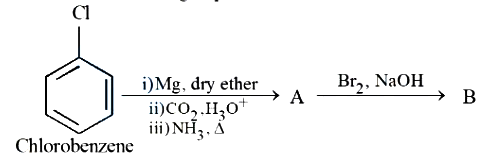
11.25 mg of chlorobenzene will produce __________ \(\times 10^{-1} \mathrm{mg}\) of product B .
(Consider the reactions result in complete conversion.)
[Given molar mass of \(\mathrm{C}, \mathrm{H}, \mathrm{O}, \mathrm{N}\) and Cl as \(12,1,16,14\) and \(35.5 \mathrm{~g} \mathrm{~mol}^{-1}\) respectively]JEE Mains 2025 Medium - Match items of Row \(I\) with those of Row \(II\). Row \(I-Image\) Row \(II:\) \((i)\) \(\alpha- D -(-)\) Fructofuranose. \((ii)\) \(\beta\)-D-(-) Fructofuranose \((iii)\) \(\alpha\)-D-(-) Glucopyranose. \((iv)\) \(\beta- D -(-)\) Glucopyranose Correct match is
 JEE Mains 2023 Hard
More PYQs from JEE Mains
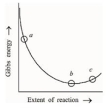
- Consider the graph of \(G i b b s\) free energy \(G\) vs Extent of reaction. The number of statement/s from the following which are true with respect to points \((a), (b)\) and \((c)\) is \(.................\) \(A.\)Reaction is spontaneous at \((a)\) and \((b)\) \(B.\)Reaction is at equilibrium at point \((b)\) and nonspontaneous at point \((c)\) \(C.\)Reaction is spontaneous at \((a)\) and nonspontaneous at \((c)\) \(D.\)Reaction is non-spontaneous at \((a)\) and \((b)\)
 JEE Mains 2023 Medium
 - x mg of \(\mathrm{Mg}(\mathrm{OH})_2(\) molar mass \(=58)\) is required to be dissolved in 1.0 L of water to produce a pH of 10.0 at 298 K. The value of x is ________ mg. (Nearest integer)
(Given : \(\mathrm{Mg}(\mathrm{OH})_2\) is assumed to dissociate completely in \(\mathrm{H}_2 \mathrm{O}\))JEE Mains 2025 Medium - For the galvanic cell, \(\mathrm{Zn}(\mathrm{s})+\mathrm{Cu}^{2+}(0.02 \mathrm{M}) \rightarrow \mathrm{Zn}^{2+}(0.04 \mathrm{M})+\mathrm{Cu}(\mathrm{s})\) \(\mathrm{E}_{\text {cell }}=...... \,\times 10^{-2} \,\mathrm{~V} { (Nearest integer) }\) \({\left[\text { Use }: \mathrm{E}_{\mathrm{Cu} / \mathrm{Cu}^{2+}}^{0}=-0.34\, \mathrm{~V}, \mathrm{E}_{2 \mathrm{n} / \mathrm{Zn}^{2+}}^{0}=+0.76 \,\mathrm{~V}\right.}\) \(\left.\frac{2.303 \mathrm{RT}}{\mathrm{F}}=0.059\, \mathrm{~V}\right]\)JEE Mains 2021 Easy
- Unpolarized light of intensity \(I\) is incident on a system of two polarizers, \(A\) followed by \(B.\) The intensity of emergent light is \(I/2.\) If a third polarizer \(C\) is placed between \(A\) and \(B,\) the intensity of emergent light is reduced to \(I/3 .\) The angle between the polarizers \(A\) and \(C\) is \(\theta \) . ThenJEE Mains 2018 Medium
- Consider the lines \(\mathrm{L}_1: \mathrm{x}-1=\mathrm{y}-2=\mathrm{z}\) and \(\mathrm{L}_2: \mathrm{x}-2=\mathrm{y}=\mathrm{z}-1\). Let the feet of the perpendiculars from the point \(\mathrm{P}(5,1,-3)\) on the lines \(\mathrm{L}_1\) and \(\mathrm{L}_2\) be \(Q\) and \(R\) respectively. If the area of the triangle PQR is A , then \(4 \mathrm{~A}^2\) is equal to :JEE Mains 2025 Hard
-
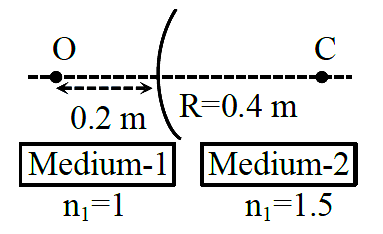
A spherical surface separates two media of refractive indices 1 and 1.5 as shown in figure. Distance of the image of an object ' O ' is :
( C is the center of curvature of the spherical surface and \(R\) is the radius of curvature)JEE Mains 2025 Easy