


JEE Mains · Chemistry · STD 12 - Amines
- JEE Mains 2026
- Hard
- MCQ
Identify the incorrect statements.
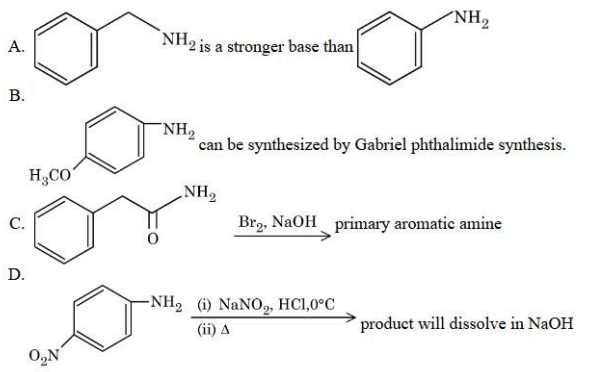
Choose the correct answer from the options given below:
Pick an option to check your answer.
Answer & Solution
Correct Answer
(C) B and C Only
Step-by-step Solution
Detailed explanation
Statement A: In benzylamine (\(C_6H_5CH_2NH_2\)), the lone pair of electrons on the nitrogen atom is localized and not involved in resonance. In aniline (\(C_6H_5NH_2\)), the lone pair is delocalized over the benzene ring. Hence, benzylamine is a stronger base than aniline. Statement A is correct.
Statement B: Gabriel phthalimide synthesis involves the nucleophilic substitution (\(S_N2\)) of an alkyl halide by the phthalimide anion. Aryl halides do not undergo nucleophilic substitution easily due to the partial double bond character of the C-X bond. Therefore, primary aromatic amines (like p-methoxyaniline) cannot be synthesized by this method. Statement B is incorrect.
Statement C: The reaction of 2-phenylacetamide (\(C_6H_5CH_2CONH_2\)) with \(Br_2\) and \(NaOH\) is the Hoffmann bromamide degradation, which yields benzylamine (\(C_6H_5CH_2NH_2\)). Benzylamine is a primary aliphatic (aralkyl) amine, not a primary aromatic amine (where the \(-NH_2\) group must be directly attached to the benzene ring). Statement C is incorrect.
Statement D: p-Nitroaniline undergoes diazotization with \(NaNO_2\) and \(HCl\) at \(0^\circ C\) to form p-nitrobenzenediazonium chloride. Heating this aqueous solution (\(\Delta\)) yields p-nitrophenol. Since p-nitrophenol is acidic, it dissolves in aqueous \(NaOH\) to form a soluble sodium salt. Statement D is correct.
The incorrect statements are B and C.
Answer: B and C Only
More questions from Chemistry
- In the following sequence of reactions the maximum number of atoms present in molecule '\(C\)' in one plane is \(A \xrightarrow[ { Cu\; tube }]{\text { Redhot }}\mathrm{B} \xrightarrow[ Anhydrous AlCl_3]{\mathrm{CH}_{3} \mathrm{Cl}(1 \mathrm{eq}} \mathrm{C}\) (\(A\) is a lowest molecular weight alkyne)JEE Mains 2020 Hard
- Both acetaldehyde and acetone (individually) undergo which of the following reactions?
A. Iodoform Reaction
B. Cannizaro Reaction
C. Aldol Condensation
D. Tollen's Test
E. Clemmensen Reduction
Choose the correct answer from the options given below:JEE Mains 2025 Medium - Given below are two statements :
Statement (I) : Corrosion is an electrochemical phenomenon in which pure metal acts as an anode and impure metal as a cathode.
Statement (II) : The rate of corrosion is more in alkaline medium than in acidic medium.
In the light of the above statements, choose the correct answer from the options given below :JEE Mains 2025 Easy - The number of paramagnetic complex among \(\left[\mathrm{FeF}_6\right]^{3-},\left[\mathrm{Fe}(\mathrm{CN})_6\right]^{3-},\left[\mathrm{Mn}(\mathrm{CN})_6\right]^{3-},\left[\mathrm{Co}\left(\mathrm{C}_2 \mathrm{O}_4\right)_3\right]^{3-}\), \(\left[\mathrm{MnCl}_6\right]^{3-}\) and \(\left[\mathrm{CoF}_6\right]^{3-}\), which involved \(\mathrm{d}^2 \mathrm{sp}^3\) hybridization is ____.JEE Mains 2025 Medium
- Match \(List-I\) with \(List-II\).
Choose the correct answer from the options given below.\(List-I\) \(List-II\) \((A)\) \(Cd ( s )+2 Ni ( OH )_{3}( s ) \rightarrow CdO ( s )+2 Ni ( OH )_{2}( s )+ H _{2} O (l)\) \((I)\) Primary battery \((B)\) \(Zn ( Hg )+ HgO ( s ) \rightarrow ZnO ( s )+ Hg (l)\) \((II)\) Discharging of secondary battery \((C)\) \(2 PbSO _{4}( s )+2 H _{2} O (l) \rightarrow Pb ( s )+ PbO _{2}( s )+ 2 H _{2} SO _{4}( aq )\) \((III)\) Fuel cell \((D)\) \(2 H _{2}( g )+ O _{2}( g ) \quad \rightarrow 2 H _{2} O (l)\) \((IV)\) Charging of secondary battery JEE Mains 2022 Medium - The correct sequence of electron gain enthalpy of the elements listed below is _______. \(A\). \(\mathrm{Ar}\) \(B\). \(\mathrm{Br}\) \(C. F\) \(D\). \(\mathrm{S}\) Choose the most appropriate from the options given below:JEE Mains 2024 Hard
More PYQs from JEE Mains
- Which of the following equations represents a travelling wave ?JEE Mains 2021 Easy
- Read the following statements: \((A)\) Volume of the nucleus is directly proportional to the mass number. \((B)\) Volume of the nucleus is independent of mass number. \((C)\) Density of the nucleus is directly proportional to the mass number. \((D)\) Density of the nucleus is directly proportional to the cube root of the mass number. \((E)\) Density of the nucleus is independent of the mass number. Choose the correct option from the following options.JEE Mains 2022 Medium
- Equivalent resistance between the adjacent corners of a regular \(n\)-sided polygon of uniform wire of resistance \(R\) would be:JEE Mains 2023 Medium
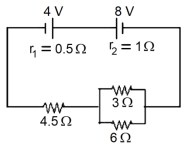
- In the circuit diagram shown in figure given below, the current flowing through resistance \(3\, \Omega\) is \(\frac{ x }{3}\,A\). The value of \(x\) is \(...........\)
 JEE Mains 2023 Hard
- To increase the resonant frequency in series \(LCR\) circuit,JEE Mains 2022 Medium
- For the reaction \(2A + B \to C\),the values of initial rate at different reactant concentrations are given in the table below: The rate law for the reaction is
\([A] (mol\,L^{-1})\) \([B] (mol\,L^{-1})\) Initial Rate \((mol\, L^{-1}\,s^{-1} )\) \(0.05\) \(0.05\) \(0.045\) \(0.10\) \(0.05\) \(0.090\) \(0.20\) \(0.10\) \(0.72\) JEE Mains 2019 Hard