


JEE Mains · Chemistry · STD 12 - Biomolecules
- JEE Mains 2026
- Easy
- MCQ
The correct statements are:
A. Activation energy for enzyme catalysed hydrolysis of sucrose is lower than that of acid catalysed hydrolysis.
B. During denaturation, secondary and tertiary structures of a protein are destroyed but primary structure remains intact.
C. Nucleotides are joined together by glycosidic linkage between \(C_{1}\) and \(C_{4}\) carbons of the pentose sugar.
D. Quaternary structure of proteins represents overall folding of the polypeptide chain.
Choose the correct answer from the options given below:
Pick an option to check your answer.
Answer & Solution
Correct Answer
(C) A and B Only
Step-by-step Solution
Detailed explanation
Explanation:
Let us analyze each statement meticulously according to the core text of the Class 12 NCERT textbook:
1. Statement A is correct: Enzymes are exceptional biological catalysts that lower the activation energy (\( E_{\text{a}} \)) of metabolic pathways with extreme efficiency. The activation energy for the enzyme-catalyzed (sucrase) hydrolysis of sucrose is significantly lower than that of ordinary acid-catalyzed hydrolysis.
2. Statement B is correct: Upon changing temperature or altering pH, a protein undergoes denaturation. During this process, weak stabilizing interactions and hydrogen bonds break down, disrupting the higher-order structural configurations. Thus, the secondary and tertiary structures are completely destroyed, while the covalent peptide bonds of the primary structure remain fully intact.
3. Statement C is incorrect: Successive nucleotides in nucleic acid strands are covalently linked together linearly by phosphodiester linkages connecting the \( C_5' \) carbon of one pentose ring to the \( C_3' \) carbon of the next. Glycosidic linkages are instead responsible for anchoring the nitrogenous bases to the \( C_1' \) carbon of the sugar unit.
4. Statement D is incorrect: According to the precise terminology used in the NCERT textbook, the tertiary structure of a protein represents the overall folding of the polypeptide chains (reflecting the further coiling of secondary structures). Conversely, the quaternary structure details the specific spatial arrangement of multiple distinct polypeptide subunits with respect to one another. Hence, statement D defines the tertiary structure, not the quaternary configuration.
Since only statements A and B are scientifically accurate, Option C is verified as the correct answer choice.
More questions from Chemistry
- The higher concentration of which gas in air can cause stiffness of flower buds?JEE Mains 2019 Medium
- In the reaction,
\(2Al(s)+6HCl(aq)\rightarrow2Al^{3+}(aq)+6Cl^{-}(aq)+3H_{2}(g)\)JEE Mains 2026 Easy - First order gas phase reaction \(A \rightarrow B + C\)
\(p_i =\) initial pressure of gas A, \(p_t =\) total pressure of the reaction mixture at time \(t\)
Expression of rate constant (\(k\)) isJEE Mains 2026 Medium - Increasing rate of \(S_N1\) reaction in the following compounds is
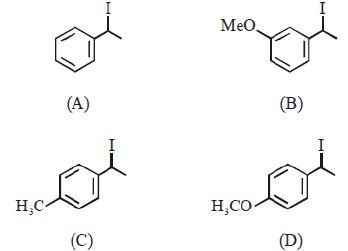 JEE Mains 2019 Hard
- \( {C{H_3} - C{H_2} - \overset{\overset{\LARGE{OH}}{|}}{\underset{\large {Ph}}{\underset{|}{C}}} - C{H_3}} \) can not be prepared byJEE Mains 2019 Hard
- The correct order of \(pK _{ a }\) values for the following compounds is:
 JEE Mains 2023 Hard
More PYQs from JEE Mains
- A cylinder of mass \(M_c\) and sphere of mass \(M_s\) are placed at points \(A\) and \(B\) of two inclines, respectively (See Figure). If they roll on the incline without sipping such that their accelerations are the same, then the ratio \(\frac{{\sin \,{\theta _c}}}{{\sin \,{\theta _s}}}\) is
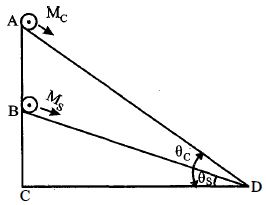 JEE Mains 2014 Hard
- The magnetic susceptibility of a material of a rod is \(499 .\) Permeability in vaccum is \(4 \pi \times 10^{-7}\; {H} / {m}\). Absolute permeability of the material of the rod is \(....\,\pi \times 10^{-4} {H} / {m}\)JEE Mains 2021 Medium
- Two separate wires \(A\) and \(B\) are stretched by \(2 \,mm\) and \(4\, mm\) respectively, when they are subjected to a force of \(2\, N\). Assume that both the wires are made up of same material and the radius of wire \(B\) is 4 times that of the radius of wire \(A\). The length of the wires \(A\) and \(B\) are in the ratio of \(a : b\). Then \(a / b\) can be expressed as \(1 / x\) where \(x\) isJEE Mains 2021 Hard
- Two ideal Carnot engines operate in cascade (all heat given up by one engine is used by the other engine to produce work) between temperatures, \(\mathrm{T}_{1}\) and \(\mathrm{T}_{2} .\) The temperature of the hot reservoir of the first engine is \(\mathrm{T}_{1}\) and the temperature of the cold reservoir of the second engine is \(\mathrm{T}_{2} . T\) is temperature of the sink of first engine which is also the source for the second engine. How is \(T\) related to \(\mathrm{T}_{1}\) and \(\mathrm{T}_{2}\), if both the engines perform equal amount of work?JEE Mains 2020 Medium
- A ray of light passing through a prism \((\mu=\sqrt{3})\) suffers minimum deviation. It is found that the angle of incidence is double the angle of refraction within the prism. Then, the angle of prism is ..... . (in degrees)JEE Mains 2021 Hard
- The relative strength of interionic/ intermolecular forces in decreasing order isJEE Mains 2020 Medium