


JEE Mains · Chemistry · STD 12 - Biomolecules
- JEE Mains 2026
- Hard
- MCQ
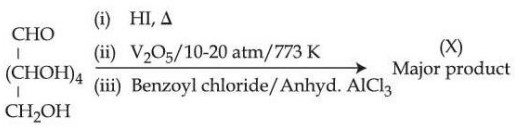
Consider the following reactions. Total number of electrons in the \(\pi\) bonds and lone pair of electrons in the product \((X)\) is :
Pick an option to check your answer.
Answer & Solution
Correct Answer
(D) \(18\)
Step-by-step Solution
Detailed explanation
Step 1: The starting material is an aldohexose (like D-glucose). On prolonged heating with \(HI\), it undergoes reduction to form n-hexane. This indicates that all six carbon atoms are linked in a straight chain.
\(\text{CHO}-(\text{CHOH})_4-\text{CH}_2\text{OH} \xrightarrow{\text{HI, } \Delta} \text{CH}_3-\text{CH}_2-\text{CH}_2-\text{CH}_2-\text{CH}_2-\text{CH}_3\) (n-hexane)
Step 2: n-Hexane, when passed over heated \(V_2O_5\) at \(773 \text{ K}\) and \(10-20 \text{ atm}\) pressure, undergoes aromatization (dehydrogenation and cyclization) to form benzene.
\(\text{n-hexane} \xrightarrow{V_2O_5, \text{ 773 K, 10-20 atm}} \text{C}_6\text{H}_6\) (Benzene)
Step 3: Benzene reacts with benzoyl chloride (\(\text{C}_6\text{H}_5\text{COCl}\)) in the presence of anhydrous \(\text{AlCl}_3\) to form benzophenone. This is a Friedel-Crafts acylation reaction.
\(\text{C}_6\text{H}_6 + \text{C}_6\text{H}_5\text{COCl} \xrightarrow{\text{Anhyd. AlCl}_3} \text{C}_6\text{H}_5-\text{CO}-\text{C}_6\text{H}_5\) (Benzophenone)
Step 4: Analyze the product (X), which is benzophenone.
The structure of benzophenone consists of two phenyl rings attached to a carbonyl group.
- Each phenyl ring contains \(3\) \(\pi\) bonds, so two rings have \(6\) \(\pi\) bonds.
- The carbonyl group (\(\text{C=O}\)) contains \(1\) \(\pi\) bond.
- Total number of \(\pi\) bonds = \(6 + 1 = 7\).
- Total number of \(\pi\) electrons = \(7 \times 2 = 14\).
- The oxygen atom in the carbonyl group has \(2\) lone pairs of electrons.
- Total number of lone pair electrons = \(2 \times 2 = 4\).
Total number of electrons in the \(\pi\) bonds and lone pairs = \(14 + 4 = 18\).
Answer: \(18\)
More questions from Chemistry
- What is the number of unpaired electron(s) in the highest occupied molecular orbital of the following species : \(N _2: N _2^{+} ; O _2 ; O _2^{+}\)?JEE Mains 2023 Medium
- In the Claisen-Schmidt reaction to prepare, dibenzalacetone from 5.3 g of benzaldehyde, a total of 3.51 g of product was obtained. The percentage yield in this reaction was ______ %.JEE Mains 2025 Medium
- The following ligand is
 JEE Mains 2019 Hard
- In alkaline medium, the reduction of permanganate anion involves a gain of \(........\) electrons.JEE Mains 2023 Easy
- A first row transition metal with highest enthalpy of atomisation, upon reaction with oxygen at high temperature forms oxides of formula \(\mathrm{M}_2 \mathrm{O}_{\mathrm{n}}\) (where \(\mathrm{n}=3,4,5\) ). The 'spin-only' magnetic moment value of the amphoteric oxide from the above oxides is. . . . . . ..\(\mathrm{BM}\) (near integer) (Given atomic number: \(\mathrm{Sc}: 21, \mathrm{Ti}: 22, \mathrm{~V}: 23\), \(\mathrm{Cr}: 24, \mathrm{Mn}: 25, \mathrm{Fe}: 26, \mathrm{Co}: 27, \mathrm{Ni}: 28, \mathrm{Cu}: 29\), \(\mathrm{Zn}: 30)\)JEE Mains 2024 Medium
- Oxidation state of Fe(Iron) in complex formed in Brown ring test.JEE Mains 2024 Medium
More PYQs from JEE Mains
- The region between \(y = 0\) and \(y = d\) contains a magnetic field \(\vec B = B\hat z\) A particle of mass \(m\) and charge \(q\) enters the region with a velocity \(\vec v = v\hat i\). If \(d = \frac{{mv}}{{2qB}}\) , the acceleration of the charged particle at the point of its emergence at the other side isJEE Mains 2019 Hard
- A hot body, obeying Newton's law of cooling is cooling down from its peak value \(80\,^oC\) to an ambient temperature of \(30\,^oC\) . It takes \(5\, minutes\) in cooling down from \(80\,^oC\) to \(40\,^oC\). ........ \(\min.\) will it take to cool down from \(62\,^oC\) to \(32\,^oC\) ? (Given \(ln\, 2\, = 0.693, ln\, 5\, = 1.609\))JEE Mains 2014 Hard
- Resistance of the wire is measured as \(2\,\Omega\) and \(3\,\Omega\) at \(10^{\circ}C\) and \(30^{\circ}C\) respectively. Temperature cocoefficient of resistance of the material of the wire is............\(^{\circ}C ^{-1}\)JEE Mains 2022 Medium
- During the propagation of electromagnetic waves in a mediumJEE Mains 2014 Easy