


JEE Mains · Chemistry · STD 12 -Aldehydes and ketones
- JEE Mains 2024
- Medium
- MCQ
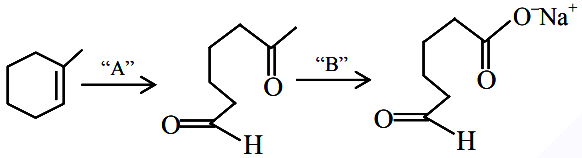
In the above chemical reaction sequence " \(\mathrm{A}\) " and " \(\mathrm{B}\) " respectively are :
Pick an option to check your answer.
Answer & Solution
Correct Answer
(A) \(\mathrm{O}_3, \mathrm{Zn} / \mathrm{H}_2 \mathrm{O}\) and \(\mathrm{NaOH}_{\text {(alc.). }} / \mathrm{I}_2\)
Step-by-step Solution
Detailed explanation
Explanation:
To determine the identity of reagents "A" and "B", we analyze each transformation step in the reaction pathway:
1. First Transformation (Identification of "A"):
The starting reactant is an unsymmetrical cyclic alkene, 1-methylcyclohexene. Under the action of reagent "A", the carbon-carbon double bond (\( \text{C}=\text{C} \)) undergoes oxidative cleavage to open the ring, generating a dicarbonyl product containing both a ketone group and an aldehyde group (6-oxoheptanal). This specific cleavage with a reductive workup that preserves aldehydes without further oxidation to carboxylic acids is known as reductive ozonolysis. Therefore, reagent "A" must be:
\( \text{O}_3 \text{ followed by } \text{Zn/H}_2\text{O} \)
2. Second Transformation (Identification of "B"):
The intermediate contains a methyl ketone group (\( -\text{COCH}_3 \)). Upon treatment with reagent "B" in the presence of iodine (\( \text{I}_2 \)), the methyl ketone group undergoes a haloform cleavage to form a bright yellow precipitate of iodoform (\( \text{CHI}_3 \)) alongside the corresponding sodium carboxylate salt. This confirmation test for methyl ketones requires a strong base. Therefore, reagent "B" is:
\( \text{NaOH} \)
Combining both components, "A" and "B" correspond perfectly to option A.
More questions from Chemistry
- An aqueous solution of \(\mathrm{NiCl}_{2}\) was heated with excess sodium cyanide in presence of strong oxidizing agent to form \(\left[\mathrm{Ni}(\mathrm{CN})_{6}\right]^{2-}\). The total change in number of unpaired electrons on metal centre is \(.....\)JEE Mains 2021 Hard
- The overall stability constant of the complex ion \(\left[\mathrm{Cu}\left(\mathrm{NH}_{3}\right)_{4}\right]^{2+}\) is \(2.1 \times 10^{13} . \quad\) The overall dissociations constant is \(\mathrm{y} \times 10^{-14}\). Then y is ....... .(Nearest integer)JEE Mains 2021 Easy
- \(1.4\,kg\) of an organic compound was digested according to Kjeldahl 's method and the ammonia evolved was absorbed in \(60\,mL\) of \(M/10\,\,H_2SO_4\) solution. The excess sulphuric acid required \(20\,mL\) of \(M/10\,\,NaOH\) solution for neutralization. The percentage of nitrogen in the compound isJEE Mains 2015 Hard
- \(2.8 \times 10^{-3} \mathrm{~mol}\) of \(\mathrm{CO}_2\) is left after removing \(10^{21}\) molecules from its ' \(x\) ' mg sample. The mass of \(\mathrm{CO}_2\) taken initially is
Given: \(\mathrm{N}_{\mathrm{A}}=6.02 \times 10^{23} \mathrm{~mol}^{-1}\)JEE Mains 2025 Easy - Consider the following statements: \((A)\) The principal quantum number \('n'\) is a positive integer with values of \('n'=1,2,3, \ldots\). \((B)\) The azimuthal quantum number \('l'\) for a given \('n'\) (principal quantum number) can have values as \('l'=0,1,2, \ldots n\) \((C)\) Magnetic orbital quantum number \('m _{l}'\) for a particular \('l'\) (azimuthal quantum number) has \((2 l\) + 1) values. \((D)\) \(\pm 1 / 2\) are the two possible orientations of electron spin. \((E)\) For \(l=5\), there will be a total of \(9\) orbital. Which of the above statements are correct?JEE Mains 2022 Hard
- The \(IUPAC\) symbols for the element with atomic number \(119\) would be:JEE Mains 2019 Medium
More PYQs from JEE Mains
- The light rays from an object have been reflected towards an observer from a standard flat mirror, the image observed by the observer are :- \(A.\) Real \(B.\) Erect \(C.\) Smaller in size then object \(D.\) Laterally inverted Choose the most appropriate answer from the options given below :JEE Mains 2023 Medium
- Two soap bubbles of radius 2 cm and 4 cm , respectively, are in contact with each other. The radius of curvature of the common surface, in cm , is ______ .JEE Mains 2025 Easy
- Reaction of BeO with ammonia and hydrogen fluoride gives ' A ' which on thermal decomposition gives \(BeF _2\) and \(NH _4 F\). What is ' A '?JEE Mains 2023 Medium
- To compare EMF of two cells using potentiometer the balancing lengths obtained are 200 cm and 150 cm . The least count of scale is 1 cm . The percentage error in the ratio of EMFs is ___________.JEE Mains 2026 Medium
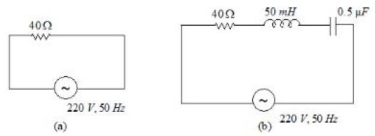
- For the given figures, choose the correct options:
 JEE Mains 2023 Medium
- The following data were obtained during the first order thermal decomposition of a gas \(A\) at constant volume: \(\mathrm{A}(\mathrm{g}) \rightarrow 2 \mathrm{B}(\mathrm{g})+\mathrm{C}(\mathrm{g})\)
The rate constant of the reaction is _______ \(\times 10^{-2} \mathrm{~s}^{-1}\). (nearest integer)S.No Time/s Total Pressure/(atm) \(1.\) \(0\) \(0.1\) \(2.\) \(115\) \(0.28\) JEE Mains 2024 Hard