


JEE Mains · Chemistry · STD 12 - 7. Alcohol, phenol and ethers
Consider the given chemical reaction sequence : Total sum of oxygen atoms in Product \(A\) and Product \(B\) are _______.

- A \(10\)
- B \(11\)
- C \(15\)
- D \(14\)
Answer & Solution
Correct Answer
(D) \(14\)
Step-by-step Solution
Detailed explanation
Picric acid is prepared by treating phenol first with concentrated sulphuric acid which converts it to phenol\(-2,4-\)disulphonic acid and then with concentrated nitric acid to get \(2,4,6\) trinitrophenol.
See the Complete Solution
Get step-by-step explanations for this and 2.5 Lakh+ more JEE, NEET & CET questions.
- Unlock all solutions
- Practice the full chapter
- Track accuracy across PYQs
4.8 rated on Google Play · 14,000+ reviews
More questions from Chemistry
- Consider the following chemical reaction. \(CH \equiv CH\xrightarrow[{{\text{(2) CO , HCl , AlC}}{{\text{l}}_3}}]{{{\text{(1) Red hot Fe tube, 873 K}}}}\) Product The number of \(sp ^{2}\) hybridized carbon atom(s) present in the product is ..........JEE Mains 2021 Medium
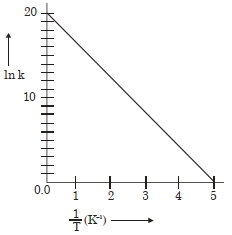
- For a reaction, given below is the graph of \(\ln k\,v s \frac{1}{ T }\). The activation energy for the reaction is equal to \(......cal\) \(mol ^{-1}\). (Nearest integer). (Given : \(R =2\,cal\,K ^{-1}\,mol ^{-1}\) )
 JEE Mains 2022 Medium
 - Match List\(-I\) with List\(-II\)
Choose the most appropriate matchList \(-I\) (Chemicals) List \(-II\) (Use / Preparation / Constituent) \((a)\) Alcoholic potassium hydroxide \((i)\) Electrodes in batteries \((b)\) \(Pd / BaSO _{4}\) \((ii)\) Obtained by addition reaction \((c)\) \(BHC\) (Benzene hexachloride) \((iii)\) Used for \(\beta\) - elimination reaction \((d)\) Polyacetylene \((iv)\) Lindlar's catalyst JEE Mains 2021 Medium - For the cell \(Zn(s)|\,Z{n^{2 + }}(aq)\,||\,{M^x+} \,(aq)|\,M(s),\) different half cells and their standard electrode potentials are given below
If \(E_{Z{n^{2 + }}/Zn}^o = - 0.76\,V,\) which cathode will given a maximum value of \(E_{cell}^o\) per electron transferred?\(M^{x+}\, (aq)\,/M(s)\) \(A{u^{3 + }}(aq)/\) \(Au(s)\) \(A{g^ + }(aq)/\) \(Ag(s)\) \(F{e^{3 + }}(aq)/\) \(F{e^{2 + }}(aq)\) \(F{e^{2 + }}(aq)/\) \(Fe(s)\) \(E^o\,M^{x+}\) \(\,/M(V)\) \(1.40\) \(0.80\) \(0.77\) \(-0.44\) JEE Mains 2019 Hard - The heat of combustion of solid benzoic acid at constant volume is \(-321.30 \mathrm{~kJ}\) at \(27^{\circ} \mathrm{C}\). The heat of combustion at constant pressure is \((-321.30-x R)\) \(\mathrm{kJ}\), the value of \(\mathrm{x}\) is _______.JEE Mains 2024 Medium
- An ammoniacal metal salt solution gives a brilliant red precipitate on addition of dimethylglyoxime. The metal ion is :JEE Mains 2023 Medium
More PYQs from JEE Mains
- Let the line \(\frac{x-3}{7}=\frac{y-2}{-1}=\frac{z-3}{-4}\) intersect the plane containing the lines \(\frac{x-4}{1}=\frac{y+1}{-2}=\frac{z}{1}\) and \(4 a x-y+5 z-7 a=0=2 x -5 y - z -3, a \in R\) at the point \(P(\alpha, \beta, \gamma)\). Then the value of \(\alpha+\beta+\gamma\) equals\(...\)JEE Mains 2022 Hard
- \(\mathop {{\rm{lim}}}\limits_{x \to 0} \frac{{\left( {1 - cos2x} \right)\left( {3 + \cos x} \right)}}{{x\;tan4x}}\) =JEE Mains 2015 Medium
- Let the maximum and minimum values of \(\left(\sqrt{8 x-x^2-12}-4\right)^2+(x-7)^2, x \in R\) be \(M\) and \(m\) respectively. Then \(\mathrm{M}^2-\mathrm{m}^2\) is equal to ...............JEE Mains 2024 Hard
- Elements P and Q form two types of non-volatile, non-ionizable compounds PQ and \( PQ_{2} \). When 1 g of PQ is dissolved in 50 g of solvent 'A', \( \Delta T_{b} \) was 1.176 K while when 1 g of \( PQ_{2} \) is dissolved in 50 g of solvent 'A', \( \Delta T_{b} \) was 0.689 K. \( K_{b} \) of 'A' = \( 5 \, K \, kg \, mol^{-1} \). The molar masses of elements P and Q (in \( g \, mol^{-1} \)) respectively, are:JEE Mains 2026 Medium
- Let \(A=\left[\begin{array}{lll}2 & a & 0 \\ 1 & 3 & 1 \\ 0 & 5 & b\end{array}\right]\) If \(A^3=4 A^2-A-21 I\), where I is the identity matrix of order \(3 \times 3\), then \(2 a+3 b\) is equal to :JEE Mains 2024 Hard
- Given below are two statements: Statement \(I\): Fluorine has most negative electron gain enthalpy in its group. Statement \(II\): Oxygen has least negative electron gain enthalpy in its group. In the light of the above statements, choose the most appropriate from the options given below.JEE Mains 2024 Hard