


Questions
13 questionsShowing 1–13 of 13 questions
-
- (A) Both \(A\) and \(R\) are correct and \(R\) is the correct explanation of \(A\).
- (B) \(A\) is not correct but \(R\) is correct.
- (C) Both \(A\) and \(R\) are correct but \(R\) is not the correct explanation of \(A\).
- (D) \(A\) is correct but \(R\) is not correct.
Show answer and solution
Correct Answer: (C)
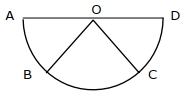
\(|\overrightarrow{A B}|=|\overrightarrow{B C}|=|\overrightarrow{C D}|\)Here, \(O\) is the centre of semi- circle
\(\therefore|\overrightarrow{O A}|=|\overrightarrow{O B}|=|\overrightarrow{O C}|=|\overrightarrow{O D}|\)
Using vector law of addition, we can write,
\(\overrightarrow{ AB }=\overrightarrow{ AO }+\overrightarrow{ OB }\)
\(\overrightarrow{ AC }=\overrightarrow{ AO }+\overrightarrow{ OC }\)
\(\overrightarrow{ AD }=\overrightarrow{ AO }+\overrightarrow{ OD }=2 \overrightarrow{ AO }\)
After adding all, we get,
\(\overrightarrow{A B}+\overrightarrow{A C}+\overrightarrow{A D}=4 \overrightarrow{A O}+\overrightarrow{O B}+\overrightarrow{O C}\)
Reason \(R\) is the direct result of Polygon law of vector addition
Therefore, Polygon law is applicable in both but the equation given in the reason is not useful in explaining the assertion.
-
- (A) \(\sqrt{A^{2}+B^{2}-\sqrt{2} A B}\)
- (B) \(\sqrt{A^{2}+B^{2}}\)
- (C) \(\sqrt{A^{2}+B^{2}+\sqrt{2} A B}\)
- (D) \(\sqrt{A^{2}+B^{2}+\sqrt{2} A B}\)
Show answer and solution
Correct Answer: (A)
\(\vec{A} \vec{B}=|\vec{A} \times \vec{B}|\)\(A B \cos \theta=A B \sin \theta \Rightarrow \theta=45^{\circ}\)
\(|\vec{A}-\vec{B}|=\sqrt{A^{2}+B^{2}-2 A B \cos 45^{\circ}}\)
\(=\sqrt{A^{2}+B^{2}-\sqrt{2} A B}\)
-
- (A) \(90\)
- (B) \(135\)
- (C) \(180\)
- (D) \(45\)
Show answer and solution
Correct Answer: (C)
\(=PQ \sin \theta\)\(= PQ \sin \theta\)
\(\Rightarrow \theta=180^{\circ}\)
-
- (A) \(-16 \hat{i}-24 \hat{j}+32 \hat{k}\)
- (B) \(16 \hat{i}+24 \hat{j}-32 \hat{k}\)
- (C) \(16 \hat{i}+24 \hat{j}+32 \hat{k}\)
- (D) \(16 \hat{i}-24 \hat{j}+32 \hat{k}\)
Show answer and solution
Correct Answer: (B)
We know,\(\because \overrightarrow{ OA }+\overrightarrow{ OB }+\overrightarrow{ OC }+\overrightarrow{ OD }+\overrightarrow{ OE }+\overrightarrow{ OF }+\overrightarrow{ OG }+\overrightarrow{ OH }=\overrightarrow{0}\)
By triangle law of vector addition, we can write
\(\overrightarrow{ AB }=\overrightarrow{ AO }+\overrightarrow{ OB } ; \overrightarrow{ AC }=\overrightarrow{ AO }+\overrightarrow{ OC }\)
\(\overrightarrow{ AD }=\overrightarrow{ AO }+\overrightarrow{ OD } ; \overrightarrow{ AE }=\overrightarrow{ A O }+\overrightarrow{ OE }\)
\(\overrightarrow{ AF }=\overrightarrow{ AO }+\overrightarrow{ OF } \quad ; \overrightarrow{ AG }=\overrightarrow{ AO }+\overrightarrow{ OG }\)
\(\overrightarrow{ AH }=\overrightarrow{ A O }+\overrightarrow{ OH }\)
Now
\(\overrightarrow{ AB }+\overrightarrow{ AC }+\overrightarrow{ AD }+\overrightarrow{ AE }+\overrightarrow{ AF }+\overrightarrow{ AG }+\overrightarrow{ AH }\)
\(=(7 \overrightarrow{ AO })+\overrightarrow{ OB }+\overrightarrow{ OC }+\overrightarrow{ OD }+\overrightarrow{ OE }+\overrightarrow{ OF }+\overrightarrow{ OG }+\overrightarrow{ OH }\)
\(=(7 \overrightarrow{ AO })+\overrightarrow{0}-\overrightarrow{ OA }\)
\(=(7 \overrightarrow{ AO })+\overrightarrow{ AO }\)
\(=8 \overrightarrow{ A O }=8(2 \hat{ i }+3 \hat{ j }-4 \hat{ k })\)
\(=16 \hat{i}+24 \hat{j}-32 \hat{k}\)
-
- (A) Statement\(-I\) is false but Statement\(-II\) is true
- (B) Statement\(-I\) is true but Statement\(-II\) is false
- (C) Both Statement\(-I\) and Statement\(-II\) are false
- (D) Both Statement\(-I\) and Statement\(-II\) are true.
Show answer and solution
Correct Answer: (D)
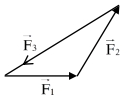
Here \(\overrightarrow{{F}}_{1}+\overrightarrow{{F}}_{2}+\overrightarrow{{F}}_{3}=0\)\(\overrightarrow{{F}}_{1}+\overrightarrow{{F}}_{2}=-\overrightarrow{{F}}_{3}\)
Since \(\overrightarrow{{F}}_{\text {net }}=0\) (equilibrium)
Both statements correct
-
- (A) Statement\(-I\) is false but Statement\(-II\) is true
- (B) Both Statement\(-I\) and Statement\(-II\) are true
- (C) Statement\(-I\) is true but Statement\(-II\) is false
- (D) Both Statement\(-I\) and Statement\(-II\) are false.
Show answer and solution
Correct Answer: (B)
\(\overrightarrow{{A}}=\overrightarrow{{P}}+\overrightarrow{{Q}}\)\(\overrightarrow{{B}}=\overrightarrow{{P}}-\overrightarrow{{Q}} \quad \overrightarrow{{P}} \perp \overrightarrow{{Q}}\)
\(|\overrightarrow{{A}}|=|\overrightarrow{{B}}|=\sqrt{{P}^{2}+{Q}^{2}}\)
\(|\overrightarrow{{A}}+\overrightarrow{{B}}|=\sqrt{2\left({P}^{2}+{Q}^{2}\right)(1+\cos \theta)}\)
\(\text { For }|\overrightarrow{{A}}+\overrightarrow{{B}}|=\sqrt{3\left({P}^{2}+{Q}^{2}\right)}\)
\(\theta_{1}=60^{\circ}\)
For \(|\vec{A}+\vec{B}|=\sqrt{2\left(P^{2}+Q^{2}\right)}\)
\(\theta_{2}=90^{\circ}\)
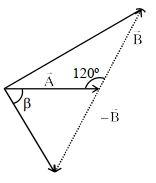
- 7. The angle between vector \((\overrightarrow{{A}})\) and \((\overrightarrow{{A}}-\overrightarrow{{B}})\) is :
 2021 Hard
- (A) \(\tan ^{-1}\left(\frac{-\frac{{B}}{2}}{{A}-{B} \frac{\sqrt{3}}{2}}\right)\)
- (B) \(\tan ^{-1}\left(\frac{{A}}{0.7 {B}}\right)\)
- (C) \(\tan ^{-1}\left(\frac{\sqrt{3} {B}}{2 {A}-{B}}\right)\)
- (D) \(\tan ^{-1}\left(\frac{{B} \cos \theta}{{A}-{B} \sin \theta}\right)\)
Show answer and solution
Correct Answer: (C)
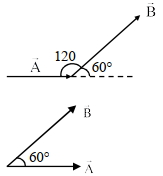
Angle between \(\overrightarrow{{A}}\) and \(\overrightarrow{{B}}, \theta=60^{\circ}\)Angle betwenn \(\overrightarrow{{A}}\) and \(\overrightarrow{{A}}-\overrightarrow{{B}}\)
\(\tan \alpha=\frac{B \sin \theta}{A-B \cos \theta}\)
\(=\frac{B \sqrt{\frac{3}{2}}}{A-B \times \frac{1}{2} 2}\)
\(\tan \alpha=\frac{\sqrt{3} B}{2 A-B}\)
-
- (A) \(\tan ^{-1} \frac{(1-\sqrt{3}-\sqrt{2})}{(1+\sqrt{3}+\sqrt{2})}\)
- (B) \(\tan ^{-1} \frac{(\sqrt{3}-1+\sqrt{2})}{(1+\sqrt{3}-\sqrt{2})}\)
- (C) \(\tan ^{-1} \frac{(\sqrt{3}-1+\sqrt{2})}{(1-\sqrt{3}+\sqrt{2})}\)
- (D) \(\tan ^{-1} \frac{(1+\sqrt{3}-\sqrt{2})}{(1-\sqrt{3}-\sqrt{2})}\)
Show answer and solution
Correct Answer: (A)
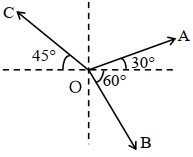
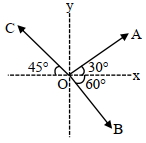
Let magnitude be equal to \(\lambda\).\(\overrightarrow{ OA }=\lambda\left[\cos 30^{\circ} \hat{ i }+\sin 30 \hat{ j }\right]=\lambda\left[\frac{\sqrt{3}}{2} \hat{ i }+\frac{1}{2} \hat{ j }\right]\)
\(\overrightarrow{ OB }=\lambda\left[\cos 60^{\circ} \hat{ i }-\sin 60 \hat{ j }\right]=\lambda\left[\frac{1}{2} \hat{ i }-\frac{\sqrt{3}}{2} \hat{ j }\right]\)
\(\overrightarrow{ OC }=\lambda\left[\cos 45^{\circ}(-\hat{ i })+\sin 45 \hat{ j }\right]=\lambda\left[-\frac{1}{\sqrt{2}} \hat{ i }+\frac{1}{\sqrt{2}} \hat{ j }\right]\)
\(\therefore \overrightarrow{ OA }+\overrightarrow{ OB }-\overrightarrow{ OC }\)
\(=\lambda\left[\left(\frac{\sqrt{3}+1}{2}+\frac{1}{\sqrt{2}}\right) \hat{ i }+\left(\frac{1}{2}-\frac{\sqrt{3}}{2}-\frac{1}{\sqrt{2}}\right) \hat{ j }\right]\)
\(\therefore\) Angle with \(x\)-axis
\(\tan ^{-1}\left[\frac{\frac{1}{2}-\frac{\sqrt{3}}{2}-\frac{1}{\sqrt{2}}}{\frac{\sqrt{3}}{2}+\frac{1}{2}+\frac{1}{\sqrt{2}}}\right]=\tan ^{-1}\left[\frac{\sqrt{2}-\sqrt{6}-2}{\sqrt{6}+\sqrt{2}+2}\right]\)
\(=\tan ^{-1}\left[\frac{1-\sqrt{3}-\sqrt{2}}{\sqrt{3}+1+\sqrt{2}}\right]\)
-
- (A) \(9.25 \hat{{i}}+5 \hat{{j}}\)
- (B) \(3 \hat{{i}}+15 \hat{{j}}\)
- (C) \(2.5 \hat{i}-14.5 \hat{{j}}\)
- (D) \(-1.5 \hat{{i}}-15.5 \hat{{j}}\)
Show answer and solution
Correct Answer: (A)
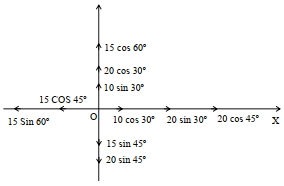
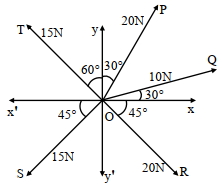
\(\hat{F}_{x}=\left(10 \times \frac{\sqrt{3}}{2}+20\left(\frac{1}{2}\right)+20\left(\frac{1}{\sqrt{2}}\right)-15\left(\frac{1}{\sqrt{2}}\right)-15\left(\frac{\sqrt{3}}{2}\right)\right) \hat{i}\)\(=9.25 \hat{i}\)
\(\vec{F}_{y}=\left(15\left(\frac{1}{2}\right)+20\left(\frac{\sqrt{3}}{2}\right)+10\left(\frac{1}{2}\right)-15\left(\frac{1}{\sqrt{2}}\right)-20\left(\frac{1}{\sqrt{2}}\right)\right) \hat{j}\)
\(=5 \hat{j}\)
-
- (A) \(11\)
- (B) \(47\)
- (C) \(5\)
- (D) \(3\)
Show answer and solution
Correct Answer: (D)
Direction of \(P=\hat{v}_{1}=\pm \frac{\vec{A} \times \vec{B}}{|\vec{A} \times \vec{B}|}=\pm \frac{\hat{i}-\hat{j}+\hat{k}}{\sqrt{3}}\)Direction of \(Q=\hat{v}_{2}=\pm \frac{\vec{A} \times \vec{C}}{|\vec{A} \times \vec{C}|}=\pm \frac{2 \hat{k}}{2}=\pm \hat{k}\)
Angle between \(\hat{v}_{1}\) and \(\hat{v}_{2}\)
\(\cos \theta = \frac{\hat{v}_{1}, \hat{v}_{2}}{\left|\hat{v}_{1}\right|\left|\hat{v}_{2}\right|}=\frac{\pm 1 / \sqrt{3}}{(1)(1)}=\pm \frac{1}{\sqrt{3}}\)
\(\Rightarrow x=3\)
-
- (A) \({\cos ^{ - 1}}\left[ {\frac{{{n^2} - 1}}{{{n^2} + 1}}} \right]\)
- (B) \({\cos ^{ - 1}}\left[ {\frac{{n - 1}}{{n + 1}}} \right]\)
- (C) \({\sin ^{ - 1}}\left[ {\frac{{{n^2} - 1}}{{{n^2} + 1}}} \right]\)
- (D) \({\sin ^{ - 1}}\left[ {\frac{{n - 1}}{{n + 1}}} \right]\)
Show answer and solution
Correct Answer: (A)
\(\begin{array}{*{20}{l}} {\left| {\vec A + \vec B} \right| = n\left| {\vec A - \vec B} \right|} \\ { \Rightarrow \,{A^2} + {B^2} + 2AB\,\cos \,\theta } \\ {\,\,\,\,\,\,\, = {n^2}\left( {{A^2} + {B^2} - 2AB\,\cos \,\theta } \right)} \\ { \Rightarrow \,\cos \,\theta \,\left( {1 + {n^2}} \right) = \frac{{2{a^2}\left( {{n^2} - 1} \right)}}{{2{a^2}}}\,\,} \\ {[A = B = c]} \\ {\cos \,\theta = \frac{{{n^2} - 1}}{{{n^2} + 1}}} \end{array}\) -
- (A) \(\cos ^{-1}\left(\frac{n^{2}+1}{n^{2}-1}\right)\)
- (B) \(\cos ^{-1}\left(\frac{{n}^{2}-1}{-{n}^{2}-1}\right)\)
- (C) \(\cos ^{-1}\left(\frac{-n^{2}-1}{n^{2}-1}\right)\)
- (D) \(\cos ^{-1}\left(\frac{n^{2}+1}{n^{2}-1}\right)\)
Show answer and solution
Correct Answer: (B)
Given \(X=Y\)\(\sqrt{ X ^{2}+ Y ^{2}-2 \times Y \cos \theta}\)
\(= n \sqrt{ X ^{2}+ Y ^{2}+2 \times Y \cos \theta}\)
Square both sides
\(2 X ^{2}(1-\cos \theta)= n ^{2} \cdot 2 X ^{2}(1+\cos \theta)\)
\(1-\cos \theta= n ^{2}+ n ^{2} \cos \theta\)
\(\cos \theta=\frac{1- n ^{2}}{1+ n ^{2}}\)
\(\theta=\cos ^{-1}\left[\frac{ n ^{2}-1}{- n ^{2}-1}\right]\)
- 13. What will be the projection of vector \(A=\hat{i}+\hat{j}+\hat{k}\) on vector \(\vec{B}=\hat{i}+\hat{j}\). 2021 Medium
- (A) \(\sqrt{2}(\hat{i}+\hat{j})\)
- (B) \((\hat{i}+\hat{j})\)
- (C) \(\sqrt{2}(\hat{i}+\hat{j}+\hat{k})\)
- (D) \(2(\hat{i}+\hat{j}+\hat{k})\)
Show answer and solution
Correct Answer: (B)
Projection of vector \(A\) on vector \(B\)\((A \cos \theta) \hat{B}=A\left(\frac{\bar{A} \cdot \bar{B}}{A B}\right) \hat{B}=\frac{\bar{A} \cdot \bar{B}}{B} \hat{B}\)
\(=\frac{2}{\sqrt{2}}\left(\frac{\hat{i}+\hat{j}}{\sqrt{2}}\right)=\hat{i}+\hat{j}\)

No questions on this page match these filters.