


JEE Mains · Chemistry · STD 11 - Organic chemistry isomerism
- JEE Mains 2026
- Hard
- MCQ
n-Butane on monochlorination under photochemical condition gives an optically active compound "P". "P" on further chlorination gives dichloro compounds. The number of dichloro compounds obtained (ignore stereoisomers) is:
Pick an option to check your answer.
Answer & Solution
Correct Answer
(B) \(4\)
Step-by-step Solution
Detailed explanation
The structure of n-butane is \(CH_3-CH_2-CH_2-CH_3\).
Monochlorination of n-butane gives two structural isomers: 1-chlorobutane and 2-chlorobutane.
Among these, 2-chlorobutane (\(CH_3-CH_2-C^{*}HCl-CH_3\)) contains a chiral carbon atom and is optically active. Thus, the optically active compound "P" is 2-chlorobutane.
Further chlorination of 2-chlorobutane can take place at any of the four carbon atoms, yielding the following dichloro compounds (ignoring stereoisomers):
1. Chlorination at C-1: \(CH_3-CH_2-CHCl-CH_2Cl\) (1,2-dichlorobutane)
2. Chlorination at C-2: \(CH_3-CH_2-CCl_2-CH_3\) (2,2-dichlorobutane)
3. Chlorination at C-3: \(CH_3-CHCl-CHCl-CH_3\) (2,3-dichlorobutane)
4. Chlorination at C-4: \(CH_2Cl-CH_2-CHCl-CH_3\) (1,3-dichlorobutane)
Therefore, 4 structurally distinct dichloro compounds are obtained.
Answer: \(4\)
More questions from Chemistry
- Glycosidic linkage is actually anJEE Mains 2013 Hard
- In order to oxidise a mixture of \(1\) mole each of \(FeC_2O_4\), \(Fe_2(C_2O_4)_3\), \(FeSO_4\) and \(Fe_2(SO_4)_3\) in acidic medium, the number of moles of \(KMnO_4\) required isJEE Mains 2026 Hard
- Which one has the highest boiling point ?JEE Mains 2015 Easy
- Lithium aluminium hydride reacts with silicon tetrachloride to formJEE Mains 2018 Hard
- In which one of the following pairs the central atoms exhibit \(\mathrm{sp}^2\) hybridization ?JEE Mains 2024 Medium
- In the molecular orbital diagram for the molecular ion, \(N_2^ + \) , the number of electrons in the \({\sigma _{2p}}\) molecular orbital isJEE Mains 2018 Medium
More PYQs from JEE Mains
- A uniform solid cylinder with radius \(R\) and length L has moment of inertia \(I_1\), about the axis of cylinder. A concentric solid cylinder of radius \(R^{\prime}=\frac{R}{2}\) and length \(L^{\prime}=\frac{L}{2}\) is caned out of the original cylinder. If \(I_2\) is the moment of inertia of the carved out portion ot the cylinder then \(\frac{I_1}{I_2}=..........\) (Both \(I_1\) and \(I_2\) are about the axis of the cylinder)JEE Mains 2023 Medium
- The equivalent capacitance between \(A\) and \(B\) in the circuit given below is.....\(μF\)
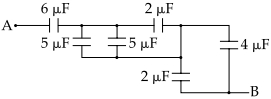 JEE Mains 2018 Hard
- A point charge \(q_1=4 q_0\) is placed at origin. Another point charge \(q_2=-q_0\) is placed at \(x =12\,cm\). Charge of proton is \(q_0\). The proton is placed on \(x\)-axis so that the electrostatic force on the proton in zero. In this situation, the position of the proton from the origin is \(..........cm\).JEE Mains 2023 Medium
- A \(2 \mathrm{~kg}\) brick begins to slide over a surface which is inclined at an angle of \(45^{\circ}\) with respect to horizontal axis. The co-efficient of static friction between their surfaces is _______.JEE Mains 2024 Hard
- A body cools from \(60^{\circ} C\) to \(40^{\circ} C\) in \(6\) minutes. If, temperature of surroundings is \(10^{\circ} C\). Then, after the next 6 minutes, its temperature will be \(.........{ }^{\circ} C\).JEE Mains 2023 Medium
- What quantity (in \(mL\)) of a \(45\%\) acid solution of a mono-protic strong acid must be mixed with a \(20\%\) solution of the same acid to produce \(800\, mL\) of a \(29.875\%\) acid solution?JEE Mains 2017 Hard