


JEE Mains · Chemistry · STD 11 - Organic chemistry isomerism
- JEE Mains 2026
- Hard
- MCQ
Given below are two statements:
Statement I: \(2,6\)-diethylcyclohexanone and \(6\)-methyl-\(2\)-n-propylcyclohexanone are metamers.
Statement II: \(2,2,6,6\)-tetramethylcyclohexanone exhibits keto-enol tautomerism.
In the light of the above statements, choose the correct answer from the options given below
Pick an option to check your answer.
Answer & Solution
Correct Answer
(C) Statement I is true but Statement II is false
Step-by-step Solution
Detailed explanation
Statement I: Metamerism arises due to different alkyl chains on either side of a polyvalent functional group. In ketones, the carbonyl group (\(>C=O\)) acts as the polyvalent functional group. In \(2,6\)-diethylcyclohexanone, the alkyl groups attached to the \(\alpha\)-carbons are two ethyl groups. In \(6\)-methyl-\(2\)-n-propylcyclohexanone, the alkyl groups are a methyl group and an n-propyl group. Since the alkyl groups around the carbonyl group are different while the molecular formula remains the same, they are metamers. Thus, Statement I is true.
Statement II: For a ketone to exhibit keto-enol tautomerism, it must have at least one \(\alpha\)-hydrogen atom. In \(2,2,6,6\)-tetramethylcyclohexanone, the \(\alpha\)-carbons (C\(2\) and C\(6\)) are bonded to two methyl groups each. Since there are no \(\alpha\)-hydrogen atoms present, it cannot undergo keto-enol tautomerism. Thus, Statement II is false.
Answer: Statement I is true but Statement II is false
More questions from Chemistry
- \(150\,g\) of acetic acid was contaminated with \(10.2\,g\) ascorbic acid \(\left( C _{6} H _{8} O _{6}\right)\) to lower down its freezing point by \(\left( x \times 10^{-1}\right)^{\circ} C\). The value of \(x\) is (Nearest integer) [Given \(K _{ f }=3.9\,K\,kg\,mol ^{-1}\);Molar mass of ascorbic acid \(=176\,g\,mol ^{-1}\) ]JEE Mains 2022 Medium
- Which of the following complex is octahedral, diamagnetic and the most stable?JEE Mains 2023 Medium
- An ideal gas, \(\overline{\mathrm{C}}_{\mathrm{V}}=\frac{5}{2} \mathrm{R}\), is expanded adiabatically against a constant pressure of \(1 \mathrm{~atm}\) untill it doubles in volume. If the initial temperature and pressure is \(298 \mathrm{~K}\) and \(5 \mathrm{~atm}\), respectively then the final temperature is _______ \(\mathrm{K}\) (nearest integer). [ \(\overline{\mathrm{C}}_{\mathrm{V}}\) is the molar heat capacity at constant volume]JEE Mains 2024 Medium
- Given below are two statements :
Statement I : Mohr's salt is composed of only three types of ions-ferrous, ammonium and sulphate.
Statement II : If the molar conductance at infinite dilution of ferrous, ammonium and sulphate ions are \(\mathrm{x}_1, \mathrm{x}_2\) and \(\mathrm{x}_3 \mathrm{~S} \mathrm{~cm}^2 \mathrm{~mol}^{-1}\), respectively then the molar conductance for Mohr's salt solution at infinite dilution would be given by \(\mathrm{x}_1+\mathrm{x}_2+2 \mathrm{x}_3\)
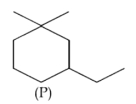
In the light of the given statements, choose the correct answer from the options given below :JEE Mains 2025 Medium - \(IUPAC\) name of following compound \((\mathrm{P})\) is
 JEE Mains 2024 Hard
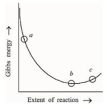
- Consider the graph of \(G i b b s\) free energy \(G\) vs Extent of reaction. The number of statement/s from the following which are true with respect to points \((a), (b)\) and \((c)\) is \(.................\) \(A.\)Reaction is spontaneous at \((a)\) and \((b)\) \(B.\)Reaction is at equilibrium at point \((b)\) and nonspontaneous at point \((c)\) \(C.\)Reaction is spontaneous at \((a)\) and nonspontaneous at \((c)\) \(D.\)Reaction is non-spontaneous at \((a)\) and \((b)\)
 JEE Mains 2023 Medium
More PYQs from JEE Mains
- The acceleration due to gravity at height \(h\) above the earth if \(h \ll R\) (radius of earth) is given byJEE Mains 2023 Medium
- In Carius method for estimation of halogens, 180 mg of an organic compound produced 143.5 mg of AgCl . The percentage composition of chlorine in the compound is _______ %.
(Given : molar mass in \(\mathrm{g} \mathrm{mol}^{-1}\) of \(\mathrm{Ag}: 108, \mathrm{Cl}: 35.5\) )JEE Mains 2025 Medium - The number of correct statement/s from the following is _____ .
Larger the activation energy, smaller is the value of the rate constant.
The higher is the activation energy, higher is the value of the temperature coefficient.
At lower temperatures, increase in temperature causes more change in the value of k than at higher temperature.
A plot of \(\ln k\) vs \(\frac{1}{T}\) is a straight line with slope equal to \(-\frac{ Ea }{ R }\)JEE Mains 2023 Medium