


JEE Mains · Chemistry · STD 12 - 8.2 Carboxylic acids and their derivative
The correct sequence of acidic strength of the following aliphatic acids in their decreasing order is _______.
\(CH _3 CH _2 COOH , CH _3 COOH , CH _3 CH _2 CH _2\)\(COOH , HCOOH\)
- A \(HCOOH > CH _3 COOH > CH _3 CH _2 COOH > CH _3 CH _2 CH _2 COOH\)
- B \(HCOOH > CH _3 CH _2 CH _2 COOH > CH _3 CH _2 COOH > CH _3 COOH\)
- C \(CH _3 CH _2 CH _2 COOH > CH _3 CH _2 COOH > CH _3 COOH > HCOOH\)
- D \(CH _3 COOH > CH _3 CH _2 COOH > CH _3 CH _2 CH _2 COOH > HCOOH\)
Answer & Solution
Correct Answer
(A) \(HCOOH > CH _3 COOH > CH _3 CH _2 COOH > CH _3 CH _2 CH _2 COOH\)
Step-by-step Solution
Detailed explanation
\(HCOOH > CH _3 COOH > CH _3 CH _2 COOH > CH _3 CH _2 CH _2 COOH\)
See the Complete Solution
Get step-by-step explanations for this and 2.5 Lakh+ more JEE, NEET & CET questions.
- Unlock all solutions
- Practice the full chapter
- Track accuracy across PYQs
4.8 rated on Google Play · 14,000+ reviews
More questions from Chemistry
- Class \(XII\) students were asked to prepare one litre of buffer solution of \(pH\,8.26\) by their chemistry teacher. The amount of ammonium chloride to be dissolved by the student in \(0.2\,M\) ammonia solution to make one litre of the buffer is \(.....\,g\) (Given \(pK _{ b }\left( NH _{3}\right)=4.74\); Molar mass of \(NH _{3}=17\,g\,mol ^{-}\) ; Molar mass of \(NH _{4} Cl =53.5\,g\,mol ^{-1}\) )JEE Mains 2022 Medium
- The incorrect statement from the following with respect to carbohydrates is:JEE Mains 2026 Medium
- The order of reactivity of the given haloalkanes towards nucleophile isJEE Mains 2013 Medium
- At \( 27^{\circ}C \) in presence of a catalyst, activation energy of a reaction is lowered by 10 kJ \( mol^{-1} \). The logarithm ratio of \( \frac{k(catalysed)}{k(uncatalysed)} \) is ....
(Consider that the frequency factor for both the reactions is same)JEE Mains 2026 Easy - Given below are two statements:
Statement I: Benzene is nitrated to give nitrobenzene, which on further treatment with \(CH_{3}COCl / AlCl_{3}\) will give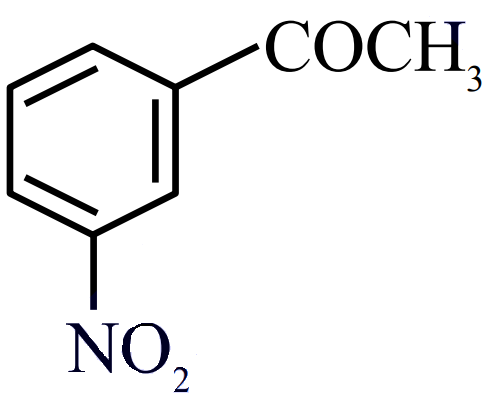
Statement II: \(NO_{2}\) group is a m-directing, and deactivating group.
In the light of the above statements, choose the most appropriate answer:JEE Mains 2026 Hard - Molal depression constant for a solvent is \(4.0\, K\, Kg\, mol^{-1}\). The depression in the freezing point of the solvent for \(0.03\, mol\, kg^{-1}\) solution of \(K_2SO_4\) is .............. \(\mathrm{K}\) (Assume complete dissociation of the electrolyte)JEE Mains 2019 Hard
More PYQs from JEE Mains
- A parallel beam of light is allowed to fall on a transparent spherical globe of diameter \(30 \,cm\) and refractive index \(1.5\). The distance from the centre of the globe at which the beam of light can converge is________ \(mm\)JEE Mains 2022 Hard
- Match the LIST-I with LIST-II.
LIST-I (Molecule/ion) LIST-II Bond pair : lone pair (on the central atom) (A) ICl2- (I) 4 : 2 (B) H2O (II) 4 : 1 (C) SO2 (III) 2 : 3 (D) XeF4 (IV) 2 : 2
Choose the correct answer from the options given below :JEE Mains 2025 Easy - A force \(\overrightarrow{ F }=(\hat{ i }+2 \hat{ j }+3 \hat{ k }) N\) acts at a point \((4 \hat{ i }+3 \hat{ j }-\hat{ k }) m \cdot\) Then the magnitude of torque about the point \((\hat{i}+2 \hat{j}+\hat{k}) m\) will be \(\sqrt{ x } N - m .\) The value of \(x\) is\(........\)JEE Mains 2020 Medium
- The square of the distance of the point of intersection of the lines \(\vec{r} = (\hat{i} + \hat{j} - \hat{k}) + \lambda(a\hat{i} - \hat{j})\), \(a \neq 0\) and \(\vec{r} = (4\hat{i} - \hat{k}) + \mu(2\hat{i} + a\hat{k})\) from the origin is:JEE Mains 2026 Hard
- At time \(\mathrm{t}=0\) magnetic field of \(1000\) Gauss is passing perpendicularly through the area defined by the closed loop shown in the figure. If the magnetic field reduces linearly to \(500\) Gauss, in the next \(5 \;\mathrm{s}\), then induced \(EMF\) in the loop is ........\( \mu \mathrm{V}\)
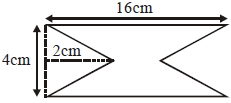 JEE Mains 2020 Medium
 - A point particle of mass, moves along the uniformly rough track \(PQR\) as shown in the figure. The coefficient of friction, between the particle and the rough track equals \(\mu\). The particle is released, from rest, from the point \(P\) and it comes to rest at a point \(R\). The energies, lost by the ball, over the parts, \(PQ\) and \(PR\), of the track, are equal to each other, and no energy is lost when particle changes direction from \(PQ\) to \(QR\). The values of the coefficient of friction \(\mu\) and the distance \(x(=QR)\) are, respecitvely close to
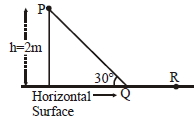 JEE Mains 2016 Hard