


JEE Mains · Chemistry · STD 12 - Amines
- JEE Mains 2026
- Medium
- MCQ
Benzyl isocyanide can be obtained from
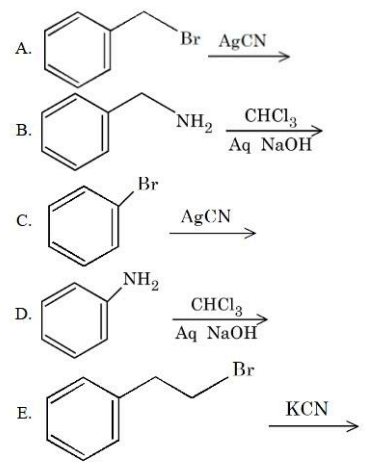
Choose the correct answer from the options given below:
Pick an option to check your answer.
Answer & Solution
Correct Answer
(A) A and B Only
Step-by-step Solution
Detailed explanation
Reaction A: \(C_6H_5CH_2Br + AgCN \rightarrow C_6H_5CH_2NC + AgBr\)
\(AgCN\) is predominantly covalent, so the nucleophilic attack occurs through the nitrogen atom, forming benzyl isocyanide.
Reaction B: \(C_6H_5CH_2NH_2 + CHCl_3 + 3NaOH \rightarrow C_6H_5CH_2NC + 3NaCl + 3H_2O\)
This is the carbylamine reaction. Primary amines react with chloroform and alkali to form isocyanides. Benzyl amine gives benzyl isocyanide.
Reaction C: \(C_6H_5Br + AgCN \rightarrow\) No reaction
Aryl halides are generally unreactive towards nucleophilic substitution under normal conditions due to the partial double bond character of the C-Br bond.
Reaction D: \(C_6H_5NH_2 + CHCl_3 + 3NaOH \rightarrow C_6H_5NC + 3NaCl + 3H_2O\)
Aniline undergoes the carbylamine reaction to form phenyl isocyanide, not benzyl isocyanide.
Reaction E: \(C_6H_5CH_2CH_2Br + KCN \rightarrow C_6H_5CH_2CH_2CN + KBr\)
\(KCN\) is predominantly ionic, so the nucleophilic attack occurs through the carbon atom, forming a cyanide (nitrile) rather than an isocyanide.
Thus, benzyl isocyanide is obtained from reactions A and B only.
Answer: A and B Only
More questions from Chemistry
- Given below are two statements:
Statement I: \(2,6\)-diethylcyclohexanone and \(6\)-methyl-\(2\)-n-propylcyclohexanone are metamers.
Statement II: \(2,2,6,6\)-tetramethylcyclohexanone exhibits keto-enol tautomerism.
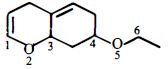
In the light of the above statements, choose the correct answer from the options given belowJEE Mains 2026 Hard - On the treatment of the following compound with a strong acid, the most susceptible site for bond cleavage is
 JEE Mains 2018 Hard
- The bond dissociation enthalpy of \(\mathrm{X}_2 \Delta \mathrm{H}_{\text {bond }}\) calculated from the given data is _______ \(\mathrm{kJ} \mathrm{mol}^{-1}\). (Nearest integer)
\(\begin{aligned}
& \mathrm{M}^{+} \mathrm{X}^{-}(\mathrm{s}) \rightarrow \mathrm{M}^{+}(\mathrm{g})+\mathrm{X}^{-}(\mathrm{g}) \Delta \mathrm{H}_{\text {lattice }}^*=800 \mathrm{~kJ} \mathrm{~mol}^{-1} \\
& \mathrm{M}(\mathrm{~s}) \rightarrow \mathrm{M}(\mathrm{~g}) \Delta \mathrm{H}_{\text {sub }}^{\circ}=100 \mathrm{~kJ} \mathrm{~mol}^{-1}
\end{aligned}\)
\(\mathrm{M}(\mathrm{~g}) \rightarrow \mathrm{M}^{+}(\mathrm{g})+\mathrm{e}^{-}(\mathrm{g}) \Delta \mathrm{H}_{\mathrm{i}}=500 \mathrm{~kJ} \mathrm{~mol}^{-1}\)
\(\mathrm{X}(\mathrm{~g})+\mathrm{e}^{-}(\mathrm{g}) \rightarrow \mathrm{X}^{-}(\mathrm{g}) \Delta \mathrm{H}_{\mathrm{eg}}^*=-300 \mathrm{~kJ} \mathrm{~mol}^{-1}\)
\(\mathrm{M}(\mathrm{~s})+\frac{1}{2} \mathrm{X}_2(\mathrm{~g}) \rightarrow \mathrm{M}^{+} \mathrm{X}^{-}(\mathrm{s}) \Delta \mathrm{H}_f^{\circ}=-400 \mathrm{~kJ} \mathrm{~mol}^{-1}\)
[Given : \(\mathrm{M}^{+} \mathrm{X}^{-}\)is a pure ionic compound and X forms a diatomic molecule \(\mathrm{X}_2\) in gaseous state]JEE Mains 2025 Medium - In \(XeO_3F_2\), the number ofbond pair \((s)\), \(\pi -\) bond \((s)\) and lone pair \((s)\) on \(Xe\) atom respectively are:JEE Mains 2018 Hard
- \(150\,g\) of acetic acid was contaminated with \(10.2\,g\) ascorbic acid \(\left( C _{6} H _{8} O _{6}\right)\) to lower down its freezing point by \(\left( x \times 10^{-1}\right)^{\circ} C\). The value of \(x\) is (Nearest integer) [Given \(K _{ f }=3.9\,K\,kg\,mol ^{-1}\);Molar mass of ascorbic acid \(=176\,g\,mol ^{-1}\) ]JEE Mains 2022 Medium
- Assuming that \(\mathrm{Ba}(\mathrm{OH})_{2}\) is completely ionised in aqueous solution under the given conditions the concentration of \(\mathrm{H}_{3} \mathrm{O}^{+}\)ions in \(0.005 \,\mathrm{M}\) aqueous solution of \(\mathrm{Ba}(\mathrm{OH})_{2}\) at \(298\, \mathrm{~K}\) is \(.....\times 10^{-12}\) \(mol\) \(\mathrm{L}^{-1}\). (Nearest integer)JEE Mains 2021 Medium
More PYQs from JEE Mains
- The electric field intensity produced by the radiation coming from a \(100\, W\) bulb at a distance of \(3\, m\) is \(E\). The electric field intensity produced by the radiation coming from \(60\, W\) at the same distance is \(\sqrt{\frac{x}{5}} E\). Where the value of \(x=......... .\)JEE Mains 2021 Hard
- A free neutron decays into a proton but a free proton does not decay into neutron. This is becauseJEE Mains 2023 Medium
- Radiation coming from transition \(n = 2\) to \(n = 1\) of hydrogen atoms fall of \(He^+\) ions in \(n = 1\) and \(n = 2\) states. The possible. Transition of helium ions as they absorb energy from the radiation isJEE Mains 2019 Hard
- A force \(\mathrm{f}=\mathrm{x}^2 \mathrm{y} \hat{\mathrm{i}}+\mathrm{y}^2 \hat{\mathrm{j}}\) acts on a particle in a plane \(\mathrm{x}+\mathrm{y}=10\). The work done by this force during a displacement from \((0,0)\) to \((4 \mathrm{~m}, 2 \mathrm{~m})\) is Joule (round off to the nearest integer)JEE Mains 2025 Easy
- The heat extracted out of \(x\) gram of water initially at \(50°C\) to cool it down to \(0°C\) is sufficient to evaporate \((1000 - x)\) gram of water also initially at \(50°C\). The value of \(x\) (closest integer) is _______.
(Take latent heat of water \(2256\text{ kJ/kg.K}\), specific heat capacity of water \(4200\text{ J/kg.K}\))JEE Mains 2026 Hard - The most common oxidation state of Lanthanoid elements is \(+3\). Which of the following is likely to deviate easily from \(+3\) oxidation state?JEE Mains 2022 Easy