


JEE Mains · Chemistry · STD 11 - Hydricarbon
- JEE Mains 2022
- Hard
- MCQ
Given below are two statements. One is labelled as Assertion A and the other is labelled as Reason \(R\). Assertion \(A\) :\([6]\) Annulene.\([8]\) Annulene and cis - \([10]\) Annulene, are respectively aromatic, not-aromatic and aromatic. Reason \(R\) : Planarity is one of the requirements of aromatic systems. In the light of the above statements, choose the most appropriate answer from the options given below.
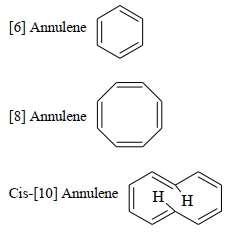
Pick an option to check your answer.
Answer & Solution
Correct Answer
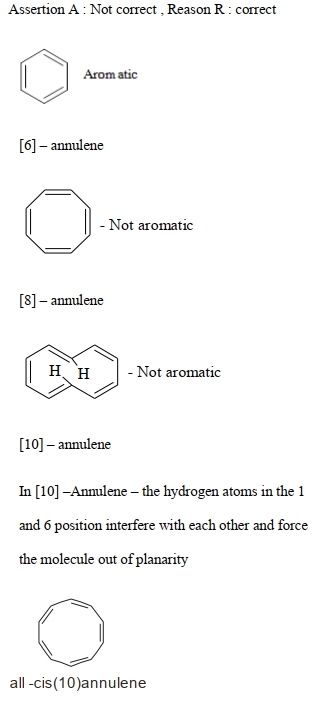
(D) \(A\) is not correct but \(R\) is correct.
Step-by-step Solution
Detailed explanation
If this annulene with five cis double bonds were planar, each internal angle would be \(144^{\circ}\). Since a normal double bond has bond angle of \(120^{\circ}\), this would be from ideal. This compound can be made but it does not adopt a planar conformation and therefore is not aromatic even though it has ten \(\pi\) electrons.
More questions from Chemistry
- Given below are two statements :
Statement I : One mole of propyne reacts with excess of sodium to liberate half a mole of \(\mathrm{H}_2\) gas.
Statement II : Four g of propyne reacts with \(\mathrm{NaNH}_2\) to liberate \(\mathrm{NH}_3\) gas which occupies 224 mL at STP.
In the light of the above statements, choose the most appropriate answer from the options given below:JEE Mains 2025 Medium - Which element is not present in Nessler's reagent?JEE Mains 2023 Hard
- Based on the equation \(\Delta E = - 2.0 \times {10^{ - 18}}\,J\left( {\frac{1}{{n_2^2}} - \frac{1}{{n_1^2}}} \right)\) the wavelength of the light that must be absorbed to excite hydrogen electron from level \(n\, = 1\) to level \(n\, = 2\) will be: \((h\, = 6.625\times10^{-34}\, J\,s,\, C\, = 3\times10^8\, m\,s^{-1})\)JEE Mains 2014 Medium
- The correct order of the rate of reaction of the following reactants with nucleophile by \(S _{ N } 1\) mechanism is :
(Given : Structure I and II are rigid)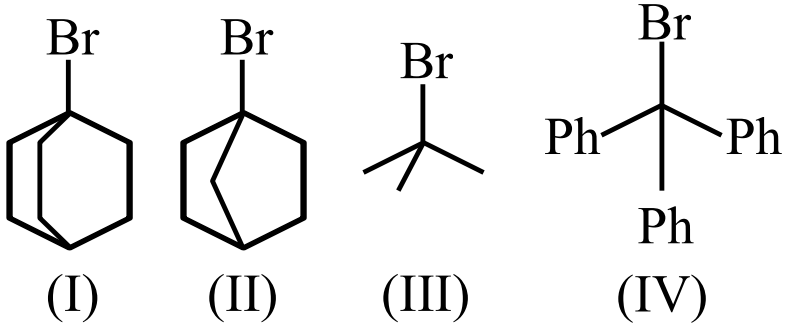 JEE Mains 2026 Hard
- Which one of the following statements regarding Henry’s law is not correct?JEE Mains 2019 Easy
- At \(T(K)\) 100 g of 98% \(H_{2}SO_{4}\) \((w/w)\) aqueous solution is mixed with 100 g of 49% \(H_{2}SO_{4}\) \((w/w)\) aqueous solution. What is the mole fraction of \(H_{2}SO_{4}\) in the resultant solution?
(Given: Atomic mass \(H=1u; S=32u; O=16u\))
(Assume that temperature after mixing remains constant)JEE Mains 2026 Easy
More PYQs from JEE Mains
- Number of complexes from the following with even number of unpaired "\(d\)" electrons is _______. \({\left[\mathrm{V}\left(\mathrm{H}_2 \mathrm{O}\right)_6\right]^{3+}, \quad\left[\mathrm{Cr}\left(\mathrm{H}_2 \mathrm{O}\right)_6\right]^{2+}, \quad\left[\mathrm{Fe}\left(\mathrm{H}_2 \mathrm{O}\right)_6\right]^{3+},}\) \({\left[\mathrm{Ni}\left(\mathrm{H}_2 \mathrm{O}\right)_6\right]^{3+},\left[\mathrm{Cu}\left(\mathrm{H}_2 \mathrm{O}\right)_6\right]^{2+}}\) [Given atomic numbers: \(\mathrm{V}=23, \mathrm{Cr}=24, \mathrm{Fe}=26\), \(\mathrm{Ni}=28, \mathrm{Cu}=29]\)JEE Mains 2024 Medium
- Given below are two statements: Statement \(I\) : In hydrogen atom, the frequency of radiation emitted when an electron jumps from lower energy orbit \(\left( E _{1}\right)\) to higher energy orbit \(\left( E _{2}\right)\), is given as \(hf = E _{1}- E _{2}\). Statement \(II\) : The jumping of electron from higher energy orbit \(\left(E_{2}\right)\) to lower energy orbit \(\left(E_{1}\right)\) is associated with frequency of radiation given as \(f\) \(=\left( E _{2}- E _{1}\right) / h\) This condition is Bohr's frequency condition. In the light of the above statements, choose the correct answer from the options given belowJEE Mains 2022 Medium
- A uniform chain of length \(3\, meter\) and mass \(3\, {kg}\) overhangs a smooth table with \(2\, meter\) laying on the table. If \(k\) is the kinetic energy of the chain in joule as it completely slips off the table, then the value of \({k}\) is (Take \(\left.g=10\, {m} / {s}^{2}\right)\)JEE Mains 2021 Hard
- Polysubstitution is a major drawback inJEE Mains 2019 Hard
- For the reaction, \(A(g) + B(g) \to C(g) + D(g),\) \(\Delta H^o\) and \(\Delta S^o\) are, respectively, \(-29.8\,\,kJ\, mol^{-1}\) and \(-0.100\,\,kJ\,K^{-1}\) \(mol^{-1}\) at \(298\,K.\) The equilibrium constant for the reaction at \(298\,K\) isJEE Mains 2016 Hard
- Consider the following data :
Heat of formation of \(\mathrm{CO}_2(\mathrm{~g})=-393.5 \mathrm{~kJ} \mathrm{~mol}^{-1}\)
Heat of formation of \(\mathrm{H}_2 \mathrm{O}(\mathrm{l})=-286.0 \mathrm{~kJ} \mathrm{~mol}^{-1}\)
Heat of combustion of benzene \(=-3267.0 \mathrm{~kJ} \mathrm{~mol}^{-1}\)
The heat of formation of benzene is _ \(\mathrm{kJ} \mathrm{mol}{ }^{-1}\). (Nearest integer)JEE Mains 2025 Medium