


JEE Mains · Physics · STD 11- 8. mechanical properties of solids
A uniformly tapering conical wire is made from a material of Young's modulus \(Y\) and has a normal, unextended length \(L.\) The radii, at the upper and lower ends of this conical wire, have values \(R\) and \(3R,\) respectively. The upper end of the wire is fixed to a rigid support and a mass \(M\) is suspended from its lower end. The equilibrium extended length, of this wire, would equal
- A \(L\left( {1 + \frac{2}{9}\frac{{Mg}}{{\pi Y{R^2}}}} \right)\)
- B \(L\left( {1 + \frac{1}{9}\frac{{Mg}}{{\pi Y{R^2}}}} \right)\)
- C \(L\left( {1 + \frac{1}{3}\frac{{Mg}}{{\pi Y{R^2}}}} \right)\)
- D \(L\left( {1 + \frac{2}{3}\frac{{Mg}}{{\pi Y{R^2}}}} \right)\)
Answer & Solution
Correct Answer
(C) \(L\left( {1 + \frac{1}{3}\frac{{Mg}}{{\pi Y{R^2}}}} \right)\)
Step-by-step Solution
Detailed explanation
Consider a small element \(dx\) of radius \(r\), \(r = \frac{{2R}}{L}x + R\) At equilibrium change in length of the wire \(\int\limits_0^l {dL = \int {\frac{{Mgdx}}{{\pi {{\left[ {\frac{{2R}}{L}x + R} \right]}^2}y}}} } \) Taking limit from \(0\) to \(L\)…
See the Complete Solution
Get step-by-step explanations for this and 2.5 Lakh+ more JEE, NEET & CET questions.
- Unlock all solutions
- Practice the full chapter
- Track accuracy across PYQs
4.8 rated on Google Play · 14,000+ reviews
More questions from Physics
- A tightly wound long solenoid carries a current of 1.5 A . An electron is executing uniform circular motion inside the solenoid with a time period of 75 ns . The number of turns per metre in the solenoid is ________.
[Take mass of electron \(\mathrm{m}_{\mathrm{e}}=9 \times 10^{-31} \mathrm{~kg}\), charge of electron \(\left|\mathrm{q}_{\mathrm{e}}\right|=1.6 \times 10^{-19} \mathrm{C}\),
\(\left.\mu_0=4 \pi \times 10^{-7} \frac{\mathrm{~N}}{\mathrm{~A}^2}, 1 \mathrm{~ns}=10^{-9} \mathrm{~s}\right]\)JEE Mains 2025 Easy - An electric dipole is formed by two equal and opposite charges \(q\) with separation \(d\). The charges the same mass \(m\). It is kept in a uniform electric field \(E\). If it slightly rotated from its equilibrium orientation, then its angular frequency \(\omega \) isJEE Mains 2019 Hard
- A diatomic gas with rigid molecules does \(10\, J\) of work when expanded at constant pressure. What would be the heat energy absorbed by the gas, in this process ..... \(J\).JEE Mains 2019 Medium
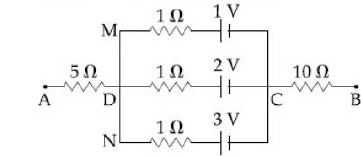
- In the circuit shown, the potential difference between \(A\) and \(B\) is ............. \(V\)
 JEE Mains 2019 Medium
 - The energy of an electron in an orbit of the Bohr's atom is \(-0.04 E _0 eV\) where \(E _0\) is the ground state energy. If \(L\) is the angular momentum of the electron in this orbit and h is the Planck's constant, then \(\frac{2 \pi L}{ h }\) is _________ :JEE Mains 2026 Easy
- Two spherical bodies of same materials having radius 0.2 m and 0.8 m are placed in same atmosphere. The temperature of the smaller body is 800 K and temperature of the bigger body is 400 K . If the energy radiated from the smaller body is E, the energy radiated from the bigger body is _________. (assume, effect of the surrounding temperature to be negligible),JEE Mains 2025 Hard
More PYQs from JEE Mains
- The area (in sq. units) of the region bounded by the curve \(x^2 = 4y\) and the straight line \(x = 4y - 2\) isJEE Mains 2019 Hard
- A mercury drop of radius \(10^{-3}\,m\) is broken into \(125\) equal size droplets. Surface tension of mercury is \(0.45\,Nm ^{-1}\). The gain in surface energy is \(......\times 10^{-5}\,J\)JEE Mains 2023 Medium
- Let \(\mathrm{H}_1: \frac{x^2}{\mathrm{a}^2}-\frac{y^2}{\mathrm{~b}^2}=1\) and \(\mathrm{H}_2:-\frac{x^2}{\mathrm{~A}^2}+\frac{y^2}{\mathrm{~B}^2}=1\) be two hyperbolas having length of latus rectums \(15 \sqrt{2}\) and \(12 \sqrt{5}\) respectively. Let their ecentricities be \(e_1=\sqrt{\frac{5}{2}}\) and \(e_2\) respectively. If the product of the lengths of their transverse axes is \(100 \sqrt{10}\), then \(25 \mathrm{e}_2^2\) is equal to ________.JEE Mains 2025 Hard
- Consider a circular coil of wire carrying constant current \(I\), forming a magnetic dipole. The magnetic flux through an infinite plane that contains the circular coil and excluding the circular coil area is given by \(\phi_{i} .\) The magnetic flux through the area of the circular coil area is given by \(\phi_{0} .\) Which of the following option is correct?JEE Mains 2020 Easy
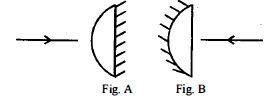
- A planoconvex lens becomes an optical system of \(28\, cm\) focal length when its plane surface is silvered and illuminated from left to right as shown in Fig \(-A\). If the same lens is instead silvered on the curved surface and illuminated from other side as in Fig. \(B\), it acts like an optical system of focal length \(10 \,cm\). The refractive index of the material of lens is
 JEE Mains 2018 Hard
 - If a semiconductor photodiode can detect a photon with a maximum wavelength of \(400\, nm ,\) then its band gap energy is Planck's constant \(h=6.63 \times 10^{-34}\, J . s\) Speed of ligh \(c =3 \times 10^{8}\, m / s\)JEE Mains 2020 Easy