


JEE Mains · Chemistry · STD 12 - Amines
- JEE Mains 2021
- Hard
- MCQ
Given below are two statements, one is labeled as Assertion \((A)\) and other is labeled as Reason \((R).\) Assertion \((A):\) Gabriel phthalimide synthesis cannot be used to prepare aromatic primary amines. Reason \((R) :\) Aryl halides do not undergo nucleophilic substitution reaction. In the light of the above statements, choose the correct answer form the options given below.
Pick an option to check your answer.
Answer & Solution
Correct Answer
(D) Both \((A)\) and \((R)\) are true and \((R)\) is correct explanation of \((A).\)
Step-by-step Solution
Detailed explanation
Gabriel pthalamide synthesis:
Aromatic halide does not gives \(\mathrm{SN}_{2}\) reaction
More questions from Chemistry
- The correct order of hydration enthalpies of alkali metal ions isJEE Mains 2019 Hard
- On complete reaction of \(FeCl _{3}\) with oxalic acid in aqueous solution containing \(KOH\), resulted in the formation of product \(A\). The secondary valency of \(Fe\) in the product \(A\) is ...... .
(Round off to the Nearest Integer).JEE Mains 2021 Easy - The number and type of bonds in \(C_2^{2 - }\) ion in \(CaC_2\) areJEE Mains 2014 Medium
- A certain orbital has \(n =4\) and \(m _{ L }=-3\). The number of radial nodes in this orbital is .......... (Round off to the Nearest Integer).JEE Mains 2021 Medium
- According to Lewis theory, the total number of \(\sigma\) bond-pairs and lone pair of electrons around the central atom of \(XeO_6^{4-}\) ion is _____.JEE Mains 2026 Medium
- The number of significant figures in \(50000.020 \times 10^{-3}\) is ..... .JEE Mains 2021 Medium
More PYQs from JEE Mains
- When \(400\, \mathrm{~mL}\) of \(0.2\, \mathrm{M} \,\mathrm{H}_{2} \mathrm{SO}_{4}\) solution is mixed with \(600\, \mathrm{~mL}\) of \(0.1\, \mathrm{M} \,\mathrm{NaOH}\) solution, the increase in temperature of the final solution is \(....\,\times 10^{-2} \,\mathrm{~K}\). (Round off to the Nearest Integer). \(\left[\right.\) Use \(: \mathrm{H}^{+}(\mathrm{aq})+\mathrm{OH}^{-}(\mathrm{aq}) \rightarrow \mathrm{H}_{2} \mathrm{O}: \Delta_{\mathrm{\gamma}} \mathrm{H}=-57.1\, \mathrm{k} \mathrm{J} \,\mathrm{mol}^{-1}\) Specific heat of \(\mathrm{H}_{2} \mathrm{O}=4.18 \mathrm{Jk}^{-} \mathrm{g}^{-}\) density of \(\mathrm{H}_{2} \mathrm{O}=1.0\, \mathrm{~g} \mathrm{~cm}^{-3}\) Assume no change in volume of solution on mixing.]JEE Mains 2021 Hard
- \(116\, g\) of a substance upon dissociation reaction, yields \(7.5 \,g\) of hydrogen, \(60 \,g\) of oxygen and \(48.5\, g\) of carbon. Given that the atomic masses of \(H , O\) and \(C\) are \(1,16\) and \(12\) respectively. The data agrees with how many formulae of the following? \((A)\) \(CH _{3} COOH\) \((B)\) \(HCHO\) \((C)\) \(CH _{3} OOCH _{3}\) \((D)\) \(CH _{3} CHO\)JEE Mains 2022 Hard
- The correct statements from the following are:
(A) Ionic radii of trivalent cations of group 13 elements decreases down the group.
(B) Electronegativity of group 13 elements decreases down the group.
(C) Among the group 13 elements, Boron has highest first ionisation enthalpy.
(D) The trichloride and triiodide of group 13 elements are covalent in nature.
Choose the correct answer from the otpions given below:JEE Mains 2026 Easy - At \(345\, K\), the half life for the decomposition of a sample of a gaseous compound initially at \(55.5\, kPa\) was \(340\, s\). When the pressure was \(27.8 \,kPa\), the half life was fund to be \(170\, s\). The order of the reaction is \(......\) [integer answer]JEE Mains 2022 Medium
- A particle of mass \('{m}'\) is moving in time \('t'\) on a trajectory given by \(\overrightarrow{{r}}=10 \alpha {t}^{2}\, \hat{{i}}+5 \beta({t}-5)\, \hat{{j}}\) Where \(\alpha\) and \(\beta\) are dimensional constants. The angular momentum of the particle becomes the same as it was for \({t}=0\) at time \({t}=\) .....\(seconds.\)JEE Mains 2021 Hard
- Uniform magnetic fields of different strengths \(\left(B_1\right.\) and \(B_2\)), both normal to the plane of the paper exist as shown in the figure. A charged particle of mass m and charge q , at the interface at an instant, moves into the region 2 with velocity \(v\) and returns to the interface. It continues to move into region 1 and finally reaches the interface. What is the displacement of the particle during this movement along the interface?
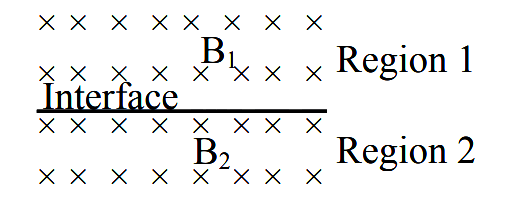
(Consider the velocity of the particle to be normal to the magnetic field and \(B_2 \gt B_1\))JEE Mains 2025 Easy