


JEE Mains · Chemistry · STD 12 - 3. Chemical kinetics
For a given chemical reaction \(\gamma_{1} A +\gamma_{2} B \rightarrow \gamma_{3} C +\gamma_{4} D\) Concentration of \(C\) changes from \(10\, mmol\) appearance of \(D\) is \(1.5\) times the rate of disappearance of \(B\) which is twice the rate of disappearance \(A\). The rate of appearance of \(D\) has been experimentally determined to be \(9 \,m\,mol\) \(dm ^{-3} s ^{-1}\). Therefore the rate of reaction is \(......\,m\,mol\, dm ^{-3} \,s ^{-1}\). (Nearest Integer)
- A \(25\)
- B \(20\)
- C \(1\)
- D \(10\)
Answer & Solution
Correct Answer
(C) \(1\)
Step-by-step Solution
Detailed explanation
\(\gamma_{1} A +\gamma_{2} B \longrightarrow \gamma_{3} C +\gamma_{4} D\) Given : \(+\frac{ d [ D ]}{ dt }=\frac{-3}{2} \frac{ d [ B ]}{ dt }\) \(\Rightarrow \frac{-1}{2} \frac{ d [ B ]}{ dt }=\frac{+1}{3} \frac{ d [ D ]}{ dt }\)…
See the Complete Solution
Get step-by-step explanations for this and 2.5 Lakh+ more JEE, NEET & CET questions.
- Unlock all solutions
- Practice the full chapter
- Track accuracy across PYQs
4.8 rated on Google Play · 14,000+ reviews
More questions from Chemistry
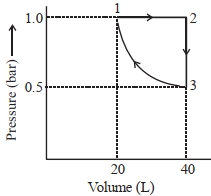
- One mole of an ideal monoatomic gas is subjected to changes as shown in the graph. The magnitude of the work done (by the system or on the system) is \(...........J\) (nearest integer). Given : \(\log 2=0.3, \ln 10=2.3\)
 JEE Mains 2023 Medium
 - Treatment of a gas '\(X\)' with a freshly prepared ferrous sulphate solution gives a compound '\(Y\)' as a brown ring. The compounds \(X\) and \(Y\) are.JEE Mains 2026 Easy
- Which of the following oxoacids of sulphur contains \("S"\) in two different oxidation states?JEE Mains 2022 Medium
- The number of moles of methane required to produce \(11 \mathrm{~g} \mathrm{CO}_2(\mathrm{~g})\) after complete combustion is _______. (Given molar mass of methane in \(\mathrm{g} \mathrm{mol}^{-1}: 16\) )JEE Mains 2024 Medium
- Correct statements for an element with atomic number 9 are
A. There can be 5 electrons for which \(\mathrm{m}_{\mathrm{s}}=+\frac{1}{2}\) and 4 electrons for which \(\mathrm{m}_{\mathrm{s}}=-\frac{1}{2}\)
B. There is only one electron in \(p_z\) orbital
C. The last electron goes to orbital with \(\mathrm{n}=2\) and \(l=1\)
4. The sum of angular nodes of all the atomic orbitals is 1.
Choose the correct answer from the options given below:JEE Mains 2025 Medium - Which amongst the following is the strongest acid?JEE Mains 2019 Medium
More PYQs from JEE Mains
- Let \(a, b \in R\). Let the mean and the variance of \(6\) observations \(-3,4,7,-6\), \(a,\ b\) be \(2\) and \(23\) , respectively. The mean deviation about the mean of these \(6\) observations is :JEE Mains 2024 Medium
- There are three co-centric conducting spherical shells \(A , B\) and C of radii \(a , b\) and c respectively. The potential of the spheres \(A , B\) and C respectively, are :JEE Mains 2026 Hard
- A variable, opposite external potential \((E_{ext})\) is applied to the cell \(Zn\,|\,Z{n^{2 + }}\,(1\,M)\,\,||\,\,C{u^{2 + }}\,(1\,M)\,|\,Cu,\) of potential \(1.1\,V.\) When \(E_{ext} < 1.1\,V\) and \(E_{ext} > 1.1\,V,\) respectively electrons flow fromJEE Mains 2015 Hard
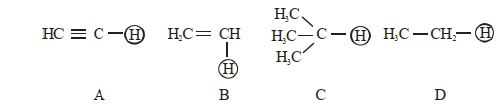
- The ascending acidity order of the following \(\mathrm{H}\) atoms is _______.
 JEE Mains 2024 Hard
 - Let the lengths of intercepts on \(x\) -axis and \(y\) -axis made by the circle \(x^{2}+y^{2}+a x+2 a y+c=0\) \((a < 0)\) be \(2 \sqrt{2}\) and \(2 \sqrt{5}\), respectively. Then the shortest distance from origin to a tangent to this circle which is perpendicular to the line \(x +2 y =0,\) is euqal to :JEE Mains 2021 Hard
- Let \(f(x)+2 f\left(\frac{1}{x}\right)=x^2+5\) and \(2 g(x)-3 g\left(\frac{1}{2}\right)=x, x \gt 0\). If \(\alpha=\int_1^2 f(x) d x\), and \(\beta=\int_1^2 g(x) d x\), then the value of \(9 \alpha+\beta\) is:JEE Mains 2025 Hard