


All STD 12 - Wave optics questions
Newest firstShowing 51–100 of 177 questions
- 51. In a single slit experiment, a parallel beam of green light of wavelength \(550 \mathrm{~nm}\) passes through a slit of width \(0.20 \mathrm{~mm}\). The transmitted light is collected on a screen \(100 \mathrm{~cm}\) away. The distance of first order minima from the central maximum will be \(\mathrm{x} \times 10^{-5} \mathrm{~m}\). The value of \(\mathrm{x}\) is _______. 2024 Hard
- 52. In a Young's double slit experiment, the intensity at a point is \(\left(\frac{1}{4}\right)^{\text {th }}\) of the maximum intensity, the minimum distance of the point from the central maximum is _______ \(\mu \mathrm{m}\). (Given : \(\lambda=600 \mathrm{~nm}, d=1.0 \mathrm{~mm}, \mathrm{D}=1.0 \mathrm{~m}\) ) 2024 Hard
- 53. In Young's double slit experiment, carried out with light of wavelength \(5000\) \(A\), the distance between the slits is \(0.3 \mathrm{~mm}\) and the screen is at \(200 \mathrm{~cm}\) from the slits. The central maximum is at \(x=0 \mathrm{~cm}\). The value of \(\mathrm{x}\) for third maxima is _______ \(\mathrm{mm}\). 2024 Hard
- 54. In Young's double slit experiment, light from two identical sources are superimposing on a screen. The path difference between the two lights reaching at a point on the screen is \(\frac{7 \lambda}{4}\). The ratio of intensity of fringe at this point with respect to the maximum intensity of the fringe is _______. 2024 Hard
- 55. In Young's double slit experiment, monochromatic light of wavelength \(5000\) \(A\) is used. The slits are \(1.0 \mathrm{~mm}\) apart and screen is placed at \(1.0 \mathrm{~m}\) away from slits. The distance from the centre of the screen where intensity becomes half of the maximum intensity for the first time is _______ \(10^{-6} \mathrm{~m}\). 2024 Hard
- 56. Light emerges out of a convex lens when a source of light kept at its focus. The shape of wavefront of the light is _______. 2024 Hard
- 57. Monochromatic light of wavelength \(500 \mathrm{~nm}\) is used in Young's double slit experiment. An interference pattern is obtained on a screen When one of the slits is covered with a very thin glass plate (refractive index \(=1.5\) ), the central maximum is shifted to a position previously occupied by the \(4^{\text {th }}\) bright fringe. The thickness of the glass-plate is _______\(\mu \mathrm{m}\). 2024 Hard
- 58. The diffraction pattern of a light of wavelength \(400\) \(\mathrm{nm}\) diffracting from a slit of width \(0.2 \mathrm{~mm}\) is focused on the focal plane of a convex lens of focal length \(100 \mathrm{~cm}\). The width of the \(1^{\text {st }}\) secondary maxima will be _______. 2024 Hard
- 59. The width of one of the two slits in a Young's double slit experiment is \(4\) times that of the other slit. The ratio of the maximum of the minimum intensity in the interference pattern is _______. 2024 Hard
- 60. Two coherent monochromatic light beams of intensities \(I\) and \(4I\) are superimposed. The difference between maximum and minimum possible intensities in the resulting beam is \(x\)I. The value of \(x\) is _______. 2024 Hard
- 61. Two slits are \(1 \mathrm{~mm}\) apart and the screen is located \(1 \mathrm{~m}\) away from the slits. A light wavelength \(500 \mathrm{~nm}\) is used. The width of each slit to obtain \(10\) maxima of the double slit pattern within the central maximum of the single slit pattern is _______ \(\times 10^{-4} \mathrm{~m}\) 2024 Hard
- 62. Two wavelengths \(\lambda_1\) and \(\lambda_2\) are used in Young's double slit experiment \(\lambda_1=450 \mathrm{~nm}\) and \(\lambda_2=650 \mathrm{~nm}\). The minimum order of fringe produced by \(\lambda_2\) which overlaps with the fringe produced by \(\lambda_1\) is \(n\). The value of \(n\) is _________. 2024 Hard
- 63. Two waves of intensity ratio \(1: 9\) cross each other at a point. The resultant intensities at the point, when (a) Waves are incoherent is \(I_1\) (b) Waves are coherent is \(I_2\) and differ in phase by \(60^{\circ}\). If \(\frac{I_1}{I_2}=\frac{10}{x}\), then \(x=\) _______. 2024 Medium
- 64. When a polaroid sheet is rotated between two crossed polaroids then the transmitted light intensity will be maximum for a rotation of : 2024 Hard
- 65. When unpolarized light is incident at an angle of \(60^{\circ}\) on a transparent medium from air. The reflected ray is completely polarized. The angle of refraction in the medium is _______. 2024 Hard
- 66. A beam of light consisting of two wavelengths \(7000\; \mathring A\) and \(5500 \;\mathring A\) is used to obtain interference pattern in Young's double slit experiment. The distance between the slits is \(2.5\,mm\) and the distance between the plane of slits and the screen is \(150\,cm\). The least distance from the central fringe, where the bright fringes due to both the wavelengths coincide, is \(n \times 10^{-5}\,m\). The value of \(n\) is ............. 2023 Medium
- 67. A scientist is observing a bacteria through a compound microscope. For better analysis and to improve its resolving power he should. (Select the best option) 2023 Medium
- 68. A single slit of width \(a\) is illuminated by a monochromatic light of wavelength \(600\,nm\). The value of \(a\) for which first minimum appears at \(\theta=30^{\circ}\) on the screen will be ........... \(\mu m\) 2023 Easy
- 69. As shown in figures, three identical polaroids \(P_1\), \(P _2\) and \(P _3\) are placed one after another. The pass axis of \(P_2\) and \(P_3\) are inclined at angle of \(60^{\circ}\) and \(90^{\circ}\) with respect to axis of \(P _1\). The source \(S\) has an intensity of \(256 \frac{ W }{ m ^2}\). The intensity of light at point \(O\) is \(...........\frac{ W }{ m ^2}\).
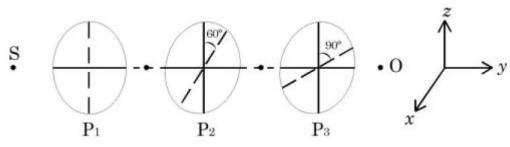 2023 Medium
- 70. As shown in the figure, in Young's double slit experiment, a thin plate of thickness \(t =10\,\mu m\) and refractive index \(\mu _{1}=1.2\) is inserted infront of slit \(S _1\). The experiment is conducted in air \((\mu=1)\) and uses a monochromatic light of wavelength \(\lambda=500\,nm\). Due to the insertion of the plate, central maxima is shifted by a distance of \(x \beta_0 . \beta_0\) is the fringe-width before the insertion of the plate.The value of the \(x\) is \(.............\)
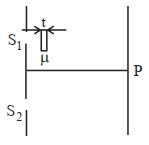 2023 Medium
- 71. Given below are two statements : Statement \(I:\) If the Brewster's angle for the light propagating from air to glass is \(\theta_{ B }\), then Brewster's angle for the light propagating from glass to air is \(\frac{\pi}{2}-\theta_B\). Statement \(II:\) The Brewster's angle for the light propagating from glass to air is \(\tan ^{-1}\left(\mu_{ g }\right)\) where \(\mu_{ g }\) is the refractive index of glass. In the light of the above statements, choose the correct answer from the options given below : 2023 Medium
- 72. In a Young's double slit experiment, the intensities at two points, for the path difference \(\frac{\lambda}{4}\) and \(\frac{\lambda}{3}\) ( \(\lambda\) being the wavelength of light used) are \(I_1\) and \(I_2\) respectively. If \(I_0\) denotes the intensity produced by each one of the individual slits, then \(\frac{ I _1+ I _2}{ I _0}=..............\) 2023 Medium
- 73. In a Young's double slit experiment, two slits are illuminated with a light of wavelength \(800 nm\). The line joining \(A _1 P\) is perpendicular to \(A _1 A _2\) as shown in the figure. If the first minimum is detected at \(P\), the value of slits separation ' \(a\) ' will be \(.........\,mm\) The distance of screen from slits \(D =5\,cm\)
 2023 Medium
- 74. In a Young's double slits experiment, the ratio of amplitude of light coming from slits is \(2: 1\). The ratio of the maximum to minimum intensity in the interference pattern is : 2023 Medium
- 75. In Young's double slit experiment, two slits \(S_1\) and \(S_2\) are ' \(d\) ' distance apart and the separation from slits to screen is \(D\) (as shown in figure). Now if two transparent slabs of equal thickness \(0.1\,mm\) but refractive index \(1.51\) and \(1.55\) are introduced in the path of beam \((\lambda=4000 \mathring A)\) from \(S_1\) and \(S_2\) respectively. The central bright fringe spot will shift by \(..........\) number of fringes.
 2023 Hard
- 76. In Young's double slits experiment, the position of \(5^{\text {th }}\) bright fringe from the central maximum is \(5\,cm\). The distance between slits and screen is \(1\,m\) and wavelength of used monochromatic light is \(600\,nm\). The separation between the slits is \(........\mu m\) 2023 Easy
- 77. \(n\) polarizing sheets are arranged such that each makes an angle \(45^{\circ}\) with the proceeding sheet. An unpolarized light of intensity \(I\) is incident into this arrangement. The output intensity is found to be \(\frac{I}{64}\). The value of \(n\) will be: 2023 Medium
- 78. The ratio of intensities at two points \(P\) and \(Q\) on the screen in a Young's double slit experiment where phase difference between two wave of same amplitude are \(\pi / 3\) and \(\pi / 2\), respectively are 2023 Medium
- 79. The width of fringe is \(2\,mm\) on the screen in a double slits experiment for the light of wavelength of \(400\,nm\). The width of the fringe for the light of wavelength \(600\,nm\) will be \(..............\,mm\) 2023 Medium
- 80. Two light waves of wavelengths \(800\) and \(600\,nm\) are used in Young's double slit experiment to obtain interference fringes on a screen placed \(7\,m\) away from plane of slits. If the two slits are separated by \(0.35\,mm\), then shortest distance from the central bright maximum to the point where the bright fringes of the two wavelength coincide will be \(.............mm\). 2023 Medium
- 81. Two polaroide \(A\) and \(B\) are placed in such a way that the pass-axis of polaroids are perpendicular to each other. Now, another polaroid \(C\) is placed between \(A\) and \(B\) bisecting angle between them. If intensity of unpolarised light is \(I _0\) then intensity of transmitted light after passing through polaroid \(B\) will be : 2023 Medium
- 82. Unpolarised light of intensity \(32\,Wm ^{-2}\) passes through the combination of three polaroids such that the pass axis of the last polaroid is perpendicular to that of the pass axis of first polaroid. If intensity of emerging light is \(3\,Wm ^{-2}\), then the angle between pass axis of first two polaroids is \(............\,^{\circ}\) 2023 Medium
- 83. A light whose electric field vectors are completely removed by using a good Polaroid, allowed to incident on the surface of the prism at Brewster's angle. Choose the most suitable option for the phenomenon related to the prism. 2022 Hard
- 84. A microscope was initially placed in air (refractive index \(1)\). It is then immersed in oil (refractive index \(2)\). For a light whose wavelength in air is \(\lambda\), calculate the change of microscope's resolving power due to oil and choose the correct option. 2022 Medium
- 85. An unpolarised light beam of intensity \(2 I _{0}\) is passed through a polaroid \(P\) and then through another polaroid \(Q\) which is oriented in such a way that its passing axis makes an angle of \(30^{\circ}\) relative to that of \(P\). The intensity of the emergent light is. 2022 Medium
- 86. For a specific wavelength \(670 \; nm\) of light coming from a galaxy moving with velocity \(v\), the observed wavelength is \(670.7 \; nm\). The value of \(v\) is ............ 2022 Medium
- 87. In a double slit experiment with monochromatic light, fringes are obtained on a screen placed at some distance from the plane of slits. If the screen is moved by \(5 \times 10^{-2} \,m\) towards the slits, the change in fringe width is \(3 \times 10^{-3} \,cm\). If the distance between the slits is \(1 \,mm\), then the wavelength of the light will be_______ \(nm\) 2022 Hard
- 88. In a Young's double slit experiment, a laser light of \(560\,nm\) produces an interference pattern with consecutive bright fringes' separation of \(7.2\,mm\). Now another light is used to produce an interference pattern with consecutive bright fringes' separation of \(8.1\,mm\). The wavelength of second light is \(......nm\) 2022 Medium
- 89. In a Young's double slit experiment, an angular width of the fringe is \(0.35^{\circ}\) on a screen placed at \(2\,m\) away for particular wavelength of \(450\,nm\). The angular width of the fringe, when whole system is immersed in a medium of refractive index \(7 / 5\), is \(\frac{1}{\alpha}\). The value of \(\alpha\) is .............. 2022 Medium
- 90. In young's double slit experiment performed using a monochromatic light of wavelength \(\lambda\), when a glass plate \((\mu=1.5)\) of thickness \(x \lambda\) is introduced in the path of the one of the interfering beams, the intensity at the position where the central maximum occurred previously remains unchanged. The value of \(x\) will be.......... 2022 Medium
- 91. In young's double slit experiment, the fringe width is \(12\,mm\). If the entire arrangement is placed in water of refractive index \(\frac{4}{3}\), then the fringe width becomes \((in\,mm)\) 2022 Medium
- 92. In Young's double slit experiment the two slits are \(0.6 \; mm\) distance apart. Interference pattern is observed on a screen at a distance \(80 \; cm\) from the slits. The first dark fringe is observed on the screen directly opposite to one of the slits. The wavelength of light will be \(\dots \; nm .\) 2022 Medium
- 93. Sodium light of wavelengths \(650\, nm\) and \(655\, nm\) is used to study diffraction at a single slit of aperture \(0.5\, mm\). The distance between the slit and the screen is \(2.0 \,m\). The separation between the positions of the first maxima of diffraction pattern obtained in the two cases is \(\times 10^{-5} \,m\) 2022 Medium
- 94. The aperture of the objective is \(24.4\,cm\). The resolving power of this telescope. If a light of wavelength \(2440 \mathring A\) is used to see the object will be 2022 Easy
- 95. The two light beams having intensities I and 9I interfere to produce a fringe pattern on a screen. The phase difference between the beams is \(\frac{\pi}{2}\) at point \(P\) and \(\pi\) at point \(Q\). Then the difference between the resultant intensities at \(P\) and \(Q\) will be.......\(I\) 2022 Medium
- 96. Two beams of light having intensities \(I\) and \(4\,I\) interfere to produce a fringe pattern on a screen. The phase difference between the two beams are \(\pi / 2\) and \(\pi / 3\) at points \(A\) and \(B\) respectively. The difference between the resultant intensities at the two points is \(x I\). The value of \(x\) will be. 2022 Medium
- 97. Two coherent sources of light interfere. The intensity ratio of two sources is \(1: 4\). For this interference pattern if the value of \(\frac{I_{\max }+I_{\min }}{I_{\max _{\max }}-I_{\min }}\) is equal to \(\frac{2 \alpha+1}{\beta+3}\), then \(\frac{\alpha}{\beta}\) will be. 2022 Hard
- 98. Two light beams of intensities \(4\,I\) and \(9\,I\) interfere on a screen. The phase difference between these beams on the screen at point \(A\) is \(zero\) and at point \(B\) is \(\pi\). The difference of resultant intensities, at the point \(A\) and \(B\), will be \(....I\). 2022 Medium
- 99. Two light beams of intensities in the ratio of \(9: 4\) are allowed to interfere. The ratio of the intensity of maxima and minima will be 2022 Medium
- 100. Using Young's double slit experiment, a monochromatic light of wavelength \(5000\,\mathring A\) produces fringes of fringe width \(0.5 \,mm\). If another monochromatic light of wavelength \(6000\,\mathring A\) is used and the separation between the slits is doubled, then the new fringe width will be ............... \(mm\) 2022 Hard
No questions on this page match these filters.