


All STD 12 - Wave optics questions
Newest firstShowing 101–150 of 177 questions
- 101. A fringe width of \(\,6 mm\) was produced for two slits separated by \(1\, mm\) apart. The screen is placed \(10\, m\) away. The wavelength of light used is \('x'\, nm.\) The value of \('x'\) to the nearest integer is 2021 Medium
- 102. A galaxy is moving away from the earth at a speed of \(286\, kms ^{-1}\). The shift in the wavelength of a red line at \(630\, nm\) is \(x \times 10^{-10}\, m\). The value of \(x ,\) to the nearest integer, is........ [Take the value of speed of light \(c,\) as \(3 \times 10^{8}\) \(\left. ms ^{-1}\right]\) 2021 Hard
- 103. A source of light is placed in front of a screen. Intensity of light on the screen is \(I.\) Two Polaroids \({P}_{1}\) and \({P}_{2}\) are so placed in between the source of light and screen that the intensity of light on screen is \({I} / 2 .\) \({P}_{2}\) should be rotated by an angle of ........ (degrees) so that the intensity of light on the screen becomes \(\frac{3 I}{8}.\) 2021 Medium
- 104. An unpolarized light beam is incident on the polarizer of a polarization experiment and the intensity of light beam emerging from the analyzer is measured as \(100\) Lumens. Now, if the analyzer is rotated around the horizontal axis (direction of light) by \(30^{\circ}\) in clockwise direction, the intensity of emerging light will be .......... Lumens. 2021 Hard
- 105. Consider the diffraction pattern obtained from the sunlight incident on a pinhole of diameter \(0.1\, \mu m\). If the diameter of the pinhole is slightly increased, it will affect the diffraction pattern such that : 2021 Hard
- 106. Given below are two statements: one is labelled as Assertion \(A\) and the other is labelled as Reason \(R\). Assertion \(A :\) An electron microscope can achieve better resolving power than an optical microscope. Reason \(R\) : The de Broglie's wavelength of the electrons emitted from an electron gun is much less than wavelength of visible light. In the light of the above statements, choose the correct answer from the options given below 2021 Medium
- 107. In a Young's double slit experiment, the slits are separated by \(0.3\, {mm}\) and the screen is \(1.5\, {m}\) away from the plane of slits. Distance between fourth bright fringes on both sides of central bright is \(2.4\, {cm}\). The frequency of light used is \(..........\,\times 10^{14} {Hz}\) 2021 Hard
- 108. In a Young's double slit experiment, the width of the one of the slit is three times the other slit. The amplitude of the light coming from a slit is proportional to the slit-width. Find the ratio of the maximum to the minimum intensity in the interference pattern. 2021 Hard
- 109. In a Young's double slit experiment two slits are separated by \(2\, mm\) and the screen is placed one meter away. When a light of wavelength \(500 \,nm\) is used, the fringe separation will be ........ \(mm\) 2021 Medium
- 110. In the Young's double slit experiment, the distance between the slits varies in time as \({d}({t})={d}_{0}+{a}_{0}\, sin\omega \,t\) ; where \({d}_{0}, \omega\) and \(a_{0}\) are constants. The difference between the largest fringe width and the smallest fringe width obtained over time is given as : 2021 Hard
- 111. In Young's double slit arrangement, slits are separated by a gap of \(0.5\, mm ,\) and the screen is placed at a distance of \(0.5\, m\) from them. The distance between the first and the third bright fringe formed when the slits are illuminated by a monochromatic light of \(5890\, A^o\) is 2021 Hard
- 112. In Young's double slit experiment, if the source of light changes from orange to blue then 2021 Medium
- 113. The difference in the number of waves when yellow light propagates through air and vacuum columns of the same thickness is one. The thickness of the air column is \(....\,{mm} .\) [Refractive index of air \(=1.0003\), wavelength of yellow light in vacuum \(=6000 \,\mathring {{A}}\) ] 2021 Hard
- 114. The light waves from two coherent sources have same intensity \({I}_{1}={I}_{2}={I}_{0} .\) In interference pattern the intensity of light at minima is zero.What will be the intensity of light at maxima? 2021 Medium
- 115. The speed of electrons in a scanning electron microscope is \(1 \times 10^{7} \,ms ^{-1}\). If the protons having the same speed are used instead of electrons, then the resolving power of scanning proton microscope will be changed by a factor of: 2021 Medium
- 116. The width of one of the two slits in a Young's double slit experiment is three times the other slit. If the amplitude of the light coming from a slit is proportional to the slit-width, the ratio of minimum to maximum intensity in the interference pattern is \(x: 4\) where \(x\) is ..... . 2021 Hard
- 117. White light is passed through a double slit and interference is observed on a screen \(1.5 \,{m}\) away. The separation between the slits is \(0.3 \,{mm}\). The first violet and red fringes are formed \(2.0 \,{mm}\) and \(3.5\, {mm}\) away from the central white fringes. The difference in wavelengths of red and voilet light is \(.... \,{nm} .\) 2021 Hard
- 118. With what speed should a galaxy move outward with respect to earth so that the sodium-D line at wavelength \(5890\) \(\stackrel{\circ}{{A}}\) is observed at \(5896\) \(\stackrel{\circ}{{A}}\) ? (in \({km} / {sec}\)) 2021 Medium
- 119. A beam of plane polarised light of large cross sectional area and uniform intensity of \(3.3 \,Wm ^{-2}\) falls normally on a polariser (cross sectional area \(3 \times 10^{-4}\, m ^{2}\) ) which rotates about its axis with an angular speed of \(31.4\, rad/s.\) The energy of light passing through the polariser per revolution, is close to ........ \( \times 10^{-4} \,J\) 2020 Hard
- 120. A polarizer - analyser set is adjusted such that the intensity of light coming out of the analyser is just \(10 \%\) of the original intensity. Assuming that the polarizer - analyser set does not absorb any light, the angle by which the analyser need to be rotated further to reduce the output intensity to be zero, is.....\(^o\) 2020 Medium
- 121. A Young's doublc\(-\)slit experiment is performed using monochromatic light of wavelength \(\lambda\). The intensity of light at a point on the screen, where the path difference is \(\lambda,\) is \(K\) units. The intensity of light at a point where the path difference is A \(\frac{\lambda}{6}\) is given by \(\frac{n K}{12},\) where \(n\) is an integer. The value of \(n\) is\(......\) 2020 Medium
- 122. Figure here shows \(P\) and \(Q\) as two equally intense coherent sources emitting radiations of wavelength \(20 \,m\). The separation \(PQ\) is \(5.0 \,m\) and phase of \(P\) is ahead of the phase of \(Q\) by \(90^{0}\). \(A, B \) and \( C\) are three distant points of observation equidistant from the mid-point of \(PQ\). The intensity of radiations at \(A, B, C\) will bear the ratio
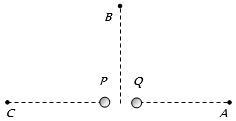 2020 Medium
- 123. In a double slit experiment, at a certain point on the screen the path difference between the two interfering waves is \(\frac{1}{8} ^{th}\) of a wavelength. The ratio of the intensity of light at that point to that at the centre of a bright fringe is 2020 Medium
- 124. In a Young's double slit experiment \(15\) fringes are observed on a small portion of the screen when light of wavelength \(500 \;\mathrm{nm}\) is used. Ten fringes are observed on the same section of the screen when another light source of wavelength \(\lambda\) is used. Then the value of \(\lambda\) is (in \(\mathrm{nm})\) 2020 Medium
- 125. In a Young's double slit experiment, \(16\) fringes are observed in a certain segment of the screen when light of wavelength \(700 \,nm\) is used. If the wavelength of light is changed to \(400 \,nm\), the number of fringes observed in the same segment of the screen would be........ 2020 Medium
- 126. In a Young's double slit experiment, light of \(500\, nm\) is used to produce an interference pattern. When the distance between the slits is \(0.05\, mm\), the angular width (in degree) of the fringes formed on the distance screen is close to\(........^o\) 2020 Medium
- 127. In a Young's double slit experiment, the separation between the slits is \(0.15\; \mathrm{mm}\). In the experiment, a source of light of wavelength \(589 \;\mathrm{nm}\) is used and the interference pattern is observed on a screen kept \(1.5\; \mathrm{m}\) away. The separation between the successive bright fringes on the screen is......\(mm\) 2020 Medium
- 128. Interference fringes are observed on a screen by illuminating two thin slits \(1 \,mm\) apart with a light source \((\lambda=632.8\, nm )\). The distance between the screen and the slits is \(100\, cm\). If a bright fringe is observed on a screen at a distance of \(1.27\, mm\) from the central bright fringe, then the path difference between the waves, which are reaching this point from the slits is close to\(....\mu m\) 2020 Hard
- 129. Orange light of wavelength \(6000 \times 10^{-10}\, m\) in illuminates a single slit of width \(0.6 \times 10^{-4}\, m\) The maximum possible number of diffraction minima produced on both sides of the central maximum is\(........\) 2020 Medium
- 130. The aperture diameter of a telescope is \(5\; \mathrm{m} .\) The separation between the moon and the earth is \(4 \times 10^{5} \;\mathrm{km} .\) With light of wavelength of \(5500\;\mathring A\), the minimum separation between objects on the surface of moon, so that they are just resolved, is close to......\(m\) 2020 Medium
- 131. Two coherent sources of sound, \(S_{1}\) and \(S_{2}\) produce sound waves of the same wavelength, \(\lambda=1\, m ,\) in phase. \(S_{1}\) and \(S_{2}\) are placed \(1.5\, m\) apart (see fig.) A listener, located at \(L,\) directly in front of \(S_{2}\) finds that the intensity is at a minimum when he is \(2\,m\) away from \(S _{2}\). The listener moves away from \(S _{1},\) keeping his distance from \(S_{2}\) fixed. The adjacent maximum of intensity is observed when the listener is at a distance \(d\) from \(S\)\(_{1}\). Then, \(d\) is\(......m\)
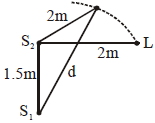 2020 Hard
- 132. Two light waves having the same wavelength \(\lambda\) in vacuum are in phase initially. Then the first wave travels a path \(L _{1}\) through a medium of refractive index \(n_{1}\) while the second wave travels a path of length \(L_{2}\) through a medium of refractive index \(n _{2}\). After this the phase difference between the two waves is: 2020 Medium
- 133. Visible light of wavelength \(6000 \times 10^{-8}\; \mathrm{cm}\) falls normally on a single slit and produces a diffraction pattern. It is found that the second diffraction minimum is at \(60^{\circ}\) from the central maximum. If the first minimum is produced at \(\theta_{1},\) then \(\theta_{1}\) is close to.....\(^o\) 2020 Medium
- 134. A system of three polarizers \(P_1, P_2, P_3\) is set up such that the pass axis of \(P_3\) is crossed with respect to that of \(P_1\). The pass axis of \(P_2\) is inclined at \(60^o\) to the pass axis of \(P_3\). When a beam of unpolarized light of intensity \(I_0\) is incident on \(P_1\), the intensity of light transmitted by the three polarizers is \(I\). The ratio \((I_0/I)\) equals (nearly) 2019 Hard
- 135. Calculate the limit of resolution of a telescope objective having a diameter of \(200\, cm\), if it has to detect light of wavelength \(500\, nm\) coming from a star 2019 Easy
- 136. Consider a tank made of glass (refractive index \(1.5\)) with a thick bottom. It is filled with a liquid of refractive index \(\mu \). A student finds that, irrespective of what the incident angle \(I\) (see figure) is for a beam of light entering the liquid, the light reflected from the liquid glass interface is never completely polarized. For this to happen, the minimum value of \(\mu \) is
 2019 Hard
- 137. Consider a Young’s double slit experiment as shown in figure. What should be the slit separation \(d\) in terms of wavelength \(\lambda \) such that the first minima occurs directly in front of the slit \((S_1)\)?
 2019 Hard
- 138. Diameter of the objective lens of a telescope is \(250\, cm\). For light of wavelength \(600\, nm\). Coming from a distant object, the limit of resolution of the telescope is close to 2019 Easy
- 139. In a double -slit experiment, green light \(\left( {5303\,\mathop A\limits^o } \right)\) falls on a double slit having a separation of \(19.44\,\mu m\) and a width of \(4.05\,\mu m\). The number of bright fringes between the first and the second diffraction minima is 2019 Hard
- 140. In a double slit experiment, when a thin film of thickness \(t\) having refractive index \(\mu \) is introduced in front of one of the slits, the maximum at the centre of the fringe pattern shifts by one fringe width. The value of \(t\) is (\(\lambda \) is the wavelength of the light used) 2019 Medium
- 141. In a Young’s double slit experiment, the path difference, at a certain point on the screen, between two interfering waves is \(1/8^{th}\) of wavelength. The ratio of the intensity at this point to that at the centre of a bright fringe is close to 2019 Medium
- 142. In a Young’s double slit experiment the ratio of the slit’s width is \(4 : 1.\) The ratio of the intensity of maxima to minima, close to central fringe on the screen will be 2019 Medium
- 143. In a Young’s double slit experiment, the slits are placed \(0.320\,mm\) apart. Light of wavelength \(\lambda = 500\,nm\) is incident on the slits. The total number of bright fringes that are observed in the angular range \( - {30^o} \le \theta \le {30^o}\) is 2019 Medium
- 144. In a Young’s double slit experiment with slit separation \(0.1\, mm\), one observes a bright fringe at angle \(\frac{1}{{40}}\, rad\) by using light of wavelength \({\lambda _1}\). When the light of wavelength \(\lambda _2\) is used a bright fringe is seen at the same angle in the same set up. Given that \({\lambda _1}\) and \({\lambda _2}\) are in visible range (\(380\, nm\) to \(740\, nm\)), their values are 2019 Medium
- 145. The figure shows a Young’s double slit experimental setup. It is observed that when a thin transparent sheet of thickness \(t\) and refractive index \(\mu \) is put in front of one of the slits, the central maximum gets shifted by a distance equal to \(n\) fringe widths. If the wavelength of light used is \(\lambda ,\,t\) will be
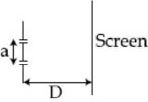 2019 Medium
- 146. The value of numerical aperature of the objective lens of a microscope is \(1.25\). If light of wavelength \(5000\,\mathop A\limits^o \) is used, the minimum separation between two points, to be seen as distinct, will be....\(\mu m\) 2019 Medium
- 147. Two coherent sources produce waves of different intensities which interfere. After interference, the ratio of the maximum intensity to the minimum intensity is \(16\). The intensity of the waves are in the ratio 2019 Medium
- 148. A plane polarized light is incident on a polariser with its pass axis making angle \(\theta\) with \(x-\) axis, as shown in the figure. At four different values of \(\theta\), \(\theta\, = 8^o, 38^o, 188^o\) and \(218^o\), the observed intensities are same. What is the angle between the direction of polarization and \(x-\) axis.....\(^o\)
 2018 Hard
- 149. Light of wavelength \(550\, nm\) falls normally on a slit of width \(22.0 \times 10^{-5}\,cm\). The angular position of the second minima from the central maximum will be (in radians) 2018 Medium
- 150. The angular width of the central maximum in a single slit diffraction pattern is \(60^o \) . The width of the slit is \(1\ \mu m\). The slit is illuminated by monochromatic plane waves. If another slit of same width is made near it, Young's fringes can be observed on a screen placed at distance \(50\ cm\) from the slits. If the observed fringe width is \(1\ cm\), what is slit separation distance?.........\(\mu m\)
(i.e. distance between the centres of each slit. ) 2018 Medium
No questions on this page match these filters.