


All STD 11 - Thermodynamics questions
Newest firstShowing 101–150 of 166 questions
- 101. A reversible heat engine converts one-fourth of the heat input into work. When the temperature of the sink is reduced by \(52\, K\), its efficiency is doubled. The temperature in Kelvin of the source will be ...... . 2021 Medium
- 102. A sample of gas with \(\gamma=1.5\) is taken through an adiabatic process in which the volume is compressed from \(1200\, {cm}^{3}\) to \(300\, {cm}^{3}\). If the initial pressure is \(200\, {kPa}\). The absolute value of the workdone by the gas in the process \(= \,..... J.\) 2021 Hard
- 103. An electric appliance supplies \(6000\, {J} / {min}\) heat to the system. If the system delivers a power of \(90\, {W}\). How long (in \(sec\)) it would take to increase the internal energy by \(2.5 \times 10^{3}\, {J}\) ? 2021 Medium
- 104. For an adiabatic expansion of an ideal gas, the fractional change in its pressure is equal to (where \(\gamma\) is the ratio of specific heats): 2021 Medium
- 105. For an ideal heat engine, the temperature of the source is \(127\,^{\circ} C\). In order to have \(60\, \%\) efficiency the temperature of the sink should be \(........\,{ }^{\circ} C\). (Round off to the Nearest Integer) 2021 Medium
- 106. If one mole of an ideal gas at \(\left( P _{1}, V _{1}\right)\) is allowed to expand reversibly and isothermally (\(A\) to \(B\) ) its pressure is reduced to one-half of the original pressure (see \(figure\)). This is followed by a constant volume cooling till its pressure is reduced to one-fourth of the initial value \(( B \rightarrow C ) .\) Then it is restored to its initial state by a reversible adiabatic compression (\(C\) to \(A\)). The net workdone by the gas is equal to ...... .
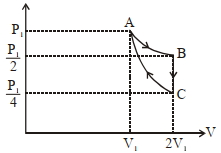 2021 Hard
- 107. In a certain thermodynamical process, the pressure of a gas depends on its volume as \(kV ^{3}\). The work done when the temperature changes from \(100^{\circ} C\) to \(300^{\circ} C\) will be .......... \(nR\), where \(n\) denotes number of moles of a gas. 2021 Hard
- 108. In the reported figure, heat energy absorbed by a system in going through a cyclic process is \(......\,\pi J\)
 2021 Medium
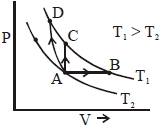
- 109. In the reported figure, there is a cyclic process \(ABCDA\) on a sample of \(1\, {mol}\) of a diatomic gas. The temperature of the gas during the process \({A} \rightarrow {B}\) and \({C} \rightarrow {D}\) are \({T}_{1}\) and \({T}_{2}\left({T}_{1}\,>\,{T}_{2}\right)\) respectively. Choose the correct option out of the following for work done if processes \(B C\) and \(D A\) are adiabatic.
 2021 Medium
- 110. In thermodynamics, heat and work are 2021 Medium
- 111. Match List\(-I\) with List\(-II\)
Choose the correct answer from the options given below 2021 MediumList\(-I\) List\(-II\) \((a)\) Isothermal \((i)\) Pressure constant \((b)\) Isochoric \((ii)\) Temperature constant \((c)\) Adiabatic \((iii)\) Volume constant \((d)\) Isobaric \((iv)\) Heat content is constant - 112. \(n\) mole a perfect gas undergoes a cyclic process \(ABCA\) (see figure) consisting of the following processes. \(A \rightarrow B :\) Isothermal expansion at temperature \(T\) so that the volume is doubled from \(V _{1}\) to \(V _{2}=2 V _{1}\) and pressure changes from \(P _{1}\) to \(P _{2}\) \(B \rightarrow C :\) Isobaric compression at pressure \(P _{2}\) to initial volume \(V _{1}\) \(C \rightarrow A\) : Isochoric change leading to change of pressure from \(P _{2}\) to \(P _{1}\) Total workdone in the complete cycle \(ABCA\) is
 2021 Hard
- 113. One mole of an ideal gas at \(27^{\circ} {C}\) is taken from \({A}\) to \({B}\) as shown in the given \({PV}\) indicator diagram. The work done by the system will be \(......\times 10^{-1} \,{J}\) [Given : \(R=8.3\, {J} /\,mole\,{K}, \ln 2=0.6931\) ] (Round off to the nearest integer)
 2021 Medium
- 114. One mole of an ideal gas is taken through an adiabatic process where the temperature rises from \(27^{\circ} {C}\) to \(37^{\circ} {C}\). If the ideal gas is composed of polyatomic molecule that has \(4\) vibrational modes which of the following is true? 2021 Medium
- 115. The amount of heat needed to raise the temperature of \(4\, moles\) of a rigid diatomic gas from \(0^{\circ} {C}\) to \(50^{\circ} {C}\) when no work is done is ......\({R}\) (\(R\) is the universal gas constant) 2021 Medium
- 116. The \(P-V\) diagram of a diatomic ideal gas system going under cyclic process as shown in figure. The work done during an adiabatic process \(CD\) is (use \(\gamma=1.4\)) (in \(J\))
 2021 Medium
- 117. The temperature of \(3.00\, {mol}\) of an ideal diatomic gas is increased by \(40.0^{\circ} {C}\) without changing the pressure of the gas. The molecules in the gas rotate but do not oscillate. If the ratio of change in internal energy of the gas to the amount of workdone by the gas is \(\frac{{x}}{10} .\) Then the value of \({x}\) (round off to the nearest integer) is ..... . \(\left(\right.\) Given \(\left.{R}=8.31\, {J} {mol}^{-1} {K}^{-1}\right)\) 2021 Medium
- 118. The volume \(V\) of a given mass of monoatomic gas changes with temperature \(T\) according to the relation \(V = KT ^{2 / 3}\). The workdone when temperature changes by \(90\, K\) will be \(x\,R\). The value of \(x\) is \([ R =\) universal gas constant \(]\) 2021 Hard
- 119. Thermodynamic process is shown below on a \(P-V\) diagram for one mole of an ideal gas. If \(V _{2}=2 V _{1}\) then the ratio of temperature \(T _{2} / T _{1}\) is ...... .
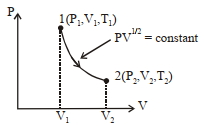 2021 Hard
- 120. Two carnot engines \(A\) and \(B\) operate in series such that engine \(A\) absorbs heat at \(T_{1}\) and rejects heat to a sink at temperature \(T\). Engine \(B\) absorbs half of the heat rejected by engine \(A\) and rejects heat to the sink at \({T}_{3}\). When workdone in both the cases is equal, the value of \({T}\) is 2021 Hard
- 121. Which one is the correct option for the two different thermodynamic processes ?
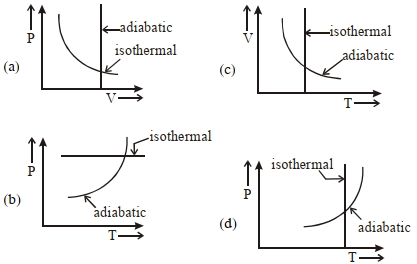 2021 Medium
- 122. A balloon filled with helium \(\left(32^{\circ} C \right.\) and \(1.7\; atm\).) bursts. Immediately afterwards the expansion of helium can be considered as 2020 Medium
- 123. A Carnot engine operates between two reservoirs of temperatures \(900\; \mathrm{K}\) and \(300 \;\mathrm{K}\) The engine performs \(1200\; \mathrm{J}\) of work per cycle. The heat energy (in \(\mathrm{J}\) ) delivered by the engine to the low temperature reservoir, in a cycle. is 2020 Medium
- 124. A closed vessel contains \(0.1\) mole of a monoatomic ideal gas at \(200\, K\). If \(0.05\) mole of the same gas at \(400\, K\) is added to it, the final equilibrium temperature (in \(K\) ) of the gas in the vessel will be closed to 2020 Medium
- 125. A heat engine is involved with exchange of heat of \(1915\, J,\) \(-40\, J ,+125\, J\) and \(-Q\,J\), during one cycle achieving an efficiency of \(50.0 \%\). The value of \(Q\) is.......\(J\) 2020 Medium
- 126. A litre of dry air at \(STP\) expands adiabatically to a volume of \(3\) litres. If \(\gamma=1.40,\) the work done by air is\((3^{1.4}=4.6555)\) [Take air to be an ideal gas \(]\) 2020 Medium
- 127. An engine operates by taking a monatomic ideal gas through the cycle shown in the figure. The percentage efficiency of the engine is close to \(.......\%\)
 2020 Hard
- 128. An engine takes in \(5\) moles of air at \(20\,^{\circ} C\) and \(1\) \(atm,\) and compresses it adiabaticaly to \(1 / 10^{\text {th }}\) of the original volume. Assuming air to be a diatomic ideal gas made up of rigid molecules, the change in its internal energy during this process comes out to be \(X\, kJ\). The value of \(X\) to the nearest integer is 2020 Hard
- 129. If minimum possible work is done by a refrigerator in converting \(100\; grams\) of water at \(0^{\circ} C\) to ice, how much heat (in calories) is released to the surrounding at temperature \(27^{\circ} C\) (Latent heat of ice \(=80 Cal / gram\) ) to the nearest integer? 2020 Medium
- 130. In an adiabatic process, the density of a diatomic gas becomes \(32\) times its initial value. The final pressure of the gas is found to be \(n\) times the initial pressure. The value of \(n\) is 2020 Medium
- 131. Match the thermodynamic processes taking place in a system with the correct conditions. In the table: \(\Delta Q\) is the heat supplied, \(\Delta W\) is the work done and \(\Delta U\) is change in internal energy of the system
2020 MediumProcess Condition \((I)\) Adiabatic \((A)\; \Delta W =0\) \((II)\) Isothermal \((B)\; \Delta Q=0\) \((III)\) Isochoric \((C)\; \Delta U \neq 0, \Delta W \neq 0 \Delta Q \neq 0\) \((IV)\) Isobaric \((D)\; \Delta U =0\) - 132. Starting at temperature \(300\; \mathrm{K},\) one mole of an ideal diatomic gas \((\gamma=1.4)\) is first compressed adiabatically from volume \(\mathrm{V}_{1}\) to \(\mathrm{V}_{2}=\frac{\mathrm{V}_{1}}{16} .\) It is then allowed to expand isobarically to volume \(2 \mathrm{V}_{2} \cdot\) If all the processes are the quasi-static then the final temperature of the gas (in \(\left. \mathrm{K}\right)\) is (to the nearest integer) 2020 Hard
- 133. Three different processes that can occur in an ideal monoatomic gas are shown in the \(P\) vs \(V\) diagram. The paths are labelled as \(A \rightarrow B, A \rightarrow C\) and \(A \rightarrow D .\) The change in internal energies during these process are taken as \(E _{ AB }, E _{ AC }\) and \(E _{ AD }\) and the work done as \(W _{ AB }\) \(W _{ AC }\) and \(W _{ AD }\) The correct relation between these parameters are
 2020 Hard
- 134. Two ideal Carnot engines operate in cascade (all heat given up by one engine is used by the other engine to produce work) between temperatures, \(\mathrm{T}_{1}\) and \(\mathrm{T}_{2} .\) The temperature of the hot reservoir of the first engine is \(\mathrm{T}_{1}\) and the temperature of the cold reservoir of the second engine is \(\mathrm{T}_{2} . T\) is temperature of the sink of first engine which is also the source for the second engine. How is \(T\) related to \(\mathrm{T}_{1}\) and \(\mathrm{T}_{2}\), if both the engines perform equal amount of work? 2020 Medium
- 135. A diatomic gas with rigid molecules does \(10\, J\) of work when expanded at constant pressure. What would be the heat energy absorbed by the gas, in this process ..... \(J\). 2019 Medium
- 136. A gas can be taken from \(A\) to \(B\) via two different processes \(ACB\) and \(ADB\). When path \(ACB\) is used \(60\, J\) of heat flows into the system and \(30\, J\) of work is done by the system. If path \(ADB\) is used work down by the system is \(10\, J\). the heat flow into the system in path \(ADB\) is ..... \(J\)
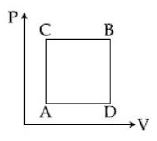 2019 Medium
- 137. A rigid diatomic ideal gas undergoes an adiabatic process at room temperature. The rational between temperature and volume for the process is \(TV^x =\) constant, then \(x\) is 2019 Medium
- 138. A sample of an ideal gas is taken through the cyclic process \(abca\) as shown in the figure. The change in the internal energy of the gas along the path \(ca\) is \(-180\, J\). The gas absorbs \(250\, J\) of heat along the path \(ab\) and \(60\, J\) along the path \(bc\). The work done by the gas along the path \(abc\) is ..... \(J\)
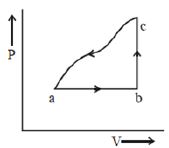 2019 Medium
- 139. Following figure shows two processes \(A\) and \(B\) for a gas. If \(\Delta Q_A\) and \(\Delta Q_B\) are the amount of heat absorbed by the system in two cases, and \(\Delta U_A\) and \(\Delta U_B\) are changes in internal energies, respectively, then
 2019 Medium
- 140. For the given cyclic process \(CAB\) as shown for a gas, the work done is ..... \(J\)
 2019 Easy
- 141. Given that \(1\,g\) of water in liquid phase has volume \(1\,cm^3\) and in vapour phase \(1671\, cm^3\) at atmospheric pressure and the latent heat of vaporization of water is \(2256\,J/g;\) the change in the internal energy in joules for \(1\,g\) of water at \(373\,K\) when it changes from liquid phase to vapour phase at the same temperature is ....... \(J\) 2019 Medium
- 142. In a process, temperature and volume of one mole of an ideal monoatomic gas are varied according to the relation \(VT = K\), where \(I\) is a constant. In this process the temperature of the gas is increased by \(\Delta T\). The amount of heat absorbed by gas is (\(R\) is gas constant) 2019 Hard
- 143. \(n-\) \(moles\) of an ideal gas with constant volume heat capacity \(C_v\) undergo an isobaric expansion by certain volume. The ratio of the work done in the process, to the heat supplied is 2019 Medium
- 144. The given diagram shows four processes i.e., isochoric, isobaric, isothermal and adiabatic. The correct assignment of the processes, in the same order is given by
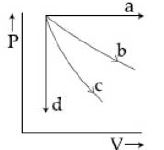 2019 Medium
- 145. Three Carnot engines operate in series between a heat source at a temperature \(T_1\) and a heat sink at temperature \(T_4\) (see figure). There are two other reservoirs at temperature \(T_2\) and \(T_3\), as shown, with \(T_1 > T_2 > T_3 > T_4\). The three engines are equally efficient if
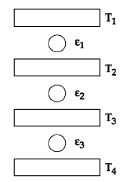 2019 Hard
- 146. Two Carnot engines \(A\) and \(B\) are operated in series. The first one, \(A,\) receives heat at \(T_1(= 600\,K)\) and rejects to a reservoir at temperature \(T_2.\) The second engine \(B\) receives heat rejected by the first engine and, in turns, rejects to a heat reservoir at \(T_3 (=400\,K).\) Calculate the temperature \(T_2\) if the work outputs of the two engines are equal ..... \(K\) 2019 Medium
- 147. A Carnot's engine works as a refrigerator between \(250\, K\) and \(300\, K\). It receives \(500\, cal\) heat from the reservoir at the lower temperature. The amount of work done in each cycle to operate the refrigerator is ..... \(J\) 2018 Medium
- 148. One mole of an ideal monoatomic gas is compressed isothermally in a rigid vessel to double its pressure at room temperature, \(27\,^oC\).The work done on the gas will be 2018 Medium
- 149. One mole of an ideal monoatomic gas is taken along the path \(ABCA\) as shown in the \(PV\) diagram. The maximum temperature attained by the gas along the path \(BC\) is given by
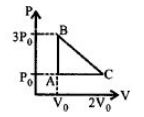 2018 Hard
- 150. Two Carnot engines \(A\) and \(B\) are operated in series. Engine \(A\) receives heat from a reservoir at \(600\,K\) and rejects heat to a reservoir at temperature \(T\). Engine \(B\) receives; heat rejected by engine \(A\) and in turn rejects it to a reservoir at \(100\,K\). If the efficiencies of the two engines \(A\) and \(B\) are represented by \({\eta _A}\) and \({\eta _B}\) respectively, then what is the value of \(\frac{{{\eta _A}}}{{{\eta _B}}}\) 2018 Hard
No questions on this page match these filters.