


All STD 11 - Kinetic theory of gases questions
Newest firstShowing 101–150 of 164 questions
- 101. Given below are two statements: Statement \(I :\) In a diatomic molecule, the rotational energy at a given temperature obeys Maxwell's distribution. Statement \(II :\) In a diatomic molecule, the rotational energy at a given temperature equals the translational kinetic energy for each molecule. In the light of the above statements, choose the correct answer from the options given below: 2021 Medium
- 102. If one mole of the polyatomic gas is having two vibrational modes and \(\beta\) is the ratio of molar specific heats for polyatomic gas \(\left(\beta=\frac{ C _{ P }}{ C _{ v }}\right)\) then the value of \(\beta\) is: 2021 Hard
- 103. If the \(rms\) speed of oxygen molecules at \(0^{\circ} {C}\) is \(160\; {m} / {s}\), find the rms speed of hydrogen molecules at \(0^{\circ} {C}\). (In \({m}/{s}\)) 2021 Medium
- 104. On the basis of kinetic theory of gases, the gas exerts pressure because its molecules: 2021 Medium
- 105. The average translational kinetic energy of \({N}_{2}\) gas molecules at \(\ldots \ldots \ldots . .{ }^{\circ} {C}\) becomes equal to the \({K} . {E}\). of an electron accelerated from rest through a potential difference of \(0.1\) \(volt.\) \(\left(\right.\) Given \(\left.{k}_{{B}}=1.38 \times 10^{-23} \, {J} / {K}\right)\) (Fill the nearest integer). 2021 Medium
- 106. The internal energy \((U),\) pressure \((P)\) and volume \(( V )\) of an ideal gas are related as \(U =\) \(3 P V+4\). The gas is :- 2021 Hard
- 107. The number of molecules in one litre of an ideal gas at \(300 \,{K}\) and \(2\) atmospheric pressure with mean kinetic energy \(2 \times 10^{-9}\, {J}\) per molecules is \(....\, \times 10^{11}\) 2021 Medium
- 108. The \(rms\) speeds of the molecules of Hydrogen, Oxygen and Carbondioxide at the same temperature are \({V}_{{H}}, {V}_{0}\) and \({V}_{{C}}\) respectively then 2021 Medium
- 109. The root mean square speed of molecules of a given mass of a gas at \(27^{\circ} C\) and \(1\) atmosphere pressure is \(200\, ms ^{-1}\). The root mean square speed of molecules of the gas at \(127^{\circ} C\) and \(2\) atmosphere pressure is \(\frac{ x }{\sqrt{3}}\, ms ^{-1} .\) The value of \(x\) will be ......\(ms ^{-1} .\) 2021 Hard
- 110. The volume \(V\) of an enclosure contains a mixture of three gases, \(16\, g\) of oxygen, \(28\, g\) of nitrogen and \(44\, g\) of carbon dioxide at absolute temperature \(T\). Consider \(R\) as universal gas constant. The pressure of the mixture of gases is 2021 Medium
- 111. Two ideal polyatomic gases at temperatures \(T _{1}\) and \(T _{2}\) are mixed so that there is no loss of energy. If \(F _{1}\) and \(F _{2}, m _{1}\) and \(m _{2}, n _{1}\) and \(n _{2}\) be the degrees of freedom, masses, number of molecules of the first and second gas respectively, the temperature of mixture of these two gases is 2021 Hard
- 112. What will be the average value of energy along one degree of freedom for an ideal gas in thermal equilibrium at a temperature \(T \,?\left( k _{ B }\right.\) is Boltzmann constant) 2021 Medium
- 113. A gas mixture consists of \(3\) moles of oxygen and \(5\) moles of argon at temperature \(T\). Assuming the gases to be ideal and the oxygen bond to be rigid, the total internal energy (in units of \(RT\) ) of the mixture is 2020 Medium
- 114. An ideal gas in a closed container is slowly heated. As its temperature increases, which of the following statements are true\(?\) \((A)\) the mean free path of the molecules decreases. \((B)\) the mean collision time between the molecules decreases. \((C)\) the mean free path remains unchanged. \((D)\) the mean collision time remains unchanged. 2020 Medium
- 115. Consider a gas of triatomic molecules. The molecules are assumed to the triangular and made of massless rigid rods whose vertices are occupied by atoms. The internal energy of a mole of the gas at temperature \(T\) is \(......RT\)
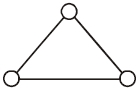 2020 Medium
- 116. Consider a mixture of \(n\) moles of helium gas and \(2 n\) moles of oxygen gas (molecules taken to be rigid) as an ideal gas. Its \(\frac{\mathrm{C}_{\mathrm{P}}}{\mathrm{C}_{\mathrm{V}}}\) value will be 2020 Medium
- 117. Consider two ideal diatomic gases \(\mathrm{A}\) and \(\mathrm{B}\) at some temperature \(T\). Molecules of the gas \(A\) are rigid, and have a mass \(m\). Molecules of the gas \(\mathrm{B}\) have an additional vibrational mode, and have a mass \(\frac{\mathrm{m}}{4} .\) The ratio of the specific heats \((\mathrm{C}_{\mathrm{v}}^{\mathrm{A}}\) and \(\mathrm{C}_{\mathrm{v}}^{\mathrm{B}})\) of gas \(\mathrm{A}\) and \(\mathrm{B}\), respectively is 2020 Medium
- 118. In a dilute gas at pressure \(P\) and temperature \(T\), the mean time between successive collisions of a molecule varies with \(T\) as 2020 Medium
- 119. Initially a gas of diatomic molecules is contained in a cylinder of volume \(V _{1}\) at a pressure \(P_{1}\) and temperature \(250\, K\). Assuming that \(25 \%\) of the molecules get dissociated causing a change in number of moles. The pressure of the resulting gas at temperature \(2000\, K ,\) when contained in a volume \(2 V _{1}\) is given by \(P _{2}\). The ratio \(\frac{P _{2}}{ P _{1}}\) is. 2020 Medium
- 120. Match the \(\frac{C _{ P }}{ C _{ v }}\) ratio for ideal gases with different type of molecules
2020 MediumMoleculae type \(\frac{C _{ P }}{ C _{ v }}\) \((A)\) Monoatomic \((I)\) \(\frac{7}{ 5}\) \((B)\) Diatomic rigid molecules \((II)\) \(\frac{9}{7}\) \((C)\) Diatomic non-rigid molecules \((III)\) \(\frac{4}{3}\) \((D)\) Triatomic rigid molecules \((IV)\) \(\frac{5}{3}\) - 121. Molecules of an ideal gas are known to have three translational degrees of freedom and two rotational degrees of freedom. The gas is maintained at a temperature of \(T\). The total internal energy, \(U\) of a mole of this gas, and the value of \(\gamma\left(=\frac{ C _{ P }}{ C _{ v }}\right)\) given, respectively, by 2020 Medium
- 122. Nitrogen gas is at \(300^{\circ} C\) temperature. The temperature (in \(K\)) at which the \(rms\) speed of a \(H _{2}\), molecule would be equal to the \(rms\) speed of a nitrogen molecule, is........ (Molar mass of \(N _{2}\) gas \(28\, g\) ) 2020 Medium
- 123. Number of molecules in a volume of \(4\, cm ^{3}\) of a perfect monoatomic gas at some temperature \(T\) and at a pressure of \(2\, cm\) of mercury is close to \(?\) (Given, mean kinetic energy of a molecule (at \(T\) ) is \(4 \times 10^{-14}\) erg, \(g=980\, cm / s ^{2}\), density of mercury \(=13.6\, g / cm ^{3}\)) 2020 Medium
- 124. The change in the magnitude of the volume of an ideal gas when a small additional pressure \(\Delta P\) is applied at a constant temperature, is the same as the change when the temperature is reduced by a small quantity \(\Delta T\) at constant pressure. The initial temperature and pressure of the gas were \(300\, K\) and \(2\; atm\) respectively. If \(|\Delta T|=C|\Delta P|\) then value of \(C\) in \((K / a t m)\) is...... 2020 Hard
- 125. To raise the temperature of a certain mass of gas by \(50^{\circ} C\) at a constant pressure, \(160\) calories of heat is required. When the same mass of gas is cooled by \(100^{\circ} C\) at constant volume, \(240\) calories of heat is released. How many degrees of freedom does each molecule of this gas have (assume gas to be ideal) \(?\) 2020 Medium
- 126. Two gases-argon (atomic radius \(0.07 \;\mathrm{nm}\),atomic weight \(40\) ) and xenon (atomic radius \(0.1\; \mathrm{nm},\) atomic weight \(140\) ) have the same number density and are at the same temperature. The raito of their respective mean free times is closest to 2020 Medium
- 127. Two moles of an ideal gas with \(\frac{\mathrm{C}_{\mathrm{P}}}{\mathrm{C}_{\mathrm{V}}}=\frac{5}{3}\) are mixed with \(3\) moles of another ideal gas with \(\frac{\mathrm{C}_{\mathrm{P}}}{\mathrm{C}_{\mathrm{V}}}=\frac{4}{3} .\) The value of \(\frac{\mathrm{C}_{\mathrm{P}}}{\mathrm{C}_{\mathrm{V}}}\) for the mixture is 2020 Hard
- 128. Under an adiabatic process, the volume of an ideal gas gets doubled. Consequently the mean collision time between the gas molecule changes from \(\tau_{1}\) to \(\tau_{2} .\) If \(\frac{C_{p}}{C_{v}}=\gamma\) for this gas then a good estimate for \(\frac{\tau_{2}}{\tau_{1}}\) is given by : 2020 Hard
- 129. \(2\, kg\) of a monoatomic gas is at a pressure of \(4\times10^4\, N/m^2\). The density of the gas is \(8\, kg/m^3\). What is the order of energy of the gas due to its thermal motion ? 2019 Medium
- 130. \(2\, moles\) of helium gas is mixed with \(3\, moles\) of hydrogen molecules (taken to be rigid). What is the molar specific heat of mixture at constant volume ....... \(J/mol\, K\) ? \((R = 8.3\, J/mol\, K)\) 2019 Hard
- 131. A \(15\,g\) mass of nitrogen gas is enclosed in a vessel at a temperature \(27\,^oC.\) Amount of heat transferred to the gas, so that rms velocity of molecules is doubled, is about ...... \(kJ\) [Take \(R = 8.3\,J/K\,mole\) ] 2019 Medium
- 132. A \(25\times10^{-3}\, m^3\) volume cylinder is filled with \(1\, mol\) of \(O_2\) gas at room temperature \((300\, K)\). The molecular diameter of \(O_2\), and its root mean square speed, are found to be \(0.3\, nm\) and \(200\, m/s\), respectively. What is the average collision rate (per second) for an \(O_2\) molecule? 2019 Hard
- 133. A cylinder with fixed capacity of \(67.2\, lit\) contains helium gas at \(STP\). The amount of heat needed to raise the temperature of the gas by \(20\,^oC\) is ..... \(J\) [Given that \(R = 8.31\, J\, mol^{-1}\, K^{-1}\)] 2019 Medium
- 134. A gas mixture consists of \(3\,moles\) of oxygen and \(5\,moles\) or argon at temperature \(T.\) Considering only translational and rotational modes, the total internal energy of the system is 2019 Medium
- 135. A mixture of \(2\, moles\) of helium gas (atomic mass \(= 4\, u\)), and \(1\, mole\) of argon gas (atomic mass \(= 40\, u\)) is kept at \(300\, K\) in a container. The ratio of their rms speeds \(\left[ {\frac{{{V_{rms}}{\rm{(helium)}}}}{{{V_{rms}}{\rm{(argon)}}}}} \right]\), is close to 2019 Medium
- 136. A vertical closed cylinder is separated into two parts by a frictionless piston of mass \(m\) and of negligible thickness. The piston is free to move along the length of the cylinder .The length of the cylinder above the piston is \(l_1,\) and that below the piston is \(l_2,\) such that \(l_1 > l_2.\) Each part of the cylinder contains \(n\) moles of an ideal gas at equal temperature \(T.\) If the piston is stationary, its mass, \(m,\) will be given by: ( \(R\) is universal gas constant and \(g\) is the acceleration due to gravity) 2019 Hard
- 137. An \(HCl\) molecule has rotational, translational and vibrational motions. If the \(rms\) velocity of \(HCl\) molecules in its gaseous phase is \(\bar v ,\,m\) is its mass and \(k_B\) is Boltzmann constant, then its temperature will be 2019 Medium
- 138. An ideal gas is enclosed in a cylinder at pressure of \(2\,atm\) and temperature, \(300\,K.\) The mean time between two successive collisions is \(6 \times 10^{-8}\, s.\) If the pressure is doubled and temperature is increased to \(500\,K,\) the mean time between two successive collisions will be close to 2019 Hard
- 139. An ideal gas occupies a volume of \(2\, m^3\) at a pressure of \(3\times10^6\, Pa\). The energy of the gas is 2019 Medium
- 140. For a given gas at \(1\,atm\) pressure, \(rms\) speed of the molecules is \(200\,m/s\) at \(127\,^oC.\) At \(2\,atm\) pressure and at \(227\,^oC,\) the \(rms\) speed of the molecules will be 2019 Medium
- 141. If \(10^{22}\) gas molecules each of mass \(10^{-26}\, kg\) collide with a surface (perpendicular to it)elastically per second over an area \(1\, m^2\) with a speed \(10^4\,m/s\), the pressure exerted by the gas molecules will be of the order of 2019 Medium
- 142. One mole of an ideal gas passes through a process where pressure and volume obey the relation \(P\, = {P_0}\,\left[ {1 - \frac{1}{2}{{\left( {\frac{{{V_0}}}{V}} \right)}^2}} \right]\). Here \(P_0\) and \(V_0\) are constants. Calculate the change in the temperature of the gas if its volume change from \(V_0\) to \(2V_0\) 2019 Hard
- 143. The number density of molecules of a gas depends on their distance \(r\) from the origin as, \(n\left( r \right) = {n_0}{e^{ - \alpha {r^4}}}\). Then the total number of molecules is proportional to 2019 Hard
- 144. The specific heats, \(C_P\) and \(C_V\) of a gas of diatomic molecules, \(A\), are given (in units of \(J\, mol^{-1}\, K^{-1}\)) by \(29\) and \(22\), respectively. Another gas of diatomic molecules \(B\), has the corresponding values \(30\) and \(21\). If they are treated as ideal gases, then 2019 Hard
- 145. The temperature, at which the root mean square velocity of hydrogen molecules equals their escape velocity from the earth is closest to : [Boltzmans Constant \(k_B = 1.38\times10^{-23}\, J / K\) Avogadro number \(N_A = 6.02\times10^{26}\, / kg\) Radius of Earth \(: 6.4\times10^6\, m\) Gravitation acceleration on Earth \(= 10\, ms^{-2}\)] 2019 Medium
- 146. When heat \(Q\) is supplied to a diatomic gas of rigid molecules at constant volume its temperature increases by \(\Delta T.\) The heat required to produce the same change in temperature, at constant pressure is 2019 Medium
- 147. The value closest to the thermal velocity of a Helium atom at room temperature \((300\,K)\)in \(ms^{-1}\) is \([k_B\, = 1 .4\times10^{-23}\,J/K;\, m_{He}\, = 7\times10^{-27}\,kg]\) 2018 Medium
- 148. Two moles of helium are mixed with \(n\) with moles of hydrogen. If \(\frac{{{C_P}}}{{{C_V}}}\, = \,\frac{3}{2}\) for the mixture, then the value of \(n\) is 2018 Hard
- 149. An ideal gas has molecules with \(5\,\) degrees of freedom. The ratio of specific heats at constant pressure \((C_p)\) and at constant volume \((C_v)\) is 2017 Easy
- 150. \(c_P\) and \(c_V\) are specific heats at constant pressure and constant volume respectively. It is observed that \(c_P - c_V = a\) for hydrogen gas \(c_P - c_V = b\) for nitrogen gas The correct relation between \(a\) and \(b\) is 2017 Medium
No questions on this page match these filters.