


All STD 11 - Kinetic theory of gases questions
Newest firstShowing 151–164 of 164 questions
- 151. \(N\,moles\) of a diatomic gas in a cylinder are at a temperature \(T\). Heat is supplied to the cylinder such that the temperature remains constant but \(n\,moles\) of the diatomic gas get converted into monoatomic gas. What is the change in the total kinetic energy of the gas ? 2017 Medium
- 152. The temperature of an open room of volume \(30\ m^3\) increases from \(17^o C\) to \(27vC\) due to sunshine. The atmospheric pressure in the room remains \(1 \times 10^5\ Pa\). Ifni and nr are the number of molecules in the room before and after heating, then \(n_f-n_i\) will be : 2017 Medium
- 153. An ideal gas undergoes a quasi static, reversible process in which its molar heat capacity \(C\) remains constant. If during this process the relation of pressure \(P\) and volume \(V\) is given by \(PV^n =\) constant, then n is given by (Here \(C_p\) and \(C_v\) are molar specific heat at constant pressure and constant volume, respectively) : 2016 Hard
- 154. Consider an ideal gas confined in an isolated closed chamber. As the gas undergoes an adiabatic expansion, the average time of collision between molecules increases as \(V ^q\), where \(V\) is the volume of the gas. The value of \(q\) is \(\left( {\gamma = \frac{{{C_P}}}{{{C_V}}}} \right)\) 2015 Hard
- 155. In an ideal gas at temperature \(T,\) the average force that a molecule applies on the walls of a closed container depends on \(T\) as \(T^q\) . A good estimate for \(q\) is 2015 Medium
- 156. Using equipartition of energy, the specific heat (in \(J\, kg^{-1}\, K^{-1}\) ) of aluminium at room temperature can be estimated to be ( atomic weight of aluminium \(= 27\)) 2015 Hard
- 157. A gas molecule of mass \(M\) at the surface of the Earth has kinetic energy equivalent to \(0\,^oC\). If it were to go up straight without colliding with any other molecules, how high it would rise? Assume that the height attained is much less than radius of the earth. (\(k_B\) is Boltzmann constant) 2014 Medium
- 158. An ideal monoatomic gas is confined in a cylinder by a spring loaded piston of cross section \(8.0\times10^{-3}\, m^2\) . Initially the gas is at \(300\, K\) and occupies a volume of \(2.4\times10^{-3}\, m^3\) and the spring is in its relaxed state as shown in figure. The gas is heated by a small heater until the piston moves out slowly by \(0.1\, m\). The force constant of the spring is \(8000\, N/m\) and the atmospheric pressure is \(1.0\times10^5\, N/m^2\) . The cylinder and the piston are thermally insulated. The piston and the spring are massless and there is no friction between the piston and the cylinder. The final temperature of the gas will be: (Neglect the heat loss through the lead wires of the heater . The heat capacity of the heater coil is also negligible)
 2014 Hard
- 159. At room temperature a diatomic gas is found to have an \(r.m.s.\) speed of \(1930\,ms^{-1}\). The gas is 2014 Medium
- 160. Modern vacuum pumps can evacuate a vessel down to a pressure of \(4.0 \times {10^{ - 15}}\, atm\) at room temperature \((300\, K)\). Taking \(R = 8.0\, JK^{-1}\, mole^{-1}\) , \(1\, atm = 10^5\, Pa\) and \(N_ {Avogadro} = 6 \times 10^{23}\, mole^{-1}\) , the mean distance between molecules of gas in an evacuated vessel will be of the order of 2014 Medium
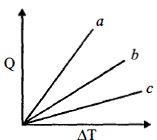
- 161. Figure shows the variation in temperature \(\left( {\Delta T} \right)\) with the amount of heat supplied \((Q)\) in an isobaric process corresponding to a monoatomic \((M)\), diatomic \((D)\) and a polyatomic \((P)\) gas. The initial state of all the gases are the same and the scales for the two axes coincide. Ignoring vibrational degrees of freedom, the lines \(a, b\) and \(c\) respectively correspond to
 2013 Medium
- 162. In the isothermal expansion of \(10\,g\) of gas from volume \(V\) to \(2V\) the work done by the gas is \(575\,J\). What is the root mean square speed of the molecules of the gas at that temperature ..... \(m/s\)? 2013 Medium
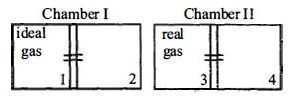
- 163. There are two identical chambers, completely thermally insulated from surroundings. Both chambers have a partition wall dividing the chambers in two compartments. Compartment \(1\) is filled with an ideal gas and Compartment \(3\) is filled with a real gas. Compartments \(2\) and \(4\) are vacuum . A small hole (orifice) is made in the partition walls and the gases are allowed to expand in vacuum Statement \(-1\) : No change in the temperature of the gas takes place when ideal gas expands in vacuum. However, the temperature of real gas goes down (cooling) when it expands in vacuum Statement \(-2\) : The internal energy of an ideal gas is only kinetic. The internal energy of a real gas is kinetic as well as potential
 2013 Medium
- 164. This question has Statement \(- 1\) and Statement \(-2\). Of the four choices given after the Statements, choose the one that best describes the two Statements.
Statement \(1\) : The internal energy of a perfect gas is entirely kinetic and depends only on absolute temperature of the gas and not on its pressure or volume.
Statement \(2\) : A perfect gas is heated keeping pressure constant and later at constant volume. For the same amount of heat the temperature of the gas at constant pressure is lower than that at constant volume. 2013 Medium
No questions on this page match these filters.