


All STD 12 - Dual nature of radiation and matter questions
Newest firstShowing 101–150 of 180 questions
- 101. The ratio of wavelengths of proton and deuteron accelerated by potential \(V_{p}\) and \(V_{d}\) is 1: \(\sqrt{2}\). Then, the ratio of \(V_{p}\) to \(V_{d}\) will be 2022 Medium
- 102. The stopping potential for photoelectrons emitted from a surface illuminated by light of wavelength \(6630 \; \mathring A\) is \(0.42 \; V\). If the threshold frequency is \(x \times\) \(10^{13} / s\), where \(x\) is\(\dots\) (nearest integer). (Given, speed light \(=3 \times 10^{8} \; m / s\), Planck's constant \(=6.63 \times 10^{-34} \; Js\) ) 2022 Medium
- 103. Two streams of photons, possessing energies to five and ten times the work function of metal are incident on the metal surface successively. The ratio of the maximum velocities of the photoelectron emitted, in the two cases respectively, will be. 2022 Medium
- 104. When light of frequency twice the threshold frequency is incident on the metal plate, the maximum velocity of emitted election is \(v _{1}\). When the frequency of incident radiation is increased to five times the threshold value, the maximum velocity of emitted electron becomes \(v _{2}\). If \(v _{2}= x\) \(v _{1}\), the value of \(x\) will be........... 2022 Medium
- 105. With reference to the observations in photo-electric effect, identify the correct statements from below: \(A.\) The square of maximum velocity of photoelectrons varies linearly with frequency of incident light. \(B.\) The value of saturation current increases on moving the source of light away from the metal surface. \(C.\) The maximum kinetic energy of photo-electrons decreases on decreasing the power of LED (light emitting diode) source of light. \(D.\) The immediate emission of photo-electrons out of metal surface can not be explained by particle nature of light/electromagnetic waves. \(E.\) Existence of threshold wavelength can not be explained by wave nature of light/electromagnetic waves. Choose the correct answer from the options given below: 2022 Hard
- 106. A light beam of wavelength \(500\, {nm}\) is incident on a metal having work function of \(1.25\, {eV}\), placed in a magnetic field of intensity \(B\). The electrons emitted perpendicular to the magnetic field \(B\), with maximum kinetic energy are bent into circular arc of radius \(30\, {cm}\). The value of \(B\) is \(....\,\times 10^{-7} \,{T}\). Given \({hc}=20 \times 10^{-26}\, {J}-{m}\), mass of electron \(=9 \times 10^{-31} \,{kg}\) 2021 Hard
- 107. A monochromatic neon lamp with wavelength of \(670.5\, {nm}\) illuminates a photo-sensitive material which has a stopping voltage of \(0.48\, {V}\). What will be the stopping voltage if the source light is changed with another source of wavelength of \(474.6 \,{nm} ?\) (In \({V}\)) 2021 Hard
- 108. A moving proton and electron have the same deBroglie wavelength. If \({K}\) and \({P}\) denote the \({KE}\). and momentum respectively. Then choose the correct option : 2021 Medium
- 109. A particle is travelling \(4\) times as fast as an electron. Assuming the ratio of de-Broglie wavelength of a particle to that of electron is \(2: 1,\) the mass of the particle is 2021 Medium
- 110. A particle of mass \(4\, {M}\) at rest disintegrates into two particles of mass \({M}\) and \(3 \,{M}\) respectively having non zero velocities. The ratio of de-Broglie wavelength of particle of mass \(M\) to that of mass \(3\, {M}\) will be : 2021 Medium
- 111. A particle of mass \(9.1 \times 10^{-31}\, {kg}\) travels in a medium with a speed of \(10^{6}\, {m} / {s}\) and a photon of a radiation of linear momentum \(10^{-27} \,{kg}\, {m} / {s}\) travels in vacuum. The wavelength of photon is \(....\) times the wavelength of the particle. 2021 Medium
- 112. An electron and proton are separated by a large distance. The electron starts approaching the proton with energy \(3\, {eV}\). The proton captures the electrons and forms a hydrogen atom in second excited state. The resulting photon is incident on a photosensitive metal of threshold wavelength \(4000\, \mathring {{A}}\). What is the maximum kinetic energy of the emitted photoelectron ? (In \({eV}\)) 2021 Medium
- 113. An electron moving with speed \(v\) and a photon moving with speed \(c,\) have same D-Broglie wavelength. The ratio of kinetic energy of electron to that of photon is - 2021 Medium
- 114. An electron of mass \(m\) and a photon have same energy \(E.\) The ratio of de-Broglie wavelengths associated with them is 2021 Medium
- 115. An electron of mass \(m _{ e }\) and a proton of mass \(m _{ p }=1836 m _{ e }\) are moving with the same speed. The ratio of their de Broglie wavelength \(\frac{\lambda_{\text {electron }}}{\lambda_{\text {proton }}}\) will be ....... . 2021 Medium
- 116. An electron of mass \(m_{e}\) and a proton of mass \(m_{p}\) are accelerated through the same potential difference. The ratio of the de-Broglie wavelength associated with the electron to that with the proton is 2021 Medium
- 117. An \(\alpha\) particle and a proton are accelerated from rest by a potential difference of \(200\, V\). After this, their de Broglie wavelengths are \(\lambda_{\alpha}\) and \(\lambda_{p}\) respectively. The ratio \(\frac{\lambda_{p}}{\lambda_{a}}\) is 2021 Medium
- 118. Consider two separate ideal gases of electrons and protons having same number of particles. The temperature of both the gases are same. The ratio of the uncertainty in determining the position of an electron to that of a proton is proportional to :- 2021 Hard
- 119. Given below are two statements Statement\(-I :\) Two photons having equal linear momenta have equal wavelengths. Statement\(-II :\) If the wavelength of photon is decreased, then the momentum and energy of a photon will also decrease. In the light of the above statements, choose the correct answer from the options given below. 2021 Medium
- 120. If \(2.5 \times 10^{-6\,} N\) average force is exerted by a light wave on a non-reflecting surface of \(30\, cm ^{2}\) area during \(40\) minutes of time span, the energy flux of light just before it falls on the surface is .................. \(W / cm ^{2}\) (Round off to the Nearest Integer) (Assume complete absorption and normal incidence conditions are there) 2021 Medium
- 121. In a photoelectric experiment, increasing the intensity of incident light : 2021 Medium
- 122. In a photoelectric experiment ultraviolet light of wavelength \(280\, {nm}\) is used with lithium cathode having work function \(\phi=2.5\, {eV}\). If the wavelength of incident light is switched to \(400\, {nm}\), find out the change in the stopping potential (in \({V}\)). \(\left({h}=6.63 \times 10^{-34}\, {J} \cdots\right.\), \(\left.{c}=3 \times 10^{8} \,{ms}^{-1}\right)\) 2021 Hard
- 123. The de-Broglie wavelength associated with an electron and a proton were calculated by accelerating them through same potential of \(100\, V\). What should nearly be the ratio of their wavelengths ? \(\left( m _{ P }=1.00727\, u , m _{ e }=0.00055 \,u \right)\) 2021 Medium
- 124. The de-Broglie wavelength of a particle having kinetic energy \(E\) is \(\lambda\). How much extra energy must be given to this particle so that the de-Broglie wavelength reduces to \(75 \,\%\) of the initial value ? 2021 Hard
- 125. The de Broglie wavelength of a proton and \(\alpha\) -particle are equal. The ratio of their velocities is ...... . 2021 Medium
- 126. The radiation corresponding to \(3 \rightarrow 2\) transition of a hydrogen atom falls on a gold surface to generate photoelectrons. These electrons are passed through a magnetic field of \(5 \times 10^{-4} \,{T}\). Assume that the radius of the largest circular path followed by these electrons is \(7\, {mm}\), the work function of the metal is \(.....\,{eV}\) (Mass of electron \(=9.1 \times 10^{-31} \,{kg}\) ) 2021 Hard
- 127. The stopping potential for electrons emitted from a photosensitive surface illuminated by light of wavelength \(491\, nm\) is \(0.710\, V\). When the incident wavelength is changed to a new value, the stopping potential is \(1.43\, V\). The new wavelength is ....... \(nm.\) 2021 Medium
- 128. The stopping potential in the context of photoelectric effect depends on the following property of incident electromagnetic radiation 2021 Easy
- 129. The temperature of an ideal gas in \(3-\)dimensions is \(300\, {K}\). The corresponding de-Broglie wavelength of the electron approximately at \(300\,{K}\), is \(....\,nm\) \(\left\lfloor{m}_{e}=\text { mass of electron }=9 \times 10^{-31} \,{kg}\right.\) \({h}=\text { Planck constant }=6.6 \times 10^{-34} {Js}\) \(\left.{k}_{{B}}=\text { Boltzmann constant }=1.38 \times 10^{-23}\, {JK}^{-1}\right]\) 2021 Medium
- 130. Two stream of photons, possessing energies equal to twice and ten times the work function of metal are incident on the metal surface successively. The value of ratio of maximum velocities of the photoelectrons emitted in the two respective cases is \(x: y .\) The value of \(x\) is ...... . 2021 Hard
- 131. What should be the order of arrangement of de-Broglie wavelength of elelctron \(\left(\lambda_{{e}}\right)\), an \(\alpha-\) particle \(\left(\lambda_{\alpha}\right)\) and proton \(\left(\lambda_{p}\right)\) given that all have the same kinetic energy ? 2021 Medium
- 132. When radiation of wavelength \(\lambda \) is incident on a metallic surface, the stopping potential is \(4.8\) volts. If the same surface is illuminated with radiation of double the wavelength, then the stopping potential becomes \(1.6\) volts. Then the threshold wavelength for the surface is 2021 Hard
- 133. A beam of electromagnetic radiation of intensity \(6.4 \times 10^{-5}\; \mathrm{W} / \mathrm{cm}^{2}\) is comprised of wavelength, \(\lambda=310 \;\mathrm{nm} .\) It falls normally on a metal (work function \(\varphi=2 \;\mathrm{eV}\) ) of surface area of \(1\; \mathrm{cm}^{2} .\) If one in \(10^{3}\) photons ejects an electron, total number of electrons ejected in \(1 \;s\) is \(10^{\mathrm{x}}\).then \(\mathrm{x}\) is \(\left(\mathrm{hc}=1240\; \mathrm{eV} \mathrm{nm}, 1\; \mathrm{eV}=1.6 \times 10^{-19} \;\mathrm{J}\right)\) 2020 Hard
- 134. A beam of electrons of energy \(E\) scatters from a target having atomic spacing of \(1\, A\). The first maximum intensity occurs at \(\theta=60^{\circ} .\) Then \(E\) (in \(eV )\) is\(......\) (Planck constant \(h =6.64 \times 10^{-34}\, Js\) \(1 \,eV =1.6 \times 10^{-19}\,J\), electron mass \(\left. m =9.1 \times 10^{-31}\, kg \right)\) 2020 Medium
- 135. A particle is moving \(5\) times as fast as an electron. The ratio of the de-Broglie wavelength of the particle to that of the electron is \(1.878 \times 10^{-4}\). The mass of the particle is close to 2020 Medium
- 136. A particle moving with kinetic energy \(E\) has de Broglie wavelength \(\lambda\). If energy \(\Delta \mathrm{E}\) is added to its energy, the wavelength become \(\frac {\lambda}{2} .\) Value of \(\Delta \mathrm{E},\) is 2020 Medium
- 137. An electron, a doubly ionized helium ion \(\left( He ^{++}\right)\) and a proton are having the same kinetic energy. The relation between their respective de\(-\)Broglie wavelengths \(\lambda_{ e }, \lambda_{ He ^{++}}\) and \(\lambda_{ P }\) is 2020 Medium
- 138. An electron (mass \(m\)) with initial velocity \(\overrightarrow{\mathrm{v}}=\mathrm{v}_{0} \hat{\mathrm{i}}+\mathrm{v}_{0} \hat{\mathrm{j}}\) is in an electric field \(\overrightarrow{\mathrm{E}}=-\mathrm{E}_{0} \hat{\mathrm{k}} .\) If \(\lambda_{0}\) is initial de-Broglie wavelength of electron, its de-Broglie wave length at time \(t\) is given by 2020 Hard
- 139. An electron of mass \(\mathrm{m}\) and magnitude of charge \(|e|\) initially at rest gets accelerated by a constant electric field \(\mathrm{E}\). The rate of change of de-Broglie wavelength of this electron at time \(t\) ignoring relativistic effects is 2020 Hard
- 140. Assuming the nitrogen molecule is moving with \(r.m.s.\) velocity at \(400\, K\), the de\(-\)Broglie wavelength of nitrogen molecule is close to\(......\mathring {A}\) (Given : nitrogen molecule weight : \(4.64 \times 10^{-26}\, kg ,\) Boltzman constant : \(1.38 \times 10^{-23}\, J / K ,\) Planck constant : \(\left.6.63 \times 10^{-34}\, J . s \right)\) 2020 Hard
- 141. Given figure shows few data points in a photo electric effect experiment for a certain metal. The minimum energy for ejection of electron from its surfface is\(.......eV\) (Plancks constant \(\left. h =6.62 \times 10^{-34}\, J . s \right)\)
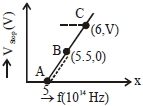 2020 Medium
- 142. In a photoelectric effect experiment, the graph of stopping potential \(V\) versus reciprocal of wavelength obtained is shown in the figure. As the intensity of incident radiation is increased
 2020 Medium
- 143. Particle \(A\) of mass \(m_{A}=\frac{m}{2}\) moving along the \(x-\)axis with velocity \(v_{0}\) collides elastically with another particle \(B\) at rest having mass \(m _{ B }=\frac{ m }{3}\) If both particles move along the \(x-\)axis after the collision, the change \(\Delta \lambda\) in \(de-\)Broglie wavelength of particle \(A,\) in terms of its \(de-\)Broglie wavelength \(\left(\lambda_{0}\right)\) before collision is 2020 Hard
- 144. Radiation \(p\) with wavelength \(6561\;\mathring A\) falls on a metal surface to produce photoelectrons. The electrons are made to enter a uniform magnetic field of \(3 \times 10^{-4}\; T\). If the radius of the largest circular path followed by the electrons is \(10 \;\mathrm{mm},\) the work function of the metal is close to ............... \(eV\) 2020 Hard
- 145. The surface of a metal is illuminated altemately with photons of energies \(E _{1}=4\, eV\) and \(E _{2}=2.5\, eV\) respectively. The ratio of maximum speeds of the photoelectrons emitted in the two cases is \(2 .\) The work function of the metal in \(( eV )\) is\(......ev\) 2020 Medium
- 146. Two sources of light emit X-rays of wavelength \(1\, nm\) and visible light of wavelength \(500\, nm ,\) respectively. Both the sources emit light of the same power \(200\, W\). The ratio of the number density of photons of X-rays to the number densitty of photons of the visible light of the given wavelengths is 2020 Medium
- 147. When photon of energy \(4.0\; eV\) strikes the surface of a metal \(\mathrm{A}\), the ejected photoelectrons have maximum kinetic energy \(\mathrm{T}_{\mathrm{A}}\; eV\) end de-Broglie wavelength \(\lambda_{\mathrm{A}} .\) The maximum kinetic energy of photoelectrons liberated from another metal \(\mathrm{B}\) by photon of energy \(4.50 \;eV\) is \(\mathrm{T}_{\mathrm{B}}=\left(\mathrm{T}_{\mathrm{A}}-1.5\right)\;eV\). If the de-Broglie wavelength of these photoelectrons \(\lambda_{B}=2 \lambda_{A}\) then the work function of metal \(\mathrm{B}\) is ............. \(eV\) 2020 Medium
- 148. When radiation of wavelength \(\lambda\) is used to illuminate a metallic surface, the stopping potential is \(V.\) When the same surface is illuminated with radiation of wavelength \(3 \lambda,\) the stopping potential is \(\frac{ V }{4} .\) If the threshold wavelength for the metallic surface is \(n \lambda\) then value of \(n\) will be...... 2020 Medium
- 149. When the wavelength of radiation falling on a metal is changed from \(500 \,nm\) to \(200\, nm ,\) the maximum kinetic energy of the photoelectrons becomes three times larger. The work function of the metal is close to\(.....eV\) 2020 Medium
- 150. \(50\, W/m^2\) energy density of sunlight is normally incident on the surface of a solar panel. Some part of incident energy \((25\%)\) is reflected from the surface and the rest is absorbed. The force exerted on \(1\, m^2\) surface area will be close to \((c = 3 \times10^8\, m / s)\) 2019 Hard
No questions on this page match these filters.