


All STD 12 - Dual nature of radiation and matter questions
Newest firstShowing 151–180 of 180 questions
- 151. A \(2\,mW\) laser operates at a wavelength of \(500\,nm.\) The number of photons that will be emitted per second is [Given Planck’s constant \(h = 6.6 \times 10^{-34}\,Js,\) speed of light \(c = 3.0\times 10^8\,m/s\) ] 2019 Hard
- 152. A metal plate of area \(1\times10^{-4}\, m^2\) is illuminated by a radiation of intensity \(16\, m\,W/m^2\). The work function of the metal is \(5\,eV\). The energy of the incident photons is \(10\, eV\) and only \(10\%\) of it produces photo electrons. The number of emitted photo electrons per second and their maximum energy, respectively, will be : \([1\, eV = 1.6\times10^{-19}\, J]\) 2019 Hard
- 153. A nucleus \(A\), with a finite de -broglie wavelength \(\lambda_A\), undergoes spontaneous fission into two nuclei \(B\) and \(C\) of equal mass. \(B\) flies in the same direction as that of \(A\), while \(C\) flies in the opposite direction with a velocity equal to half of that of \(B\). The de -Broglie wavelength \(\lambda_B\) and \(\lambda_C\) of \(B\) and \(C\) are respectively 2019 Hard
- 154. A particle \(A\) of mass \(‘m’\) and charge \(‘q’\) is accelerated by a potential difference of \(50\, V\). Another particle \(B\) of mass \(‘4\, m’\) and charge \(‘q’\) is accelerated by a potential difference of \(2500\, V\). The ratio of de-Broglie wavelength \(\frac{{{\lambda _A}}}{{{\lambda _B}}}\) is close to 2019 Medium
- 155. If the deBroglie wavelength of an electron is equal to \(10^{-3}\) times the wavelength of a photon of frequency \(6\,\times 10^{14}\,Hz,\) then the speed of electron is equal to: (Speed of light \(=3\times 10^8\,m/s\,;\) Planck’s constant \(=6.63\times 10^{-34}\,J.s\,;\) Mass of electron \(=9.1\times 10^{-31}\,kg\) ) 2019 Medium
- 156. In a Frank-hertz experiment, an electron of energy \(5.6\,eV\) passes through mercury vapour and emerges with an energy \(0.7\,eV.\) The minimum wavelength of photons emitted by mercury atoms is close to ............. \(nm\) 2019 Medium
- 157. In a photoelectric effect experiment the threshold wavelength of incident light is \(380\, nm\), If the wavelength of the incident light is \(260\,nm\), the maximum kinetic energy of emitted electrons will be: .............. \(eV\) Given \(E\) (in \(eV\)) \( = \frac{{1237}}{{\lambda \left( {in\,nm} \right)}}\) 2019 Medium
- 158. In a photoelectric experiment, the wavelength of the light incident on a metal is changed from \(300\, nm\) to \(400\, nm\). The decrease in the stopping potential is close to ................ \(V\) \(\left( {\frac {{hc}}{e} = 1240\,nm - V} \right)\) 2019 Hard
- 159. In an electron microscope, the resolution that can be achieved is of the order of the wavelength of electrons used. To resolve a width of \(7.5 \times 10^{-12}\, m\), the minimum electron energy required is close to .............. \(keV\) 2019 Medium
- 160. Light is incident normally on a completely absorbing surface with an energy flux of \(25\,W\,cm^{-2}.\) If the surface has an area of \(25\,cm^2,\) the maximum momentum transferred to the surface in \(40\,min\) time duration will be 2019 Medium
- 161. Surface of certain metal is first illuminated with light of wavelength \({\lambda _1} = 350\,nm\) and then, the light of wavelength \({\lambda _2} = 540\,nm\). It is found that the maximum speed of the photo electrons in the two cases differ by a factor of \(2\). The work function of the metal (in \(eV\)) is close to: (Energy of photon \( = \frac{{1240}}{{\lambda {\rm{(in\, nm)}}}}\,eV\)) 2019 Hard
- 162. The electric field of light wave is given as \(\vec E\, = \,{10^{ - 3}}\,\cos \,\,\left( {\frac{{2\pi x}}{{5 \times {{10}^{ - 7}}}} - 2\pi \times 6 \times {{10}^{14}}t} \right)\hat x\frac{N}{C}\). This light falls on a metal plate of work function \(2\,eV.\) The stopping potential of the photoelectrons is ................ \(V\) 2019 Hard
- 163. The magnetic field associated with a light wave is given, at the origin, by \(B = B_0 [sin\,(3.14 \times 10^7)\,ct\,+\,sin\,(6.28 \times 10^7)\,ct]\) If this light falls on a silver plate having a work function of \(4.7\,eV,\) what will be the maximum kinetic energy of the photo electrons? .............. \(eV\) 2019 Hard
- 164. The stopping potential \(V_0\) (in \(volt\)) as a function of frequency \((v)\) for a sodium emitter, is shown in the figure. The work function of sodium, from the data plotted in the figure, will be : ................. \(eV\) (Given : Planck's constant \((h) = 6.63 \times 10^{-34}\, Js\), electron charge \(e = 1.6 \times 10^{-19}\, C\))
 2019 Medium
- 165. Two particles move at right angle to each other. Their de Broglie wavelengths are \({\lambda _1}\) and \({\lambda _2}\) respectively. The particles suffere perfectly inelastic collision. The de Broglie wavelength \(\lambda \) , of the final particle, is given by 2019 Hard
- 166. When a certain photosensitive surface is illuminated with monochromatic light of frequency \(v\) , the stopping potential for the photo current is \(-V_0/2.\) When the surface is illuminated by monochromatic light of frequency \(v/2,\) the stopping potential is \(-V_0.\) The threshold frequency for photoelectric emission is 2019 Medium
- 167. Both the nucleus and the atom of some element are in their respective first excited states. They get de-excited by emitting photons of wavelengths \(\lambda _N,\,\lambda _A\) respectively. The ratio \(\frac{{{\lambda _N}}}{{{\lambda _A}}}\) is closest to 2018 Medium
- 168. Two electrons are moving with non-relativistic speeds perpendicular to each other. If corresponding de Broglie wavelengths are \({\lambda _1}\) and \({\lambda _2}\), their de Broglie wavelength in the frame of reference attached to their centre of mass is 2018 Hard
- 169. A Laser light of wavelength \(660\,nm\) is used to weld Retina detachment. If a Laser pulse of width \(60\, ms\) and power \(0.5\, kW\) is used the approximate number of photons in the pulse are : [Take Planck's constant \(h\, = 6.62\times10^{- 34}\, Js\)] 2017 Medium
- 170. The maximum velocity of the photoelectrons emitted from the surface is \(v\) when light of frequency \(n\) falls on a metal surface. If the incident frequency is increased to \(3n\) , the maximum velocity of the ejected photoelectrons will be 2017 Medium
- 171. When photons of wavelength \(\lambda _1\) are incident on an isolated sphere, the corresponding stopping potential is found to be \(V.\) When photons of wavelength \(\lambda _2\) are used, the corresponding stopping potential was thrice that of the above value . If light of wavelength \(\lambda _3\) is used then find the stopping potential for this case 2016 Hard
- 172. de-Broglie wavelength of an electron accelerated by a voltage of \(50\,\,V\) is close to ............. \(\mathop {\rm{A}}\limits^o \) \((\left| e \right| = 1.6 \times {10^{ - 19}}\,\,C,\,\,{m_e} = 9.1 \times {10^{ - 31}}\,kg,\,\,h = 6.6 \times {10^{ - 34}}\,\,Js)\) 2015 Medium
- 173. Match List \(- I\) (Fundamental Experiment) with List \(- II\) (its conclusion) and select the correct option from the choices given below the list \(\begin{array}{|||} \hline List\,\,-1 & List\,\,-II\,\, \\ \hline a\,\,Franck-Hertz\,\,Experiment & i\,\,Particle\,\,nature\,\,of\,\,light \\ \hline b\,\,Photo\,\,-electric\,\,Experiment & ii\,\,Discrete\,\,energy \,\, levels\,\,of\,\,atom \\ \hline c\,\,Davison-Germer\,\,Experiment & iii\,\,Wave\,\,nature\,\,of\,\,electron \\ \hline & iv\,\,Structure\,\,of\,\,atom \\ \hline \end{array}\) 2015 Medium
- 174. A beam of light has two wavelengths of \(4972\,\mathop A\limits^o \) and \(6216\,\mathop A\limits^o \) with a total intensity of \(3 .6 \times 10^{- 3}\,\,Wm^{-2}\) equally distributed among the two wavelengths. The beam falls normally on an area of \(1\,cm^2\) of a clean metallic surface of work function \( 2.3\,eV.\) Assume that there is no loss of light by reflection and that each capable photon ejects one electron. The number of photoelectrons liberated in \(2\,s\) is approximately 2014 Hard
- 175. A photon of wavelength \(\lambda \) is scattered from an electron, which was at rest. The wavelength shift \(\Delta \lambda \) is three times of \( \lambda \) and the angle of scattering \(\theta \) is \(60^o\) . The angle at which the electron recoiled is \(\phi \). The value of \(tan\,\phi \) is : ( electron speed is much smaller than the speed of light) 2014 Hard
- 176. For which of the following particles will it be most difficult to experimentally verify the deBroglie relationship? 2014 Easy
- 177. A copper ball of radius \(1\, cm\) and work function \(4.47\,eV\) is irradiated with ultraviolet radiation of wavelength \(2500\mathop A\limits^o \). The effect of irradiation results in the emission of electrons from the ball. Further the ball will acquire charge and due to this there will be a finite value of the potential on the ball. The charge acquired by the ball is 2013 Hard
- 178. Electrons are accelerated through a potential difference \(V\) and protons are accelerated through a potential difference \(4\, V\). The de-Broglie wavelengths are \(\lambda_e \) and \(\lambda_p \) for electrons and protons respectively. The ratio of \(\frac{{{\lambda _e}}}{{{\lambda _p}}}\) is given by : (given \(m_e\) is mass of electron and \(m_p\) is mass of proton). 2013 Hard
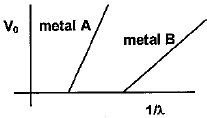
- 179. In an experiment on photoelectric effect, a student plots stopping potential \(V_0\) against reciprocal of the wavelength \(\lambda \) of the incident light for two different metals \(A\) and \(B\). These are shown in the figure Looking at the graphs, you can most appropriately say that
 2013 Hard
- 180. Orbits of a particle moving in a circle are such that the perimeter of the orbit equals an integer number of de-Broglie wavelengths of the particle. For a charged particle moving in a plane perpendicular to a magnetic field, the radius of the \(n^{th}\) orbital will therefore be proportional to 2013 Hard
No questions on this page match these filters.