


All STD 12 - Ray optics and optical instruments questions
Newest firstShowing 151–200 of 248 questions
- 151. The speed of light in media \('A'\) and \('B'\) are \(2.0 \times\) \(10^{10} \,cm / s\) and \(1.5 \times 10^{10} \,cm / s\) respectively. A ray of light enters from the medium \(B\) to \(A\) at an incident angle ' \(\theta\) '. If the ray suffers total internal reflection, then 2022 Medium
- 152. The \(X-Y\) plane be taken as the boundary between two transparent media \(M _{1}\) and \(M _{2} . M _{1}\) in \(Z \geq 0\) has a refractive index of \(\sqrt{2}\) and \(M _{2}\) with \(Z <0\) has a refractive index of \(\sqrt{3}\). A ray of light travelling in \(M_{1}\) along the direction given by the vector \(\overrightarrow{ A }=4 \sqrt{3 i }-3 \sqrt{3 \hat{j}}-5 \hat{ k }\), is incident on the plane of separation. The value of difference between the angle of incident in \(M _{1}\) and the angle of refraction in \(M _{2}\) will be \(....\) degree. 2022 Hard
- 153. Time taken by light to travel in two different materials \(A\) and \(B\) of refractive indices \(\mu_{A}\) and \(\mu_{B}\) of same thickness is \(t_{1}\) and \(t_{2}\) respectively. If \(t_{2}-t_{1}=5 \times 10^{-10}\) s and the ratio of \(\mu_{A}\) to \(\mu_{B}\) is \(1: 2\). Then the thickness of material, in meter is: (Given \(v_{A}\) and \(v_{B}\) are velocities of light in \(A\) and \(B\) materials respectively). 2022 Hard
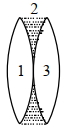
- 154. Two identical thin biconvex lenses of focal length \(15\, cm\) and refractive index \(1.5\) are in contact with each other. The space between the lenses is filled with a liquid of refractive index \(1.25\). The focal length of the combination is \(cm\).
 2022 Hard
- 155. Which of the following statement is correct? 2022 Medium
- 156. A deviation of \(2^{\circ}\) is produced in the yellow ray when prism of crown and flint glass are achromatically combined. Taking dispersive powers of crown and flint glass are \(0.02\) and \(0.03\) respectively and refractive index for yellow light for these glasses are \(1.5\) and \(1.6\) respectively. The refracting angles for crown glass prism will be \(........\,^{\circ}\) (in degree) (Round off to the Nearest Integer) 2021 Hard
- 157. A glass tumbler having inner depth of \(17.5\, {cm}\) is kept on a table. A student starts pouring water \((\mu=4 / 3)\) into it while looking at the surface of water from the above. When he feels that the tumbler is half filled, he stops pouring water. Up to what height, the tumbler is actually filled ? (In \(cm\)) 2021 Hard
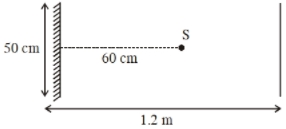
- 158. A point source of light \(S\), placed at a distance \(60 \,cm\) infront of the centre of a plane mirror of width \(50 \,cm\), hangs vertically on a wall. A man walks infront of the mirror along a line parallel to the mirror at a distance \(1.2\, m\) from it (see in the \(figure\)). The distance between the extreme points where he can see the image of the light source in the mirror is \(\ldots \ldots \ldots\, cm.\)
 2021 Hard
- 159. A prism of refractive index \(\mu\) and angle \(A\) is placed in the minimum deviation position. If the angle of minimum deviation is \(A,\) then the value of \(A\) in terms of \(\mu\) is 2021 Hard
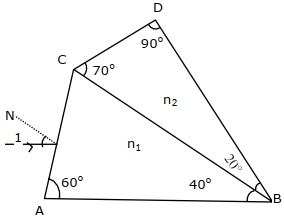
- 160. A prism of refractive index \(n_{1}\) and another prism of refractive index \(n_{2}\) are stuck together (as shown in the figure). \(n_{1}\) and \(n_{2}\) depend on \(\lambda\), the wavelength of light, according to the relation \({n}_{1}=1.2+\frac{10.8 \times 10^{-14}}{\lambda^{2}} \text { and } {n}_{2}=1.45+\frac{1.8 \times 10^{-14}}{\lambda^{2}}\) The wavelength for which rays incident at any angle on the interface \(B C\) pass through without bending at that interface will be \(....\,nm.\)
 2021 Hard
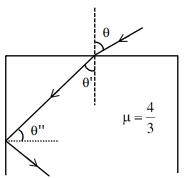
- 161. A ray of light entering from air into a denser medium of refractive index \(\frac{4}{3}\), as shown in figure. The light ray suffers total internal reflection at the adjacent surface as shown. The maximum, value of angle \(\theta\) should be equal to -
 2021 Hard
- 162. A ray of light passing through a prism \((\mu=\sqrt{3})\) suffers minimum deviation. It is found that the angle of incidence is double the angle of refraction within the prism. Then, the angle of prism is ..... . (in degrees) 2021 Hard
- 163. A short straight object of height \(100\, cm\) lies before the central axis of a spherical mirror whose focal length has absolute value \(| f |=40\, cm .\) The image of object produced by the mirror is of height \(25\, cm\) and has the same orientation of the object. One may conclude from the information 2021 Hard
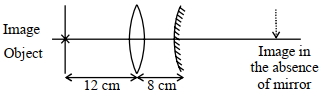
- 164. An object is placed at a distance of \(12 \,{cm}\) from a convex lens. A convex mirror of focal length \(15 \,{cm}\) is placed on other side of lens at \(8 \,{cm}\) as shown in the figure. Image of object coincides with the object.When the convex mirror is removed, a real and inverted image is formed at a position. The distance of the image from the object will be ..... \((cm)\)
 2021 Hard
- 165. An object is placed at the focus of concave lens having focal length \(f\). What is the magnification and distance of the image from the optical centre of the lens? 2021 Hard
- 166. An object is placed beyond the centre of curvature \({C}\) of the given concave mirror. If the distance of the object is \({d}_{1}\) from \({C}\) and the distance of the image formed is \({d}_{2}\) from \({C}\), the radius of curvature of this mirror is 2021 Hard
- 167. An object viewed from a near point distance of \(25\, {cm}\), using a microscopic lens with magnification \('6',\) gives an unresolved image. A resolved image is observed at infinite distance with a total magnification double the earlier using an eyepiece along with the given lens and a tube of length \(0.6\, {m}\), if the focal length of the eyepiece is euqal to \(.... \,{cm} .\) 2021 Hard
- 168. Car \(B\) overtakes another car \(A\) at a relative speed of \(40\, ms^{-1}\). How fast will the image of car \({B}\) appear to move in the mirror of focal length \(10\, cm\) fitted in car \({A}\), when the car \({B}\) is \(1.9\, m\) away from the car \({A}\) ? (In \(ms^{-1}\)) 2021 Hard
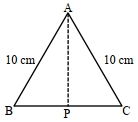
- 169. Cross-section view of a prism is the equilateral triangle \({ABC}\) in the figure. The minimum deviation is observed using this prism when the angle of incidence is equal to the prism angle. The time taken by light to travel from midpoint of \({BC}\) to \({A}\) is \(.....\times 10^{-10}\, {s}\). \((\) Given, speed of light in vacuum \(=3 \times 10^{8} \,{m} / {s}\) and \(\left.\cos 30^{\circ}=\frac{\sqrt{3}}{2}\right)\)
 2021 Hard
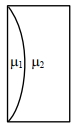
- 170. Curved surfaces of a plano-convex lens of refractive index \(\mu_{1}\) and a plano-concave lens of refractive index \(\mu_{2}\) have equal radius of curvature as shown in figure. Find the ratio of radius of curvature to the focal length of the combined lenses.
 2021 Hard
- 171. Diameter of a plano-convex lens is \(6 \,cm\) and thickness at the centre is \(3\, mm\). If the speed of light in the material of the lens is \(2 \times 10^8 m/sec\), the focal length of the lens is.......\(cm\) 2021 Hard
- 172. Find the distance of the image from object \(O\), formed by the combination of lenses in the figure : (in \(cm\))
 2021 Hard
- 173. Given below are two statements : one is labelled as Assertion \(A\) and the other is labelled as Reason \(R\). Assertion \(A :\) For a simple microscope, the angular size of the object equals the angular size of the image. Reason \(R\) : Magnification is achieved as the small object can be kept much closer to the eye than \(25\, cm\) and hence it subtends a large angle. In the light of the above statements, choose the most appropriate answer from the options given below: 2021 Hard
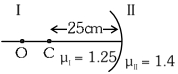
- 174. Region \(I\) and \(II\) are separated by a spherical surface of radius \(25\, {cm}\). An object is kept in region \(I\) at a distance of \(40\, {cm}\) from the surface. The distance of the image from the surface is \(.....\,cm\)
 2021 Medium
- 175. The angle of deviation through a prism is minimum when \((A)\) Incident ray and emergent ray are symmetric to the prism \((B)\) The refracted ray inside the prism becomes parallel to its base \((C)\) Angle of incidence is equal to that of the angle of emergence \((D)\) When angle of emergence is double the angle of incidence Choose the correct answer from the options given below
 2021 Medium
- 176. The focal length \(f\) is related to the radius of curvature \(R\) of the spherical convex mirror by 2021 Easy
- 177. The image of an object placed in air formed by a convex refracting surface is at a distance of \(10\, m\) behind the surface. The image is real and is at \(\frac{2}{3}\) of the distance of the object from the surface . The wavelength of light inside the surface is \(\frac{2}{3}\) times the wavelength in air. The radius of the curved surface is \(\frac{ x }{13}\, m\). the value of \(^{\prime} x^{\prime}\) is ....... . 2021 Hard
- 178. The incident ray, reflected ray and the outward drawn normal are denoted by the unit vectors \(\overrightarrow{ a }, \overrightarrow{ b }\) and \(\overrightarrow{ c }\) respectively. Then choose the correct relation for these vectors. 2021 Hard
- 179. The refractive index of a converging lens is \(1.4.\) What will be the focal length of this lens if it is placed in a medium of same refractive index ? (Assume the radii of curvature of the faces of lens are \(R _{1}\) and \(R _{2}\) respectively) 2021 Medium
- 180. The relative permittivity of distilled water is \(81 .\) The velocity of light in it will be \(....\,\times 10^{7}\,{m} / {s}\) \(\left(\right.\) Given \(\left.\mu_{r}=1\right)\) 2021 Medium
- 181. The same size images are formed by a convex lens when the object is placed at \(20\, cm\) or at \(10\, cm\) from the lens. The focal length of convex lens is ............ \(cm\). 2021 Hard
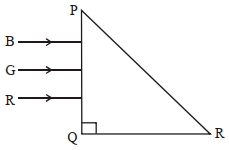
- 182. Three rays of light, namely red (R), green (G) and blue (B) are incident on the face \(PQ\) of a right angled prism PQR as shown in figure. The refractive indices of the material of the prism for red, green and blue wavelength are \(1.27, 1.42\) and \(1.49\) respectively. The colour of the ray(s) emerging out of the face \(PR\) is:
 2021 Hard
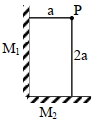
- 183. Two plane mirrors \({M}_{1}\) and \({M}_{2}\) are at right angle to each other shown. A point source \('P'\) is placed at \('a'\) and \('2a'\) meter away from \({M}_{1}\) and \({M}_{2}\) respectively. The longest distance between the images thus formed is : (Take \(\sqrt{5}=2.3\) )
 2021 Hard
- 184. Your friend is having eye sight problem. She is not able lo see clearly a distant uniform window mesh and it appears to her as non-uniform and distorted. The doctor diagnosed the problem as 2021 Medium
- 185. A compound microscope consists of an objective lens of focal length \(1 \,cm\) and an eye piece of focal length \(5 \,cm\) with a separation of \(10 \,cm\) The distance between an object and the objective lens, at which the strain on the eye is minimum is \(\frac{ n }{40}\, cm .\) The value of \(n\) is\(....\) 2020 Medium
- 186. A double convex lens has power \(P\) and same radii of curvature \(R\) of both the surfaces. The radius of curvature of a surface of a plano-convex lens made of the same material with power \(1.5P\) is ......\(R\) 2020 Medium
- 187. A light ray enters a solid glass sphere of refractive index \(\mu=\sqrt{3}\) at an angle of incidence \(60^{\circ}\). The ray is both reflected and refracted at the farther surface of the sphere. The angle (in degrees) between the reflected and refracted rays at this surface is...... 2020 Hard
- 188. A point like object is placed at a distance of \(1\, m\) in front of a convex lens of focal length \(0.5\, m .\) A plane mirror is placed at a distance of \(2\,m\) behind the lens. The position and nature of the final image formed by the system is 2020 Medium
- 189. A point object in air is in front of the curved surface of a plano-convex lens. The radius of curvature of the curved surface is \(30 \;\mathrm{cm}\) and the refractive index of the lens material is \(1.5 .\) then the focal length of the lens (in \(\mathrm{cm}\) ) is 2020 Medium
- 190. A prism of angle \(A=1^{\circ}\) has a refractive index \(\mu=1.5 .\) A good estimate for the minimum angle of deviation (in degrees) is close to \(N/10\) Value of \(N\) is...... 2020 Medium
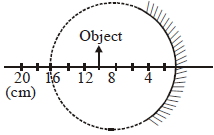
- 191. A spherical mirror is obtained as shown in the figure from a hollow glass sphere. If an object is positioned in front of the mirror, what will be the nature and magnification of the image of the object ? (Figure drawn as schematic and not to scale)
 2020 Hard
- 192. A thin lens made of glass (refractive index \(= 1.5\)) of focal length \(f=16\; \mathrm{cm}\) is immersed in a liquid of refractive index \(1.42 .\) If its focal length in liquid is \(f_{l},\) then the ratio \(f_{l} /f\) is closest to the integer 2020 Hard
- 193. A vessel of depth \(2 \mathrm{h}\) is half filled with a liquid of refractive index \(2 \sqrt{2}\) and the upper half with another liquid of refractive index \(\sqrt{2} .\) The liquids are immiscible. The apparent depth of the inner surface of the bottom of vessel will be 2020 Medium
- 194. If we need a magnification of \(375\) from a compound microscope of tube length \(150\; \mathrm{mm}\) and an objective of focal length \(5\; \mathrm{mm}\), the focal length of the eye-piece, should be close to.....\(mm\) 2020 Medium
- 195. In a compound microscope, the magnified virtual image is formed at a distance of \(25\, cm\) from the eye-piece. The focal length of its objective lens is \(1\, cm .\) If the magnification is \(100\) and the tube length of the microscope is \(20\, cm ,\) then the focal length of the eye-piece lens (in \(cm\) ) is 2020 Hard
- 196. The critical angle of a medium for a specific wavelength, if the medium has relative permittivity \(3\) and relative permeability \(\frac{4}{3}\) for this wavelength, will be.....\(^o\) 2020 Medium
- 197. The distance between an object and a screen is \(100\, cm .\) A lens can produce real image of the object on the screen for two different positions between the screen and the object. The distance between these two positions is \(40\, cm .\) If the power of the lens is close to \(\left(\frac{ N }{100}\right) D\) where \(N\) is an integer, the value of \(N\) is....... 2020 Hard
- 198. The magnifying power of a telescope with tube \(60\; \mathrm{cm}\) is \(5 .\) What is the focal length of its eye piece?......\(cm\) 2020 Medium
- 199. There is a small source of light at some depth below the surface of water (refractive index \(=\frac{4}{3}\) ) in a tank of large cross sectional surface area. Neglecting any reflection from the bottom and absorption by water, percentage of light that emerges out of surface is (nearly)...........\(\%\) [Use the fact that surface area of a spherical cap of height \(\mathrm{h}\) and radius of curvature \(\mathrm{r} \text { is } 2 \pi \mathrm{rh}]\) 2020 Hard
- 200. When an object is kept at a distance of \(30\, cm\) from a concave mirror, the image is formed at a distance of \(10\, cm\) from the mirror. If the object is moved with a speed of \(9\, cms ^{-1}\), the speed (in \(cms ^{-1}\) ) with which image moves at that instant is\(....m/s\) 2020 Medium
No questions on this page match these filters.