


All STD 12 - Ray optics and optical instruments questions
Newest firstShowing 51–100 of 248 questions
- 51. A slanted object \(A B\) is placed on one side of convex lens as shown in the diagram. The image is formed on the opposite side. Angle made by the image with principal axis is:
 2025 Medium
- 52. A spherical surface of radius of curvature \(R\), separates air from glass (refractive index \(=1.5\) ). The centre of curvature is in the glass medium. A point object ' \(O\) ' placed in air on the optic axis of the surface, so that its real image is formed at ' \(I\) ' inside glass. The line OI intersects the spherical surface at P and \(\mathrm{PO}=\mathrm{PI}\). The distance PO equals to ________. 2025 Medium
- 53.
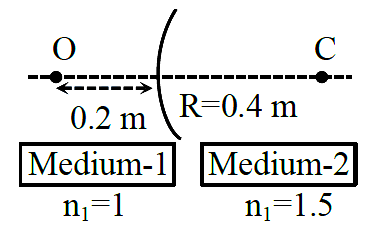
A spherical surface separates two media of refractive indices 1 and 1.5 as shown in figure. Distance of the image of an object ' O ' is :
( C is the center of curvature of the spherical surface and \(R\) is the radius of curvature) 2025 Easy - 54. A thin plano convex lens made of glass of refractive index 1.5 is immersed in a liquid of refractive index 1.2. When the plane side of the lens is silver coated for complete reflection, the lens immersed in the liquid behaves like a concave mirror of focal length 0.2 m . The radius of curvature of the curved surface of the lens is _______. 2025 Hard
- 55. A thin prism \(\mathrm{P}_1\) with angle \(4^{\circ}\) made of glass having refractive index 1.54 , is combined with another thin prism \(\mathrm{P}_2\) made of glass having refractive index 1.72 to get dispersion without deviation. The angle of the prism \(P_2\) in degrees is _______. 2025 Medium
- 56. A transparent block A having refractive index \(\mu=1.25\) is surrounded by another medium of refractive index \(\mu=1.0\) as shown in figure. A light ray is incident on the flat face of the block with incident angle \(\theta\) as shown in figure. What is the maximum value of \(\theta\) for which light suffers total internal reflection at the top surface of the block?
 2025 Medium
- 57. At the interface between two materials having refractive indices \(n_1\) and \(n_2\), the critical angle for reflection of an em wave is \(\theta_{1 C}\). The \(n_2\) material is replaced by another material having refractive index \(n_3\) such that the critical angle at the interface between \(n_1\) and \(n_3\) materials is \(\theta_{2 \mathrm{C}}\). If \(\mathrm{n}_3\gt\mathrm{n}_2\gt\mathrm{n}_1 ; \frac{\mathrm{n}_2}{\mathrm{n}_3}=\frac{2}{5}\) and \(\sin \theta_{2 \mathrm{C}}-\sin \theta_{1 \mathrm{C}}=\frac{1}{2}\), then \(\theta_{1 \mathrm{C}}\) is : 2025 Hard
- 58. Consider following statements for refraction of light through prism, when angle of deviation is minimum.
(A) The refracted ray inside prism becomes parallel to the base.
(B) Larger angle prisms provide smaller angle of minimum deviation.
(C) Angle of incidence and angle of emergence becomes equal.
(D) There are always two sets of angle of incidence for which deviation will be same except at minimum deviation setting.
(E) Angle of refraction becomes double of prism angle.
Choose the correct answer from the options given below. 2025 Medium - 59. Distance between object and its image \(\left( \text{magnified by } -\frac{1}{3}\right)\) is 30 cm. The focal length of the mirror used is \(\left(\frac{x}{4}\right) \mathrm{cm}\),
where magnitude of value of \(x\) is _________. 2025 Medium - 60. Given a thin convex lens (refractive index \(\mu_2\) ), kept in a liquid (refractive index \(\mu_1, \mu_1 \lt \mu_2\) ) having radii of curvatures \(\left|R_1\right|\) and \(\left|R_2\right|\). Its second surface is silver polished. Where should an object be placed on the optic axis so that a real and inverted image is formed at the same place? 2025 Medium
- 61. Given below are two statements : one is labelled as Assertion (A) and the other is labelled as Reason (R)
Assertion (A) : Refractive index of glass is higher than that of air.
Reason ( \(\mathrm{R}\)) : Optical density of a medium is directly proportionate to its mass density which results in a proportionate refractive index.
In the light of the above statements, choose the most appropriate answer from the options given below : 2025 Medium - 62. Given is a thin convex lens of glass (refractive index \(\mu\) ) and each side having radius of curvature \(R\). One side is polished for complete reflection. At what distance from the lens, an object be placed on the optic axis so that the image gets formed on the object itself ? 2025 Easy
- 63. In a long glass tube, mixture of two liquids A and B with refractive indices 1.3 and 1.4 respectively, forms a convex refractive meniscus towards \(A\). If an object placed at 13 cm from the vertex of the meniscus in A forms an image with a magnification of ' \(-2^{\prime}\) then the radius of curvature of meniscus is : 2025 Hard
- 64. In the diagram given below, there are three lenses formed. Considering negligible thickness of each of them as compared to \(\left|R_1\right|\) and \(\left|R_2\right|\), i.e., the radii of curvature for upper and lower surfaces of the glass lens, the power of the combination is :
 2025 Hard
- 65. Light from a point source in air falls on a spherical glass surface (refractive index, \(\mu=1.5\) and radius of curvature \(=50 \mathrm{~cm}\)). The image is formed at a distance of 200 cm from the glass surface inside the glass. The magnitude of distance of the light source from the glass surface is ________ m. 2025 Medium
- 66. The driver sitting inside a parked car is watching vehicles approaching from behind with the help of his side view mirror, which is a convex mirror with radius of curvature \(\mathrm{R}=2 \mathrm{~m}\). Another car approaches him from behind with a uniform speed of \(90 \mathrm{~km} / \mathrm{hr}\). When the car is at a distance of 24 m from him, the magnitude of the acceleration of the image of the car in the side view mirror is ' a '. The value of 100 a is _______ \(\mathrm{m} / \mathrm{s}^2\). 2025 Hard
- 67. The radius of curvature for a thin convex lens are 10 cm and 15 cm respectively. The focal length of the lens is 12 cm. The refractive index of the lens material is : 2025 Easy
- 68. The refractive index of the material of a glass prism is \(\sqrt{3}\). The angle of minimum deviation is equal to the angle of the prism. What is the angle of the prism? 2025 Easy
- 69.

Two concave refracting surfaces of equal radii of curvature and refractive index 1.5 face each other in air as shown in figure. A point object O is placed midway, between P and B . The separation between the images of \(O\), formed by each refracting surface is : 2025 Hard - 70. Two identical objects are placed in front of convex mirror and concave mirror having same radii of curvature of 12 cm , at same distance of 18 cm from the respective mirrors. The ratio of sizes of the images formed by convex mirror and by concave mirror is : 2025 Easy
- 71. Two identical symmetric double convex lenses of focal length \(f\) are cut into two equal parts \(L_1, L_2\) by \(A B\) plane and \(L_3, L_4\) by \(X Y\) plane as shown in figure respectively. The ratio of focal lengths of lenses \(L_1\) and \(L_3\) is ________.
 2025 Medium
- 72. Two light beams fall on a transparent material block at point 1 and 2 with angle \(\theta_1\) and \(\theta_{2^{\prime}}\) respectively, as shown in figure. After refraction, the beams intersect at point 3 which is exactly on the interface at other end of the block. Given : the distance between 1 and 2, \(\mathrm{d}=4 \sqrt{3} \mathrm{~cm}\) and \(\theta_1=\theta_2=\cos ^{-1}\left(\frac{\mathrm{n}_2}{2 \mathrm{n}_1}\right)\), where refractive index of the block \(\mathrm{n}_2\gt\) refractive index of the outside medium \(\mathrm{n}_1\), then the thickness of the block is ________ cm.
 2025 Hard
- 73. Two thin convex lenses of focal length 30 cm and 10 cm are placed coaxially, 10 cm apart. The power of this combination is : 2025 Medium
- 74. What is the lateral shift of a ray refracted through a parallel-sided glass slab of thickness ' \(h\) ' in terms of the angle of incidence ' \(i\) ' and angle of refraction ' \(r\) ', if the glass slab is placed in air medium? 2025 Medium
- 75. What is the relative decrease in focal length of a lens for an increase in optical power by 0.1 D from 2.5D ? ['D' stands for dioptre] 2025 Medium
- 76. When an object is placed 40 cm away from a spherical mirror an image of magnification \(\frac{1}{2}\) is produced. To obtain an image with magnification of \(\frac{1}{3}\), the object is to be moved : 2025 Medium
- 77. A biconvex lens of refractive index \(1.5\) has a focal length of \(20 \mathrm{~cm}\) in air. Its focal length when immersed in a liquid of refractive index \(1.6\) will be: 2024 Hard
- 78. A convex mirror of radius of curvature \(30 \mathrm{~cm}\) forms an image that is half the size of the object. The object distance is : 2024 Hard
- 79. A light ray is incident on a glass slab of thickness \(4 \sqrt{3} \mathrm{~cm}\) and refractive index \(\sqrt{2}\). The angle of incidence is equal to the critical angle for the glass slab with air. The lateral displacement of ray after passing through glass slab is _______ \(\mathrm{cm}\). \(\left(\right.\) Given \(\left.\sin 15^{\circ}=0.25\right)\) 2024 Hard
- 80. An effective power of a combination of \(5\) identical convex lenses which are kept in contact along the principal axis is \(25 \mathrm{D}\). Focal length of each of the convex lens is _______. 2024 Hard
- 81. Critical angle of incidence for a pair of optical media is \(45^{\circ}\). The refractive indices of first and second media are in the ratio _______. 2024 Hard
- 82. For the thin convex lens, the radii of curvature are at \(15 \mathrm{~cm}\) and \(30 \mathrm{~cm}\) respectively. The focal length the lens is \(20 \mathrm{~cm}\). The refractive index of the material is _______. 2024 Hard
- 83. Given below are two statements : Statement \(I\) : When the white light passed through a prism, the red light bends lesser than yellow and violet. Statement \(II\) : The refractive indices are different for different wavelengths in dispersive medium.
In the light of the above statements, choose the correct answer from the options given below : 2024 Hard - 84. Given below are two statements :
Statement (I) : When an object is placed at the centre of curvature of a concave lens, image is formed at the centre of curvature of the lens on the other side.
Statement (II) : Concave lens always forms a virtual and erect image.
In the light of the above statements, choose the correct answer from the options given below : 2024 Medium - 85. Given below are two statements: Statement \((I)\) : When currents vary with time, Newton's third law is valid only if momentum carried by the electromagnetic field is taken into account. Statement \((II)\) : Ampere's circuital law does not depend on Biot-Savart's law. In the light of the above statements, choose the correct answer from the options given below: 2024 Hard
- 86. Identify the physical quantity that cannot be measured using spherometer : 2024 Hard
- 87. If the distance between object and its two times magnified virtual image produced by a curved mirror is \(15 \mathrm{~cm}\), the focal length of the mirror must be _______. 2024 Hard
- 88. If the refractive index of the material of a prism is \(\cot \left(\frac{A}{2}\right)\), where \(A\) is the angle of prism then the angle of minimum deviation will be 2024 Hard
- 89. In an experiment to measure focal length \((f)\) of convex lens, the least counts of the measuring scales for the position of object \((u)\) and for the position of image \((v)\) are \(\Delta u\) and \(\Delta v\), respectively. The error in the measurement of the focal length of the convex lens will be _______. 2024 Hard
- 90. In an experiment to measure the focal length ( \(f\) ) of a convex lens, the magnitude of object distance \((x)\) and the image distance \((y)\) are measured with reference to the focal point of the lens. The \(y-x\) plot is shown in figure. The focal length of the lens is _______ \(\mathrm{cm}\).
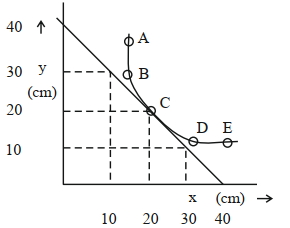 2024 Hard
- 91. Light from a point source in air falls on a convex curved surface of radius \(20 \mathrm{~cm}\) and refractive index \(1.5.\) If the source is located at \(100 \mathrm{~cm}\) from the convex surface, the image will be formed at _______ \(\mathrm{cm}\) from the object. 2024 Hard
- 92. move in opposite direction with speed ratio \(1: 2\). The following figure represents two biconvex lenses \(L_1\) and \(L_2\) having focal length \(10 \mathrm{~cm}\) and \(15 \mathrm{~cm}\) respectively. The distance between \(\mathrm{L}_1 \& \mathrm{~L}_2\) is _______.
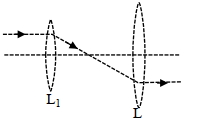 2024 Hard
- 93. The distance between object and its \(3\) times magnified virtual image as produced by a convex lens is \(20 \mathrm{~cm}\). The focal length of the lens used is _______ \(\mathrm{cm}\). 2024 Hard
- 94. The distance between object and its two times magnified real image as produced by a convex lens is \(45 \mathrm{~cm}\). The focal length of the lens used is _______ \(\mathrm{cm}\). 2024 Hard
- 95. The position of the image formed by the combination of lenses is _______. \(\mathrm{f}_1=10 \mathrm{~cm} \quad \mathrm{f}_2=10 \quad \mathrm{f}_3=30 \mathrm{~cm}\)
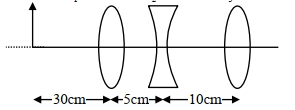 2024 Hard
- 96. The refractive index of a prism with apex angle \(A\) is \(\cot A / 2\). The angle of minimum deviation is _______. 2024 Hard
- 97. The refractive index of prism is \(\mu=\sqrt{3}\) and the ratio of the angle of minimum deviation to the angle of prism is one. The value of angle of prism is _______ \(^\circ\). 2024 Hard
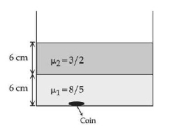
- 98. Two immiscible liquids of refractive indices \(\frac{8}{5}\) and \(\frac{3}{2}\) respectively are put in a beaker as shown in the figure. The height of each column is \(6 \mathrm{~cm}\). A coin is placed at the bottom of the beaker. For near normal vision, the apparent depth of the coin is \(\frac{\alpha}{4} \mathrm{~cm}\). The value of \(\alpha\) is__________.
 2024 Hard
- 99. A \(2\,meter\) long scale with least count of \(0.2\,cm\) is used to measure the locations of objects on an optical bench. While measuring the focal length of a convex lens, the object pin and the convex lens are placed at \(80\,cm\) mark and \(1\,m\) mark, respectively. The image of the object pin on the other side of lens coincides with image pin that is kept at \(180\,cm\) mark. The \(\%\) error in the estimation of focal length is 2023 Hard
- 100. A bi convex lens of focal length \(10\,cm\) is cut in two identical parts along a plane perpendicular to the principal axis. The power of each lens after cut is \(...........\,D\). 2023 Medium
No questions on this page match these filters.