


All STD 12 - Ray optics and optical instruments questions
Newest firstShowing 201–248 of 248 questions
- 201. A concave mirror for face viewing has focal length of \(0.4\,m.\) The distance at which you hold the mirror from your face in order to see your image upright with a magnification of \(5\) is......\(m\) 2019 Medium
- 202. A concave mirror has radius of curvature of \(40\, cm\). It is at the bottom of a glass that has water filled up to \(5\, cm\) (see figure). If a small particle is floating on the surface of water, its image as seen, from directly above the glass, is at a distance \(d\) from the surface of water. The value of \(d\) is close to ......\(cm\) (Refractive index of water \(= 1.33\))
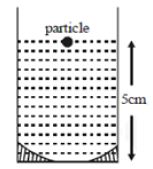 2019 Hard
- 203. A convex lens is put \(10\, cm\) from a light source and it makes a sharp image on a screen, kept \(10\, cm\) from the lens. Now a glass block (refractive index \(1.5\)) of \(1.5\, cm\) thickness is placed in contact with the light source. To get the sharp image again, the screen is shifted by a distance \(d\). Then \(d\) is 2019 Hard
- 204. A convex lens (of focal length \(20\, cm\)) and a concave mirror, having their principal axes along the same lines, are kept \(80\, cm\) apart from each other. The concave mirror is to the right of the convex lens. When an object is kept at a distance of \(30\, cm\) to the left of the convex lens, its image remains at the same position even if the concave mirror is removed. The maximum distance of the object for which this concave mirror, by itself would produce a virtual image would be.....\(cm\) 2019 Hard
- 205. A convex lens of focal length \(20\, cm\) produces images of the same magnification \(2\) when an object is kept at two distances \(x_1\) and \(x_2\) \((x_1 > x_2)\) from the lens. The ratio of \(x_1\) and \(x_2\) is 2019 Hard
- 206. A monochromatic light is incident at a certain angle on an equilateral triangular prism and suffers minimum deviation. If the refractive index of the material of the prism is \(\sqrt 3\) , then the angle of incidence....\(^o\) 2019 Medium
- 207. A plano-convex lens (focal length \(f_2,\) refractive index \(\mu _2,\) radius of curvature \(R\) ) fits exactly into a plano-concave lens (focal length \(f_1,\) refractive index \(\mu _1,\) radius of curvature \(R\) ). Their plane surfaces are parallel to each other. Then, the focal length of the combination will be 2019 Medium
- 208. A plano convex lens of refractive index \({\mu _1}\) and focal length \(f_1\) is kept in contact with another plano concave lens of refractive index \({\mu _2}\) and focal length \(f_2\). If the radius of curvature of their spherical faces is \(R\) each and \(f_1 = 2f_2\), then \({\mu _1}\) and \({\mu _2}\) are related as 2019 Hard
- 209. A ray of light \(AO\) in vacuum is incident on a glass slab at angle \(60^o\) and refracted at angle \(30^o\) along \(OB\) as shown in the figure. The optical path length of light ray from \(A\) to \(B\) is
 2019 Hard
- 210. A thin convex lens \(L\) (refractive index \(= 1.5\)) is placed on a plane mirror \(M\). When a pin is placed at \(A\), such that \(OA = 18\, cm\), its real inverted image is formed at \(A\) itself, as shown in figure. When a liquid of refractive index \({\mu _1}\) is put between the lens and the mirror, the pin has to be moved to \(A’\). such that \(OA’ = 27\,cm\), to get its inverted real image at \(A'\) itself. The value of \({\mu _1}\) will be
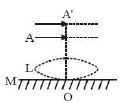 2019 Hard
- 211. A transparent cube of side \(d\), made of a material of refractive index \(\mu_2\), is immersed in a liquid of refractive index \(\mu_1(\mu_1 < \mu_2)\). A ray is incident on the face \(AB\) at an angle \(\theta \) (shown in the figure). Total internal reflection takes place at point \(E\) on the face \(BC\). The \(\theta\) must satisfy
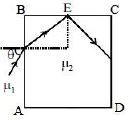 2019 Hard
- 212. An object is at a distance of \(20\,m\) from a convex lens of focal length \(0.3\,m.\) The lens forms an image of the object. If the object moves away from the lens at a speed of \(5\,m/s,\) the speed and direction of the image will be 2019 Medium
- 213. An upright object is placed at a distance of \(40\, cm\) in front of a convergent lens of focal length \(20\, cm\). A convergent mirror of focal length \(10\, cm\) is placed at a distance of \(60\, cm\) on the other side of the lens. The position and size of the final image will be 2019 Hard
- 214. Formation of real image using a biconvex lens is shown below: If the whole set up is immersed in water without disturbing the object and the screen positions, what will one observe on the screen?
 2019 Medium
- 215. In figure, the optical fiber is \(I = 2\,m\) long and has a diameter of \(d = 20\,\mu \,m\). If a ray of light is incident on one end of the fiber at angle \({\theta _1} = {40^o}\) , the number of reflection it makes before emerging from the other end is close to
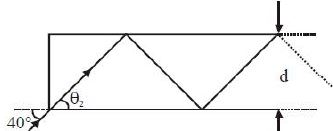 2019 Hard
- 216. One plano-convex and one plano-concave lens of same radius of curvature \(‘R’\) but of different materials are joined side by side as shown in the figure. If the refractive index of the material of \(1\) is \(\mu_1\) and that of \(2\) is \(\mu _2\), then the focal length of the combination is
 2019 Hard
- 217. The eye can be regarded as a single refracting surface. The radius of curvature of this surface is equal to that of cornea \((7.8\, mm)\). This surface separates two media of refractive indices \(1\) and \(1.34\). Calculate the distance from the refracting surface at which a parallel beam of light will come to focus.......\(cm\) 2019 Medium
- 218. The graph shows how the magnification \(m\) produced by a thin lens varies with image distance \(v\). What is the focal length of the lens used?
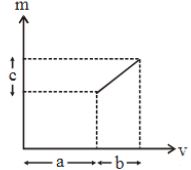 2019 Medium
- 219. Two plane mirrors are inclined to each other such that a ray of light incident to the first mirror \((M_1)\) and parallel to the second mirror \((M_2)\) is finally reflected from the second mirror \((M_2)\) parallel to the first mirror \((M_1).\) The angle between the two mirrors will be......\(^o\) 2019 Medium
- 220. What is the position and nature of image formed by lens combination shown in figure? (\(f_1, f_2\) are focal lengths)
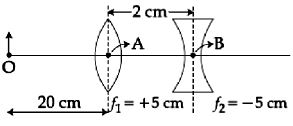 2019 Hard
- 221. A convergent doublet of separated lenses, corrected for spherical aberration, has resultant focal length of \(10\,cm\). The separation between the two lenses is \(2\,cm\). The focal lengths of the component lenses 2018 Hard
- 222. A particle is oscillating on the \(X-\) axis with an amplitude \(2\, cm\) about the point \(x_0 = 10\, cm\) with a frequency \(\omega \). A concave mirror of focal length \(5\,
cm\) is placed at the origin ( see figure) Identify the correct statements \((A)\) The image executes periodic motion \((B)\) The image executes non-periodic motion \((C)\) The turning points of the image are asymmetric w.r.t the image of the point at \(x =10\,cm\) \((D)\) The distance between the turning points of the oscillation of the image is \(\frac{{100}}{{21}}\)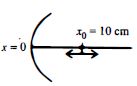 2018 Hard
- 223. A planoconvex lens becomes an optical system of \(28\, cm\) focal length when its plane surface is silvered and illuminated from left to right as shown in Fig \(-A\). If the same lens is instead silvered on the curved surface and illuminated from other side as in Fig. \(B\), it acts like an optical system of focal length \(10 \,cm\). The refractive index of the material of lens is
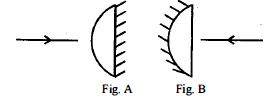 2018 Hard
- 224. A ray of light is incident at an angle of \(60^o\) on one face of a prism of angle \(30^o\) . The emergent ray of light makes an angle of \(30^o\) with incident ray. The angle made by the emergent ray with second face of prism will be....\(^o\) 2018 Hard
- 225. A diverging lens with magnitude of focal length \(25\ cm\) is placed at a distance of \(15\ cm\) from a converging lens of magnitude of focal length \(20\ cm\). A beam of parallel light falls on the diverging lens. The final image formed is 2017 Medium
- 226. In an experiment a convex lens of focal length \(15\, cm\) is placed coaxially on an optical bench in front of a convex mirror at a distance of \(5\,cm\) from it. It is found that an object and its image coincide, if the object is placed at a distance of \(20\,cm\) from the lens. The focal length of the convex mirror is.......\(cm\) 2017 Hard
- 227. Let the refractive index of a denser medium with respect to a rarer medium be \(n_{12}\) and its critical angle be \(\theta_C\). At an angle of incidence \(A\) when light is travelling from denser medium to rarer medium, a part of the light is reflected and the rest is refracted and the angle between reflected and refracted rays is \(90^o\). Angle \(A\) is given by 2017 Hard
- 228. A convex lens, of focal length \(30\,cm,\) a concave lens of focal length \(120\,cm,\) and a plane mirror are arranged as shown. For an object kept at a distance of \(60\,cm\) from the convex lens, the final image, formed by the combination, is a real image, at a distance of
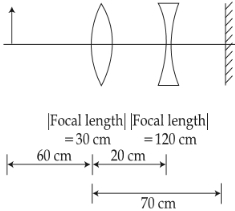 2016 Hard
- 229. A hemispherical glass body of radius \(10\, cm\) and refractive index \(1.5\) is silvered on its curved surface. A small air bubble is \(6\, cm\) below the flat surface inside it along the axis. The position of the image of the air bubble made by the mirror is seen
 2016 Hard
- 230. An observer looks at a distant tree of height \(10\ m\) with a telescope of magnifying power of \(20\). To the observer the tree appears : 2016 Easy
- 231. In an experiment for determination of refractive index of glass of a prism by \(i - \delta\) , plot it was found thata ray incident at angle \(35 ^o \), suffers a deviation of \(40 ^o \) and that it emerges at angle \(7 9 ^o \). In that case which of the following is closest to the maximum possible value of the refractive index? 2016 Medium
- 232. To determine refractive index of glass slab using a travelling microscope, minimum number of readings required are 2016 Medium
- 233. To find the focal length of a convex mirror, a student records the following data
The focal length of the convex lens is \(f_1\) and that of mirror is \(f_2\). Then taking index correction to be negligibly small, \(f_1\) and \(f_2\) are close to 2016 HardObject Pin Convex Lens Convex Mirror Image Pin \(22.2\,cm\) \(32.2\,cm\) \(45.8\,cm\) \(71.2\,cm\) - 234. A telescope has an objective lens of focal length \(150\,\,cm\) and an eyepiece of focal length \(5 \,\,cm.\) If a \(50\,\,m\) tall tower at a distance of \(1\,\,km\) is observed through this telescope in normal setting, the angle formed by the image of the tower is \(\theta \), then \(\theta \) is close to.....\(^o\) 2015 Hard
- 235. A thin convex lens of focal length \('f'\) is put on a plane mirror as shown in the figure. When an object is kept at a distance \('a'\) from the lens - mirror combination, its image is formed at a distance \(\frac{a}{3}\) in front of the combination. The value of \('a'\) is
 2015 Hard
- 236. Monochromatic light is incident on a glass prism of angle \(A\). If the refractive index of the material of the prism is \(μ\), a ray, incident at an angle \(\theta\), on the face \(AB\) would get transmitted through the face \(AC\) of the prism provided
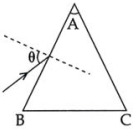 2015 Hard
- 237. You are asked to design a shaving mirror assuming that a person keeps it \(10\,cm\) from his face and views the magnified image of the face at the closest comfortable distance of \(25\,cm.\) The radius of curvature of the mirror would then be.....\(cm\) 2015 Medium
- 238. A diver looking up through the water sees the outside world contained in a circular horizon. The refractive index of water is \(\frac{4}{3}\), and the diver's eyes are \(15\, cm\) below the surface of water. Then the radius of the circle is 2014 Hard
- 239. A green light is incident from the water to the air - water interface at the critical angle \((\theta)\). Select the correct statement . 2014 Easy
- 240. A thin convex lens made from crown glass \(\left( {\mu = \frac{3}{2}} \right)\) has focal length \(f\). When it is measured in two different liquids having refractive indices \(\frac{4}{3}\) and \(\frac{5}{3}\) it has the focal lengths \(f_1\) and \(f_2\) respectively. The correct relation between the focal lengths is: 2014 Medium
- 241. An object is located in a fixed position in front of a screen. Sharp image is obtained on the screen for two positions of a thin lens separated by \(10\, cm\). The size of the images in two situations are in the ratio \(3 : 2\). What is the distance between the screen and the object?......\(cm\) 2014 Hard
- 242. In a compound microscope the focal length of objective lens is \(1.2\, cm\) and focal length of eye piece is \(3.0\, cm\). When object is kept at \(1.25\, cm\) in front of objective, final image is formed at infinity. Magnifying power of the compound microscope should be 2014 Hard
- 243. The focal lengths of objective lens and eye lens of a Galilean telescope are respectively \(30\, cm\) and \(3.0\, cm\). telescope produces virtual, erect image of an object situated far away from it at least distance of distinct vision from the eye lens. In this condition, the magnifying power of the Galilean telescope should be 2014 Medium
- 244. A printed page is pressed by a glass of water. The refractive index of the glass and water is \(1.5\) and \(1.33\), respectively. If the thickness of the bottom of glass is \(1\, cm\) and depth of water is \(5\, cm\) , how much the page will appear to be shifted if viewed from the top ? 2013 Medium
- 245. Light is incident from a medium into air at two possible angles of incidence \((A)\, 20^o\) and \((B)\, 40^o\) . In the medium light travels \(3.0\, cm\) in \(0.2\, ns\). The ray will 2013 Hard
- 246. The focal length of the objective and the eyepiece of a telescope are \(50\,cm\) and \(5\,cm\) respectively. If the telescope is focussed for distinct vision on a scale distant \(2\,m\) from its objective, then its magnifying power will be 2013 Hard
- 247. The image of an illuminated square is obtained on a screen with the help of a converging lens. The distance of the square from the lens is \(40\,cm.\) The area of the image is \(9\,times\) that of the square. The focal length of the lens is........\(cm\) 2013 Hard
- 248. This question has Statement \(-1\) and Statement \(-2\). Of the four choices given after the Statements, choose the one that best describes the two Statements. Statement \(1\) : Very large size telescopes are reflecting telescopes instead of refracting telescopes. Statement \(2\) : It is easier to provide mechanical support to large size mirrors than large size lenses. 2013 Hard
No questions on this page match these filters.