


All STD 11 - Oscillations questions
Newest firstShowing 101–150 of 158 questions
- 101. The point \(A\) moves with a uniform speed along the circumference of a circle of radius \(0.36\, m\) and covers \(30^{\circ}\) in \(0.1\, s\). The perpendicular projection \('P'\) from \('A'\) on the diameter \(MN\) represents the simple harmonic motion of \('P'.\) The restoration force per unit mass when \(P\) touches \(M\) will be ...... \(N\)
 2021 Hard
- 102. Time period of a simple pendulum is \(T\) inside a lift when the lift is stationary. If the lift moves upwards with an acceleration \(g / 2,\) the time period of pendulum will be 2021 Medium
- 103. Time period of a simple pendulum is \(T\). The time taken to complete \(5 / 8\) oscillations starting from mean position is \(\frac{\alpha}{\beta} T\). The value of \(\alpha\) is ..... . 2021 Hard
- 104. Two identical springs of spring constant \('2k'\) are attached to a block of mass \(m\) and to fixed support (see figure). When the mass is displaced from equilibrium position on either side, it executes simple harmonic motion. The time period of oscillations of this sytem is ...... .
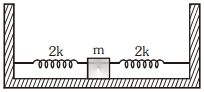 2021 Medium
- 105. Two particles \(A\) and \(B\) of equal masses are suspended from two massless springs of spring constants \(K _{1}\) and \(K _{2}\) respectively.If the maximum velocities during oscillations are equal, the ratio of the amplitude of \(A\) and \(B\) is 2021 Medium
- 106. Two simple harmonic motion, are represented by the equations \({y}_{1}=10 \sin \left(3 \pi {t}+\frac{\pi}{3}\right)\) \(y_{2}=5(\sin 3 \pi t+\sqrt{3} \cos 3 \pi t)\) Ratio of amplitude of \({y}_{1}\) to \({y}_{2}={x}: 1\). The value of \({x}\) is ...... . 2021 Medium
- 107. Two simple harmonic motions are represented by the equations \({x}_{1}=5 \sin \left(2 \pi {t}+\frac{\pi}{4}\right)\) and \({x}_{2}=5 \sqrt{2}(\sin 2 \pi {t}+\cos 2 \pi {t})\) The amplitude of second motion is ....... times the amplitude in first motion. 2021 Medium
- 108. When a particle executes \(SHM\) the nature of graphical representation of velocity as a function of displacement is : 2021 Medium
- 109. \(Y = A \sin \left(\omega t +\phi_{0}\right)\) is the time-displacement equation of a SHM. At \(t=0\) the displacement of the particle is \(Y =\frac{ A }{2}\) and it is moving along negative \(x\) -direction. Then the initial phase angle \(\phi_{0}\) will be ...... . 2021 Hard
- 110. A block of mass \(m\) attached to massless spring is performing oscillatory motion of amplitude \('A'\) on a frictionless horizontal plane. If half of the mass of the block breaks off when it is passing through its equilibrium point, the amplitude of oscillation for the remaining system become \(fA.\) The value of \(f\) is 2020 Medium
- 111. A \(LCR\) circuit behaves like a damped harmonic oscillator. Comparing it with a physical springmass damped oscillator having damping constant \(\mathrm{b}\), the correct equivalence would be: 2020 Hard
- 112. A ring is hung on a nail. It can oscillate, without slipping or sliding \((i)\) in its plane with a time period \(T_{1}\) and, \((ii)\) back and forth in a direction perpendicular to its plane, with a period \(T _{2}\). the ratio \(\frac{ T _{1}}{ T _{2}}\) will be 2020 Hard
- 113. An object of mass \(m\) is suspended at the end of a massless wire of length \(L\) and area of cross\(-\)section, \(A\). Young modulus of the material of the wire is \(Y\). If the mass is pulled down slightly its frequency of oscillation along the vertical direction is 2020 Medium
- 114. The displacement time graph of a particle executing \(S.H.M.\) is given in figure: (sketch is schematic and not to scale) Which of the following statements is are true for this motion? \((A)\) The force is zero \(t=\frac{3 T}{4}\) \((B)\) The acceleration is maximum at \(t=T\) \((C)\) The speed is maximum at \(t =\frac{ T }{4}\) \((D)\) The \(P.E.\) is equal to \(K.E.\) of the oscillation at \(t=\frac{T}{2}\)
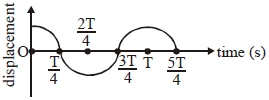 2020 Hard
- 115. When a particle of mass \(m\) is attached to a vertical spring of spring constant \(k\) and released, its motion is described by \(y ( t )= y _{0} \sin ^{2} \omega t ,\) where \('y'\) is measured from the lower end of unstretched spring. Then \(\omega\) is 2020 Hard
- 116. A damped harmonic oscillator has a frequency of \(5\) oscillations per second. The amplitude drops to half its value for every \(10\) oscillations. The time it will take to drop to \(\frac{1}{1000}\) of the original amplitude is close to .... \(s\) 2019 Hard
- 117. A massless spring \((k = 800\, N/m)\), attached with a mass \((500\, g)\) is completely immersed in \(1\, kg\) of water. The spring is stretched by \(2\, cm\) and released so that it starts vibrating. What would be the order of magnitude of the change in the temperature of water when the vibrations stop completely? (Assume that the water container and spring receive negligible heat and specific heat of mass \(= 400\, J/kg\, K\), specific heat of water \(= 4184\, J/kg\, K\)) 2019 Hard
- 118. A particle executes simple harmonic motion with an amplitude of \(5\, cm\). When the particle is at \(4\, cm\) from the mean position, the magnitude of its velocity is \(SI\,units\) is equal to that of its acceleration. Then, its periodic time in seconds is 2019 Medium
- 119. A particle is executing simple harmonic motion \((SHM)\) of amplitude \(A,\) along the \(x-\) axis, about \(x = 0.\) When its potential energy \((PE)\) equals kinetic energy \((KE),\) the position of the particle will be 2019 Medium
- 120. A particle of mass \(m\) is moving along a trajectory given by
\(x = x_0 + a\, cos\,\omega_1 t\)
\(y = y_0 + b\, sin\,\omega_2t\)
The torque, acing on the particle about the origin, at \(t = 0\) is 2019 Hard - 121. A particle undergoing simple harmonic motion has time dependent displacement given by \(x(t)\, = \,A\,\sin \,\frac{{\pi t}}{{90}}\). The ratio of kinetic to potential energy \(o\) the particle at \(t=210\,s\) will be 2019 Medium
- 122. A pendulum is executing simple harmonic motion and its maximum kinetic energy is \(K_1\). If the length of the pendulum is doubled and it performs simple harmonic motion with the same amplitude as in the first case, its maximum kinetic energy is \(K_2\) then 2019 Medium
- 123. A person of mass \(M\) is, sitting on a swing of length \(L\) and swinging with an angular amplitude \(\theta_0\). If the person stands up when the swing passes through its lowest point, the work done by him, assuming that his centre of mass moves by a distance \(l\, ( l < < L)\), is close to 2019 Hard
- 124. A rod of mass \(‘M’\) and length \(‘2L’\) is suspended at its middle by a wire. It exhibits torsional oscillations; If two masses each of \(‘m’\) are attached at distance \(‘L/2’\) from its centre on both sides, it reduces the oscillation frequency by \(20\%\). The value of ratio \(m/M\) is close to 2019 Hard
- 125. A simple harmonic motion is represented by \(y\, = 5\,(\sin \,3\pi t\, + \,\sqrt 3 \,\cos \,3\pi t)\,cm\) The amplitude and time period of the motion are 2019 Medium
- 126. A simple pendulum of length \(1\, m\) is oscillating with an angular frequency \(10\, rad/s\). The support of the pendulum starts oscillating up and down with a small angular frequency of \(1\, rad/s\) and an amplitude of \(10^{-2}\, m\). The relative change in the angular frequency of the pendulum is best given by 2019 Medium
- 127. A simple pendulum oscillating in air has period \(T.\) The bob of the pendulum is completely immersed in a non-viscous liquid. The density of the liquid is \(\frac {1}{16}\) of the material of the bob. If the bob is inside liquid all the time, its period of oscillation in this liquid is 2019 Hard
- 128. A spring whose unstretched length is \(\ell \) has a force constant \(k\). The spring is cut into two pieces of unstretched lengths \(\ell_1\) and \(\ell_2\) where, \(\ell_1 = n\ell_2\) and \(n\) is an integer. The ratio \(k_1/k_2\) of the corresponding force constants, \(k_1\) and \(k_2\) will be 2019 Medium
- 129. The displacement of a damped harmonic oscillator is given by \(x\left( t \right) = {e^{ - 0.1\,t}}\,\cos \left( {10\pi t + \varphi } \right)\) The time taken for its amplitude of vibration to drop to half of its initial value is close to .... \(s\) 2019 Medium
- 130. The position co-ordinates of a particle moving in a \(3-D\) coordinates system is given by \(x = a\,cos\,\omega t\) , \(y = a\,sin\,\omega t\) and \(z = a\omega t\) The speed of the particle is 2019 Medium
- 131. Two light identical springs of spring constant \(k\) are attached horizontally at the two ends of a uniform horizontal rod \(AB\) of length \(l\) and mass \(m\). the rod is pivoted at its centre \(‘O’\) and can rotate freely in horizontal plane. The other ends of the two springs are fixed to rigid supports as shown in figure. The rod is gently pushed through a small angle and released. The frequency of resulting oscillation is
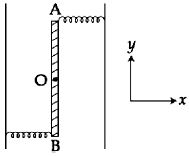 2019 Hard
- 132. A particle executes simple harmonic motion and is located at \(x = a, b\) and \(c\) at times \(t_0, 2t_0\) and \(3t_0\) respectively. The frequency of the oscillation is 2018 Hard
- 133. An oscillator of mass \(M\) is at rest in its equilibrium position in a potential \(V\, = \,\frac{1}{2}\,k{(x - X)^2}.\) A particle of mass \(m\) comes from right with speed \(u\) and collides completely inelastically with \(M\) and sticks to it . This process repeats every time the oscillator crosses its equilibrium position .The amplitude of oscillations after \(13\) collisions is: \((M = 10,\, m = 5,\, u = 1,\, k = 1 ).\) 2018 Hard
- 134. silver atom in a solid oscillates in simple harmonic motion in some direction with a frequency of \(10^{12} /sec\). What is the force constant of the bonds connecting one atom with the other? ................ \(\mathrm{N/m}\) (Mole wt. of silver \(= 108 \) andAvagadro number \(= 6.02 \times 10^{23}\) \(gm \ mole^{ -1}\) ) 2018 Medium
- 135. Two simple harmonic motions, as shown, are at right angles. They are combined to form Lissajous figures \(x\left( t \right) = A\,\sin \,\left( {at + \delta } \right)\) \(y\left( t \right) = B\,\sin \,\left( {bt} \right)\) Identify the correct match below 2018 Hard
- 136. A \(1 \,kg\) block attached to a spring vibrates with a frequency of \(1\, Hz\) on a frictionless horizontal table. Two springs identical to the original spring are attached in parallel to an \(8\, kg\) block placed on the same table. So, the frequency of vibration of the \(8\, kg\) block is ..... \(Hz\) 2017 Medium
- 137. A block of mass \(0.1\, kg\) is connected to an elastic spring of spring constant \(640\, Nm^{-1}\) and oscillates in a damping medium of damping constant \(10^{-2}\, kg\,s^{-1}\) . The system dissipates its energy gradually. The time taken for its mechanical energy of vibration to drop to half of its initial value, is closest to ..... \(s\) 2017 Hard
- 138. In an experiment to determine the period of a simple pendulum of length \(1\, m\), it is attached to different spherical bobs of radii \(r_1\) and \(r_2\) . The two spherical bobs have uniform mass distribution. If the relative difference in the periods, is found to be \(5\times10^{-4}\, s\), the difference in radii, \(\left| {{r_1} - {r_2}} \right|\) is best given by .... \(cm\) 2017 Hard
- 139. The ratio of maximum acceleration to maximum velocity in a simple harmonic motion is \(10\,s^{-1}\). At, \(t = 0\) the displacement is \(5\, m\). What is the maximum acceleration ? The initial phase is \(\frac{\pi }{4}\) 2017 Hard
- 140. A pendulume clock loses \(12\;s\) a day if the temperature is \(40^oC\) and gains \(4\;s\) a day if the temperature is \(20^oC\). The temperature at which the clock will show correct time, and the coeffecient of linear expansion \((\alpha)\) of the metal of the pendulum shaft are respectively 2016 Hard
- 141. In an engine the piston undergoes vertical simple harmonic motion with amplitude \(7\, cm\) . A washer rests on top of the piston and moves with it. The motor speed is slowly increased. The frequency of the piston at which the washer no longer stays in contact with the piston, is close to ...... \(Hz\) 2016 Medium
- 142. Two particles are performing simple harmonic motion in a straight line about the same equilibrium point. The amplitude and time period for both particles are same and equal to \(A\) and \(T,\) respectively. At time \(t=0\) one particle has displacement \(A\) while the other one has displacement \(\frac {-A}{2}\) and they are moving towards each other. If they cross each other at time \(t,\) then \(t\) is 2016 Hard
- 143. A cylindrical block of wood (density \(= 650\, kg\, m^{-3}\)), of base area \(30\,cm^2\) and height \(54\, cm\), floats in a liquid of density \(900\, kg\, m^{-3}\) . The block is depressed slightly and then released. The time period of the resulting oscillations of the block would be equal to that of a simple pendulum of length ..... \(cm\) (nearly) 2015 Medium
- 144. A pendulum with time period of \(1\, s\) is losing energy due to damping. At certain time its energy is \(45\, J\). If after completing \(15\,oscillations\) , its energy has become \(15\, J\), its damping constant (in \(s^{-1}\) ) is 2015 Medium
- 145. A simple harmonic oscillator of angular frequency \(2\,rad\,s^{-1}\) is acted upon by an external force \(F = sin\,t\,N .\) If the oscillator is at rest in its equilibrium position at \(t = 0,\) its position at later times is proportional to 2015 Hard
- 146. pendulum made of a uniform wire of cross sectional area \(A\) has time period \(T\). When an additional mass \(M\) is added to its bob, the time period changes to \(T_M\). If the Young's modulus of the material of the wire is \(Y\) then \(\frac{1}{Y}\) is equal to : (\(g\) = gravitational acceleration) 2015 Hard
- 147. A body is in simple harmonic motion with time period half second \((T\, = 0.5\, s)\) and amplitude one \(cm\, (A\,= 1\, cm)\). Find the average velocity in the interval in which it moves form equilibrium position to half of its amplitude .... \(cm/s\) 2014 Medium
- 148. In an experiment for determining the gravitational acceleration \(g\) of a place with the help of a simple pendulum, the measured time period square is plotted against the string length of the pendulum in the figure. What is the value of \(g\) at the place? ...... \(m/s^2\)
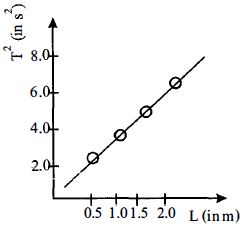 2014 Medium
- 149. particle moves with simple harmonic motion in a straight line. In first \(\tau\ s\), after starting from rest it travels a distance \(a\), and in next \(\tau\ s\) it travels \(2a\), in same direction, then 2014 Hard
- 150. The angular frequency of the damped oscillator is given by, \(\omega = \sqrt {\left( {\frac{k}{m} - \frac{{{r^2}}}{{4{m^2}}}} \right)} \) where \(k\) is the spring constant, \(m\) is the mass of the oscillator and \(r\) is the damping constant. If the ratio \(\frac{{{r^2}}}{{mk}}\) is \(8\%\), the change in time period compared to the undamped oscillator is approximately as follows 2014 Medium
No questions on this page match these filters.