


JEE Mains · Physics · STD 11 - 13. oscillations
Two particles are performing simple harmonic motion in a straight line about the same equilibrium point. The amplitude and time period for both particles are same and equal to \(A\) and \(T,\) respectively. At time \(t=0\) one particle has displacement \(A\) while the other one has displacement \(\frac {-A}{2}\) and they are moving towards each other. If they cross each other at time \(t,\) then \(t\) is
- A \(\frac{{5T}}{6}\)
- B \(\frac{{T}}{3}\)
- C \(\frac{{T}}{4}\)
- D \(\frac{{T}}{6}\)
Answer & Solution
Correct Answer
(D) \(\frac{{T}}{6}\)
Step-by-step Solution
Detailed explanation
Angle covered to meet \(\theta=60^{\circ}=\frac{\pi}{3} \mathrm{rad}\) If they cross each other at time \(t\) then \(t=\frac{\theta}{2 \pi}=\frac{\pi}{3 \times 2 \pi} \mathrm{T}=\frac{\mathrm{T}}{6}\)
See the Complete Solution
Get step-by-step explanations for this and 2.5 Lakh+ more JEE, NEET & CET questions.
- Unlock all solutions
- Practice the full chapter
- Track accuracy across PYQs
4.8 rated on Google Play · 14,000+ reviews
More questions from Physics
- A small metallic sphere of diameter 2 mm and density \(10.5 g / cm ^3\) is dropped in glycerine having viscosity 10 Poise and density \(1.5 g / cm ^3\) respectively. The terminal velocity attained by the sphere is ___________ \(cm / s\).
\(\left(\pi=\frac{22}{7}\right.\) and \(\left.g=10 m / s ^2\right)\)JEE Mains 2026 Hard - In an experiment to find acceleration due to gravity \((g)\) using simple pendulum, time period of \(0.5\,s\) is measured from time of \(100\) oscillation with a watch of \(1\;s\) resolution. If measured value of length is \(10\; cm\) known to \(1\; mm\) accuracy. The accuracy in the determination of \(g\) is found to be \(x \%\). The value of \(x\) isJEE Mains 2022 Medium
- The magnetic field of an electromagnetic wave is given by \(\vec B = 1.6 \times {10^{ - 6}}\,\cos \,\left( {2 \times {{10}^7}z + 6 \times {{10}^{15}}t} \right)\left( {2\hat i + \hat j} \right)\frac{{Wb}}{{{m^2}}}\) The associated electric field will beJEE Mains 2019 Medium
- In an experiment with photoelectric effect, the stopping potential,JEE Mains 2025 Medium
- The electric field of an electromagnetic wave in free space is represented as \(\vec{E}=E_0 \cos (\omega t-k z) \hat{i}\). The corresponding magnetic induction vector will be _______.JEE Mains 2024 Hard
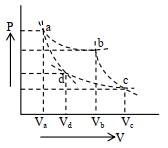
- Two different adiabatic paths for the same gas intersect two isothermal curves as shown in\(P-V\) diagram. The relation between the ratio \(\frac{V_a}{V_d}\) and the ratio \(\frac{V_b}{V_c}\) is _______.
 JEE Mains 2024 Hard
More PYQs from JEE Mains
- Resistance of a wire at \(0^{\circ} \mathrm{C}, 100^{\circ} \mathrm{C}\) and \(t^{\circ} \mathrm{C}\) is found to be \(10 \Omega, 10.2 \Omega\) and \(10.95 \Omega\) respectively. The temperature \(t\) in Kelvin scale is _______.JEE Mains 2024 Hard
- The \(H\) amount of thermal energy is developed by a resistor in \(10\,s\) when a current of \(4\,A\) is passed through it. If the current is increased to \(16\,A\), the thermal energy developed by the resistor in \(10\,s\) will be \(........\,H\)JEE Mains 2023 Medium
- \(5\) moles of unknown gas is heated at constant volume from \(10 \, °C\) to \(20 \, °C\). The molar specific heat of this gas at constant pressure \(c_p = 8\) cal/mol.°C and \(R = 8.36\) J/mol.°C. The change in the internal energy of the gas is _______ calorie.JEE Mains 2026 Medium
- If \(\int \frac{\sin x}{\sin ^{3} x+\cos ^{3} x} d x=\) \(\alpha \log _{\mathrm{e}}|1+\tan \mathrm{x}|+\beta \log _{\mathrm{c}}\left|1-\tan \mathrm{x}+\tan ^{2} \mathrm{x}\right|+\gamma \tan ^{-1}\left(\frac{2 \tan \mathrm{x}-1}{\sqrt{3}}\right)+\mathrm{C}\) when \(\mathrm{C}\) is constant of integration, then the value of \(18\left(\alpha+\beta+\gamma^{2}\right)\) is .... .JEE Mains 2021 Hard
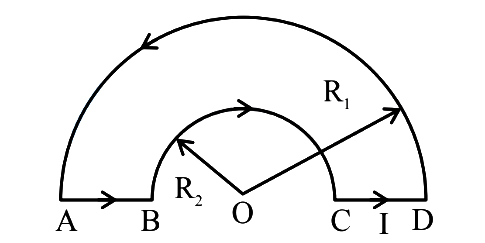
- A loop ABCDA , carrying current \(\mathrm{I}=12 \mathrm{~A}\), is placed in a plane, consists of two semi-circular segments of radius \(R_1=6 \pi \mathrm{~m}\) and \(\mathrm{R}_2=4 \pi \mathrm{~m}\). The magnitude of the resultant magnetic field at center O is \(\mathrm{k} \times 10^{-7} \mathrm{~T}\). The value of k is ______ (Given \(\mu_0=4 \pi \times 10^{-7} \mathrm{Tm} \mathrm{A}^{-1}\))
 JEE Mains 2025 Medium
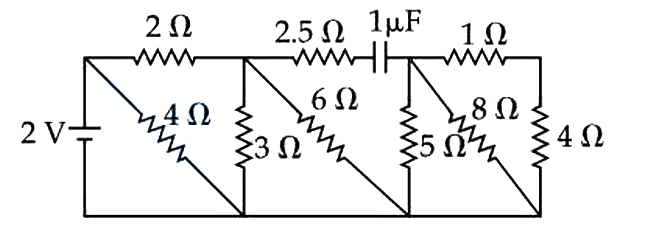
 - The net current flowing in the given circuit is_______ A.
 JEE Mains 2025 Medium