


All STD 12 - Electric charges and fields questions
Newest firstShowing 101–150 of 161 questions
- 101. A particle of mass \(1 \,{mg}\) and charge \(q\) is lying at the mid-point of two stationary particles kept at a distance \('2 \,{m}^{\prime}\) when each is carrying same charge \('q'.\) If the free charged particle is displaced from its equilibrium position through distance \('x'\) \((x\,< \,1\, {m})\). The particle executes \(SHM.\) Its angular frequency of oscillation will be \(....\,\times 10^{8}\, {rad} / {s}\) if \({q}^{2}=10\, {C}^{2}\) 2021 Hard
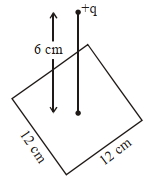
- 102. A point charge of \(+\,12 \,\mu C\) is at a distance \(6 \,cm\) vertically above the centre of a square of side \(12\, cm\) as shown in figure. The magnitude of the electric flux through the square will be ....... \(\times 10^{3} \,Nm ^{2} / C\)
 2021 Medium
- 103. A uniformly charged disc of radius \(R\) having surface charge density \(\sigma\) is placed in the \({xy}\) plane with its center at the origin. Find the electric field intensity along the \(z\)-axis at a distance \(Z\) from origin :- 2021 Hard
- 104. An electric dipole is placed on \({x}\)-axis in proximity to a line charge of linear charge density \(3.0 \times 10^{-6}\, {C} / {m}\). Line charge is placed on \(z-\)axis and positive and negative charge of dipole is at a distance of \(10\, {mm}\) and \(12\, {mm}\) from the origin respectively. If total force of \(4\, {N}\) is exerted on the dipole, find out the amount of positive or negative charge of the dipole. 2021 Hard
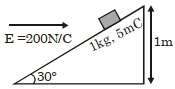
- 105. An inclined plane making an angle of \(30^{\circ}\) with the horizontal is placed in a uniform horizontal electric field \(200 \, \frac{ N }{ C }\) as shown in the figure. A body of mass \(1\, kg\) and charge \(5\, mC\) is allowed to slide down from rest at a height of \(1\, m\). If the coefficient of friction is \(0.2,\) find the time (in \(s\) )taken by the body to reach the bottom. \(\left[ g =9.8 \,m / s ^{2}, \sin 30^{\circ}=\frac{1}{2}\right.\); \(\left.\cos 30^{\circ}=\frac{\sqrt{3}}{2}\right]\)
 2021 Hard
- 106. An infinite number of point charges, each carrying \(1 \,\mu C\) charge, are placed along the y-axis at \(y=1\, m , 2\, m , 4 \,m , 8\, m \ldots \ldots \ldots \ldots \ldots\) The total force on a \(1 \,C\) point charge, placed at the origin, is \(x \times 10^{3}\, N\). The value of \(x\), to the nearest integer, is ......... [Take \(\left.\frac{1}{4 \pi \epsilon_{0}}=9 \times 10^{9} \,Nm ^{2} / C ^{2}\right]\) 2021 Medium
- 107. An oil drop of radius \(2\, mm\) with a density \(3\, g\) \(cm ^{-3}\) is held stationary under a constant electric field \(3.55 \times 10^{5}\, V\, m ^{-1}\) in the Millikan's oil drop experiment. What is the number of excess electrons that the oil drop will possess ? (consider \(\left. g =9.81\, m / s ^{2}\right)\) 2021 Hard
- 108. Choose the incorrect statement : \((a)\) The electric lines of force entering into a Gaussian surface provide negative flux. \((b)\) A charge ' \(q\) ' is placed at the centre of a cube. The flux through all the faces will be the same. \((c)\) In a uniform electric field net flux through a closed Gaussian surface containing no net charge, is zero. \((d)\) When electric field is parallel to a Gaussian surface, it provides a finite non-zero flux. Choose the most appropriate answer from the options given below 2021 Medium
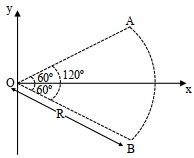
- 109. Figure shows a rod \({AB}\), which is bent in a \(120^{\circ}\) circular arc of radius \(R\). A charge \((-Q)\) is uniformly distributed over rod \({AB}\). What is the electric field \(\overrightarrow{{E}}\) at the centre of curvature \({O}\) ?
 2021 Hard
- 110. Find out the surface charge density at the intersection of point \(x =3\, m\) plane and \(x\) -axis, in the region of uniform line charge of \(8\, nC / m\) lying along the \(z\) -axis in free space. 2021 Hard
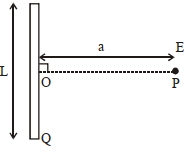
- 111. Find the electric field at point \(P\) (as shown in figure) on the perpendicular bisector of a uniformly charged thin wire of length \(L\) carrying a charge \(Q.\) The distance of the point \(P\) from the centre of the rod is \(a=\frac{\sqrt{3}}{2} L\).
 2021 Hard
- 112. Given below are two statements: Statement \(I :\) An electric dipole is placed at the centre of a hollow sphere. The flux of electric field through the sphere is zero but the electric field is not zero anywhere in the sphere. Statement \(II :\) If \(R\) is the radius of a solid metallic sphere and \(Q\) be the total charge on it. The electric field at any point on the spherical surface of radius \(r ( < R )\) is zero but the electric flux passing through this closed spherical surface of radius \(r\) is not zero. In the light of the above statements, choose the correct answer from the options given below: 2021 Hard
- 113. The electric field in a region is given by \(\vec E = \frac{3}{5}{E_0}\hat i + \frac{4}{5}{E_0}\hat j\) and \(E_0 = 2\times10^3\, N/C\). Then, the flux of this field through a rectangular surface of area \(0.2\, m^2\) parallel to the \(y-z\) plane is......\(\frac{{N - {m^2}}}{C}\) 2021 Medium
- 114. The electric field in a region is given by \(\overrightarrow{ E }=\frac{2}{5} E _{0} \hat{ i }+\frac{3}{5} E _{0} \hat{ j }\) with \(E _{0}=4.0 \times 10^{3}\, \frac{ N }{ C } .\) The flux of this field through a rectangular surface area \(0.4 \,m ^{2}\) parallel to the \(Y - Z\) plane is ....... \(Nm ^{2} C ^{-1}\) 2021 Medium
- 115. The electric field in a region is given \(\overrightarrow{ E }=\left(\frac{3}{5} E _{0} \hat{ i }+\frac{4}{5} E _{0} \hat{ j }\right) \frac{ N }{ C } .\) The ratio of flux of reported field through the rectangular surface of area \(0.2\, m ^{2}\) (parallel to \(y - z\) plane) to that of the surface of area \(0.3\, m ^{2}\) (parallel to \(x - z\) plane \()\) is \(a : b ,\) where \(a =\) ............. [Here \(\hat{ i }, \hat{ j }\) and \(\hat{ k }\) are unit vectors along \(x , y\) and \(z-\)axes respectively] 2021 Hard
- 116. The total charge enclosed in an incremental volume of \(2 \times 10^{-9} \,{m}^{3}\) located at the origin is ...... \(nC,\) if electric flux density of its field is found as \(D=e^{-x} \sin y \hat{i}-e^{-x} \cos y \hat{j}+2 z \hat{k}\, C / m^{2}\) 2021 Hard
- 117. Two electrons each are fixed at a distance \('2d'\). A third charge proton placed at the midpoint is displaced slightly by a distance \(x ( x << d )\) perpendicular to the line joining the two fixed charges. Proton will execute simple harmonic motion having angular frequency : \(( m =\) mass of charged particle) 2021 Hard
- 118. Two ideal electric dipoles \(A\) and \(B\) having their dipole moment \(p_{1}\) and \(p_{2}\) respectively are placed on a plane with their centres at \(O\) as shown in the figure. At point \(C\) on the axis of dipole \(A\), the resultant electric field is making an angle of \(37^{\circ}\) with the axis. The ratio of the dipole moment of \(A\) and \(B, \frac{P_{1}}{P_{2}}\) is \(....\) (take \(\left.\sin 37^{\circ}=\frac{3}{5}\right)\)
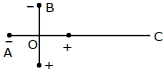 2021 Hard
- 119. Two identical conducting spheres with negligible volume have \(2.1\, nC\) and \(-0.1\, nC\) charges, respectively. They are brought into contact and then separated by a distance of \(0.5 \,m\). The electrostatic force acting between the spheres is \(.......... \, \times 10^{-9} \,N\) [Given : \(4 \pi \varepsilon_{0}=\frac{1}{9 \times 10^{9}} SI\) unit] 2021 Medium
- 120. Two identical tennis balls each having mass \(m\) and charge \(q\) are suspended from a fixed point by threads of length \(l\). What is the equilibrium separation when each thread makes a small angle \(\theta\) with the vertical? 2021 Hard
- 121. Two particles \({A}\) and \({B}\) having charges \(20\, \mu {C}\) and \(-5\, \mu {C}\) respectively are held fixed with a separation of \(5\, {cm}\). At what position a third charged particle should be placed so that it does not experience a net electric force?
 2021 Medium
- 122. Two small spheres each of mass \(10 \,mg\) are suspended from a point by threads \(0.5 \,m\) long. They are equally charged and repel each other to a distance of \(0.20 \,m\). The charge on each of the sphere is \(\frac{ a }{21} \times 10^{-8} \, C\). The value of \(a\) will be ...... . \(\left[\right.\) Given \(\left.g=10 \,ms ^{-2}\right]\) 2021 Hard
- 123. What will be the magnitude of electric field at point \(O\) as shown in figure ? Each side of the figure is \(I\) and perpendicular to each other.
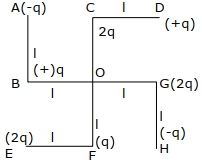 2021 Hard
- 124. A charged particle (mass \(m\) and charge \(q\) ) moves along \(X\) axis with velocity \(V _{0}\). When it passes through the origin it enters a region having uniform electric field \(\overrightarrow{ E }=- E \hat{ j }\) which extends upto \(x = d\). Equation of path of electron in the region \(x > d\) is
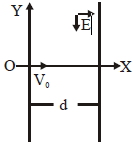 2020 Hard
- 125. An electric dipole of moment \(\overrightarrow{\mathrm{p}}=(-\hat{\mathrm{i}}-3 \hat{\mathrm{j}}+2 \hat{\mathrm{k}}) \times 10^{-29}\; \mathrm{C} \cdot \mathrm{m}\) is at the origin \((0,0,0) .\) The electric field due to this dipole at \(\overrightarrow{\mathrm{r}}=+\hat{\mathrm{i}}+3 \hat{\mathrm{j}}+5 \hat{\mathrm{k}}\) (note that \(\overrightarrow{\mathrm{r}} \cdot \overrightarrow{\mathrm{p}}=0)\) is parallel to 2020 Medium
- 126. An electric field \(\overrightarrow{\mathrm{E}}=4 \mathrm{x} \hat{\mathrm{i}}-\left(\mathrm{y}^{2}+1\right) \hat{\mathrm{j}}\; \mathrm{N} / \mathrm{C}\) passes through the box shown in figure. The flux of the electric field through surfaces \(A B C D\) and \(BCGF\) are marked as \(\phi_{I}\) and \(\phi_{\mathrm{II}}\) respectively. The difference between \(\left(\phi_{\mathrm{I}}-\phi_{\mathrm{II}}\right)\) is (in \(\left.\mathrm{Nm}^{2} / \mathrm{C}\right)\)
 2020 Medium
- 127. Charges \(Q _{1}\) and \(Q _{2}\) arc at points \(A\) and \(B\) of a right angle triangle \(OAB\) (see figure). The resultant electric field at point \(O\) is perpendicular to the hypotenuse, then \(Q _{1} / Q _{2}\) is proportional to
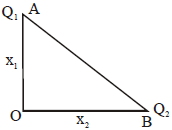 2020 Hard
- 128. Consider a sphere of radius \(\mathrm{R}\) which carries a uniform charge density \(\rho .\) If a sphere of radius \(\frac{\mathrm{R}}{2}\) is carved out of it, as shown, the ratio \(\frac{\left|\overrightarrow{\mathrm{E}}_{\mathrm{A}}\right|}{\left|\overrightarrow{\mathrm{E}}_{\mathrm{B}}\right|}\) of magnitude of electric field \(\overrightarrow{\mathrm{E}}_{\mathrm{A}}\) and \(\overrightarrow{\mathrm{E}}_{\mathrm{B}}\) respectively, at points \(\mathrm{A}\) and \(\mathrm{B}\) due to the remaining portion is
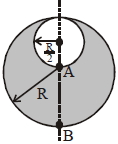 2020 Hard
- 129. In finding the electric field using Gauss Law the formula \(|\overrightarrow{\mathrm{E}}|=\frac{q_{\mathrm{enc}}}{\varepsilon_{0}|\mathrm{A}|}\) is applicable. In the formula \(\varepsilon_{0}\) is permittivity of free space, \(A\) is the area of Gaussian surface and \(q_{enc}\) is charge enclosed by the Gaussian surface. The equation can be used in which of the following situation? 2020 Medium
- 130. Three charged particle \(A, B\) and \(C\) with charges \(-4 q, 2 q\) and \(-2 q\) are present on the circumference of a circle of radius \(d\). the charged particles \(A, C\) and centre \(O\) of the circle formed an equilateral triangle as shown in figure. Electric field at \(O\) along \(x-\)direction is
 2020 Medium
- 131. Two infinite planes each with uniform surface charge density \(+\sigma\) are kept in such a way that the angle between them is \(30^{\circ} .\) The electric field in the region shown between them is given by
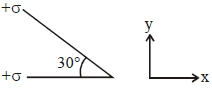 2020 Medium
- 132. An electric dipole is formed by two equal and opposite charges \(q\) with separation \(d\). The charges the same mass \(m\). It is kept in a uniform electric field \(E\). If it slightly rotated from its equilibrium orientation, then its angular frequency \(\omega \) is 2019 Hard
- 133. Charge is distributed within a sphere of radius \(R\) with a volume charge density \(\rho (r) = \frac{A}{{{r^2}}}{e^{ - 2r/a}}\) where \(A\) and \(a\) are constants. If \(Q\) is the total charge of this charge distribution, the radius \(R\) is. 2019 Hard
- 134. Charges \(-q\) and \(+ q\) located at \(A\) and \(B\), respectively, constitute an electric dipole. Distance \(AB = 2a\), \(O\) is the mid point of the dipole and \(OP\) is perpendicular to \(AB\). A charge \(Q\) is placed at \(P\) where \(OP = y\) and \(y >> 2a\). The charge \(Q\) experiences an electrostatic force \(F\). If \(Q\) is now moved along the equatorial line to \(P'\) such that \(OP' = \frac{y}{3}\), the force on \(Q\) will be close to: \(\left( {\frac{y}{3} > > 2a} \right)\)
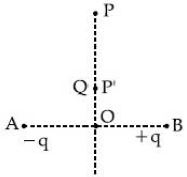 2019 Hard
- 135. Determine the electric dipole moment of the system of three charges, placed on the vertices of an equilateral triangle, as shown in the figure
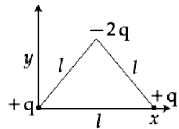 2019 Hard
- 136. For a uniformly charged ring of radius \(R\), the electric field on its axis has the largest magnitude at a distance \(h\) from its centre. Then value of \(h\) is 2019 Hard
- 137. Four point charges \(-q, +q, +q\) and \(-q\) are placed on \(y\) axis at \(y = -2d\), \(y = -d, y = +d\) and \(y = +2d\), respectively. The magnitude of the electric field \(E\) at a point on the \(x -\) axis at \(x = D\), with \(D > > d\), will vary as 2019 Hard
- 138. Let a total charge \(2Q\) be distributed in a sphere of radius \(R\), with the charge density given by \(\rho(r) = kr\), where \(r\) is the distance from the centre. Two charges \(A\) and \(B\), of \(-Q\) each, are placed on diametrically opposite points, at equal distance, \(a\), from the centre. If \(A\) and \(B\) do not experience any force, then 2019 Hard
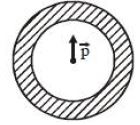
- 139. Shown in the figure is a shell made of a conductor. It has inner radius \(a\) and outer radius \(b\), and carries charge \(Q\). At its centre is a dipole \(\vec P\) as shown. In this case
 2019 Hard
- 140. The bob of a simple pendulum has mass \(2\,g\) and a charge of \(5.0\,\mu C\). It is at rest in a uniform horizontal electric field of intensity \(2000\,\frac{V}{m}\). At equilibrium, the angle that the pendulum makes with the vertical is (take \(g = 10\,\frac{m}{{{s^2}}}\)) 2019 Hard
- 141. Three charges \(+Q, q, +Q\) are placed respectively, at distance, \(0, \frac d2\) and \(d\) from the origin, on the \(x-\) axis. If the net force experienced by \(+Q\), placed at \(x = 0\), is zero, then value of \(q\) is 2019 Hard
- 142. Two point charges \(q_1\,(\sqrt {10}\,\,\mu C)\) and \(q_2\,(-25\,\,\mu C)\) are placed on the \(x-\) axis at \(x = 1\,m\) and \(x = 4\,m\) respectively. The electric field (in \(V/m\) ) at a point \(y = 3\,m\) on \(y-\) axis is, [ take \({\mkern 1mu} {\mkern 1mu} \frac{1}{{4\pi {\varepsilon _0}}} = 9 \times {10^9}{\mkern 1mu} {\mkern 1mu} N{m^2}{C^{ - 2}}{\rm{ }}\) ] 2019 Hard
- 143. A body of mass \(M\) and charge \(q\) is connected to a spring of spring constant \(k\). It is oscillating along \(x-\) direction about its equilibrium position, taken to be at \(x = 0\), with an amplitude \(A\). An electric field \(E\) is applied along the \(x-\) direction. Which of the following statements is correct? 2018 Hard
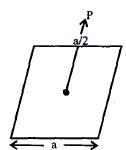
- 144. A charge \(Q\) is placed at a distance \(a/2\) above the centre of the square surface of edge \(a\) as shown in the figure. The electric flux through the square surface is
 2018 Medium
- 145. A solid ball of radius \(R\) has a charge density \(\rho \) given by \(\rho = {\rho _0}\left( {1 - \frac{r}{R}} \right)\) for \(0 \leq r \leq R\). The electric field outside the ball is 2018 Hard
- 146. Two identical conducting spheres \(A\) and \(B,\) carry equal charge. They are separated by a distance much larger than their diameter, and the force between them is \(F\) . A third identical conducting sphere, \(C,\) is uncharged. Sphere \(C\) is first touched to \(A,\) then to \(B,\) and then removed. As a result, the force between \(A\) and \(B\) would be equal to 2018 Hard
- 147. An electric dipole has a fixed dipole moment \(\vec P\) which makes angle \(\theta \) with respect to \(x-\)axis. When subjected to an electric field \(\overrightarrow {{E_1}} \) \(=E\)\(\hat i\) it experiences a torque \(\overrightarrow {{T_1}} \) =\(\;\tau \hat k\) When subjected to another electric field \(\overrightarrow {{E_2}} = \sqrt 3 {E_1}\hat j\) it experiences torque \(\overrightarrow {{T_2}} \) = \( - \overrightarrow {{T_1}} \) The angle \(\theta \;\) is.......\(^o\) 2017 Hard
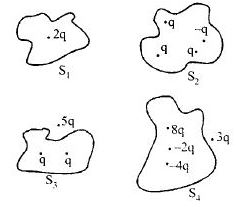
- 148. Four closed surfaces and corresponding charge distributions are shown below Let the respective electric fluxes through the surfaces be \({\phi _1},{\phi _2},{\phi _3}\) and \({\phi _4}\) . Then
 2017 Hard
- 149. The region between two concentric spheres ofradii '\(a\)' and '\(b\)', respectively (see figure), have volume charge density \(\rho = \frac{A}{r}\) where \(A\) is a constant and \(r\) is the distance from the centre. At the centre of the spheres is a point charge \(Q\). The value of \(A\) such that the electric field in the region between the spheres will be constant, is :
 2016 Hard
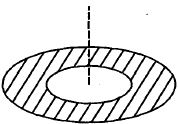
- 150. A thin disc of radius \(b = 2a\) has a concentric hole of radius \('a'\) in it (see figure). It carries uniform surface charge \('\sigma '\) on it. If the electric field on its axis at height \('h'\) \((h << a)\) from its centre is given as \('Ch'\) then value of \('C'\) is
 2015 Hard
No questions on this page match these filters.