


JEE Mains · Physics · STD 12 - 1. Electric charges and fields
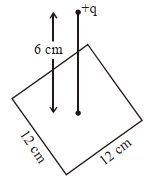
A point charge of \(+\,12 \,\mu C\) is at a distance \(6 \,cm\) vertically above the centre of a square of side \(12\, cm\) as shown in figure. The magnitude of the electric flux through the square will be ....... \(\times 10^{3} \,Nm ^{2} / C\)
- A \(452\)
- B \(381\)
- C \(226\)
- D \(113\)
Answer & Solution
Correct Answer
(C) \(226\)
Step-by-step Solution
Detailed explanation
From symmetry \(\phi=\frac{1}{6}\left(\frac{ q }{\varepsilon_{0}}\right)\) \(=\frac{12 \times 10^{-6}}{6 \times 8.85 \times 10^{-12}}\) \(=225.98 \times 10^{3} \,\frac{ Nm ^{2}}{ s }\) \(\simeq 226 \times 10^{3} \, \frac{ Nm ^{2}}{ C }\)
See the Complete Solution
Get step-by-step explanations for this and 2.5 Lakh+ more JEE, NEET & CET questions.
- Unlock all solutions
- Practice the full chapter
- Track accuracy across PYQs
4.8 rated on Google Play · 14,000+ reviews
More questions from Physics
- A piece of wood from a recently cut tree shows \(20\,decays\) per minute. A wooden piece of same size placed in a museum ( obtained from a tree cut many years back) shows \(2\,decays\) per minute. If half life of \(C^{14}\) is \(5730\, years\), then age of the wooden piece placed in the museum is approximately ........... \(years\)JEE Mains 2014 Hard
- For which of the following particles will it be most difficult to experimentally verify the deBroglie relationship?JEE Mains 2014 Easy
- A moving coil galvanometer has resistance \(50\,\Omega \) and it indicates full deflection at \(4\,mA\) current. A voltmeter is made using this galvanometer and a \(5\,k\Omega \) resistance. The maximum voltage, that can be measured using this voltamenter, will be close to ......\(V\)JEE Mains 2019 Medium
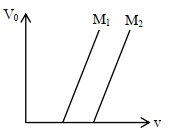
- Given below are two statements: Statement-\(I\): Figure shows the variation of stopping potential with frequency \((v)\) for the two photosensitive materials \(M_1\) and \(M_2\). The slope gives value of \(\frac{h}{e}\), where \(h\) is Planck's constant, \(e\) is the charge of electron. Statement-\(II\): \(M_2\) will emit photoelectrons of greater kinetic energy for the incident radiation having same frequency. In the light of the above statements, choose the most appropriate answer from the options given below.
 JEE Mains 2024 Hard
 - The ratio of the de-Broglie wavelengths of proton and electron having same kinetic energy: (Assume \(m_p=m_e \times 1849\) )JEE Mains 2023 Medium
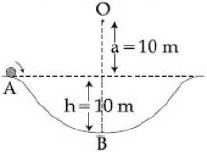
- A particle of mass \(20\,g\) is released with an initial velocity \(5\,m/s\) along the curve from the point \(A,\) as shown in the figure. The point \(A\) is at height \(h\) from point \(B.\) The particle slides along the frictionless surface. When the particle reaches point \(B,\) its angular momentum about \(O\) will be ......... \(kg - m^2/s\). [Take \(g = 10\,m/s^2\) ]
 JEE Mains 2019 Medium
More PYQs from JEE Mains
- If \(\sum_{r=1}^{30} \frac{r^2\left({ }^{30} C_r\right)^2}{{ }^{30} C_{r-1}}=\alpha \times 2^{29}\), then \(\alpha\) is equal to ______JEE Mains 2025 Hard
- \(A , B, C\) try to hit a target simultaneously but independently. Their respective probabilities of hitting targets are \(\frac{3}{4},\frac{1}{2},\frac{5}{8}\). The probability that the target is hit by \(A\) or \(B\) but not by \(C\) isJEE Mains 2013 Medium
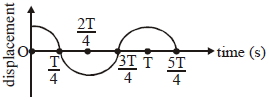
- The displacement time graph of a particle executing \(S.H.M.\) is given in figure: (sketch is schematic and not to scale) Which of the following statements is are true for this motion? \((A)\) The force is zero \(t=\frac{3 T}{4}\) \((B)\) The acceleration is maximum at \(t=T\) \((C)\) The speed is maximum at \(t =\frac{ T }{4}\) \((D)\) The \(P.E.\) is equal to \(K.E.\) of the oscillation at \(t=\frac{T}{2}\)
 JEE Mains 2020 Hard
 - \(\int \limits_0^{\infty} \frac{6}{e^{3 x}+6 e^{2 x}+11 e^x+6} d x\)JEE Mains 2023 Hard
- Let \(A\) be a \(3 \times 3\) matrix such that \(A^2 -5A+ 7I = 0\). Statement \(-I\) : \({A^{ - 1}} = \frac{1}{7}\left( {5I - A} \right).\) Statement \(II\) : the polynomial \(A^3 - 2A^2 - 3A + I\) can be reduced to \(5\, (A - 4I)\).JEE Mains 2016 Hard
- A solid ball of radius \(R\) has a charge density \(\rho \) given by \(\rho = {\rho _0}\left( {1 - \frac{r}{R}} \right)\) for \(0 \leq r \leq R\). The electric field outside the ball isJEE Mains 2018 Hard