


All STD 11 - Work,energy,power and collision questions
Newest firstShowing 151–191 of 191 questions
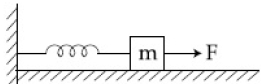
- 151. A block of mass \(m\), lying on a smooth horizontal surface, is attached to a spring (of negligible mass) of spring constant \(k\). The other end of the spring is fixed, as shown in the figure. The block is initially at rest in a equilibrium position. If now the block is pulled with a constant force \(F\), the maximum speed of the block is
 2019 Hard
- 152. A body of mass \(1\,kg\) falls freely from a height of \(100\,m,\) on a platform of mass \(3\,kg\) which is mounted on a spring having spring constant \(k = 1.25 \times 10^6\, N/m.\) The body sticks to the platform and the spring’s maximum compression is found to be \(x.\) Given that \(g = 10\,ms^{-2},\) the value of \(x\) will be close to ................ \(\mathrm{cm}\) 2019 Hard
- 153. A body of mass \(2\,kg\) makes an elastic collision with a second body at rest and continues to move in the original direction but with one fourth of its original speed. What is the mass of the second body? ................ \( \mathrm{kg}\) 2019 Medium
- 154. A bullet of mass \(20\,g\) has an initial speed of \(1\,ms^{-1}\) just before it starts penetrating a mud wall of thickness \(20\,cm.\) If the wall offers a mean resistances of \(2.5 \times 10^{-2}\,N,\) the speed of the bullet after emerging from the other side of the wall is close to .............. \(\mathrm{ms}^{-1}\) 2019 Medium
- 155. A force acts on a \(2\,kg\) object so that its position is given as a function of time as \(x= 3t^2 + 5.\) What is the work done by this force in first \(5\,seconds\) ? ................ \(\mathrm{J}\) 2019 Medium
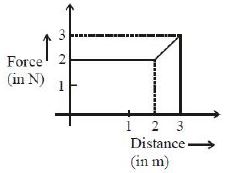
- 156. A particle moves in one dimension from rest under the influence of a force that varies with the distance traveled by the particle as shown in the figure. The kinetic energy of the particle after it has traveled \(3\, m\) is ................ \(\mathrm{J}\)
 2019 Medium
- 157. A particle of mass \(m\) is moving with speed \(2\, v\) collides with a mass \(2\,m\) moving with speed \(v\) in the same direction. After collision, the first mass is stopped completely while the second one splits into two particles each of mass \(m\), which move at angle \(45^o\) with respect to the original direction. The speed of each of the moving particle will be 2019 Medium
- 158. A particle which is experiencing a force, given by \(\vec F = 3\vec i -12\vec j\), undergoes a displacement of \(\vec d = 4\vec i\) . If the particle had a kinetic energy of \(3\, J\) at the beginning of the displacement, what is its kinetic energy at the end of the displacement? 2019 Medium
- 159. A satellite of mass \(M\) is in a circular orbit of radius \(R\) about the centre of the earth. A meteorite of the same mass, falling towards the earth collides with the satellite completely inelastically. The speeds of the satellite and the meteorite are the same, just before the collision. The subsequent motion of the combined body will be 2019 Medium
- 160. A simple pendulum, made of a string of length \(l\) and a bob of mass \(m\) , is released from a small angle \(\theta_0\). It strikes a block of mass \(M\), kept on a horizontal surface at its lowest point of oscillations, elastically. It bounces back and goes up to an angle \(\theta_1\). Then \(M\) is given by 2019 Hard
- 161. A uniform cable of mass \(‘M’\) and length \(‘L’\) is placed on a horizontal surface such that its \({\left( {\frac{1}{n}} \right)^{th}}\) part is hanging below the edge of the surface. To lift the hanging part of the cable upto the surface, the work done should be 2019 Hard
- 162. A wedge of mass \(M = 4\,m\) lies on a frictionless plane. A particle of mass \(m\) approaches the wedge with speed \(v\). There is no friction between the particle and the plane or between the particle and the wedge. The maximum height climbed by the particle on the wedge is given by 2019 Medium
- 163. An alpha-particle of mass \(m\) suffers \(1-\) dimensional elastic collision with a nucleus at rest of unknown mass. It is scattered directly backwards losing, \(64\%\) of its initial kinetic energy. The mass of the nucleus is .......... \(\mathrm{m}\) 2019 Hard
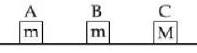
- 164. Three blocks \(A, B\) and \(C\) are lying on a smooth horizontal surface, as shown in the figure. \(A\) and \(B\) have equal masses, \(m\) while \(C\) has mass \(M\). Block \(A\) is given an initial speed \(v\) towards \(B\) due to which it collides with \(B\) perfectly inelastically. The combined mass collides with \(C\), also perfectly inelastically. The combined mass collides with \(C\), also perfectly inelastically if \(\frac{5}{6}^{th}\) of the initial kinetic energy is lost in whole process. What is value of \(M/m\) ?
 2019 Hard
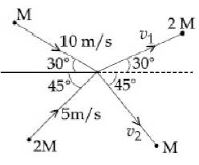
- 165. Two particles, of masses \(M\) and \(2M\), moving as shown, with speeds of \(10\, m/s\) and \(5\, m/s\), collide elastically at the origin. After the collision, they move along the indicated directions with speeds \(v_1\) and \(v_2\) respectively. The value of \(v_1\) and \(v_2\) are nearly
 2019 Hard
- 166. A body of mass \(m\) starts moving from rest along \(x-\) axis so that its velocity varies as \(v = a\sqrt s\) where \(a\) is a constant and \(s\) is the distance covered by the body. The total work done by all the forces acting on the body in the first second after the start of the motion is 2018 Hard
- 167. A particle is moving in a circular path of radius a under the action of an attractive potential \(U = - \frac{k}{{2{r^2}}}\) Its total energy is 2018 Medium
- 168. A proton of mass \(m\) collides elastically with a particle of unknown mass at rest. After the collision, the proton and the unknown particle are seen moving at an angle of \(90^o\) with respect to each other. The mass of unknown particle is 2018 Hard
- 169. In a collinear collision, a particle with an initial speed \(v_0\) strikes a stationary particle of the same mass. If the final total kinetic energy is \(50\%\) greater than the original kinetic energy, the magnitude of the relative velocity between the two particles, after collision, is: 2018 Medium
- 170. It is found that if a neutron suffers an elastic collinear collision with deuterium at rest, fractional loss of its energy is \(p_d \) ; while for its similar collision with carbon nucleus at rest, fractional loss of energy is \(P_c\). The values of \(P_d\) and \(P_c\) are respectively 2018 Hard
- 171. Two particles of the same mass are moving in circular orbits because of force, given by \(F(r) = \frac{{ - 16}}{r}\, - \,{r^3}\) The first particle is at a distance \(r = 1,\) and the second, at \(r = 4.\) The best estimate for the ratio of kinetic energies of the first and the second particle is closest to 2018 Hard
- 172. A body of mass \(m= 10^{-2}\) \(kg\) is moving in a medium and experiences a frictional force \(F= -kv^2\). Its initial speed is \(v_0= 10\) \(ms^{-1}\). If, after \(10\; s\), its energy is \(\frac{1}{8}\) \(mv_0^2\) the value of \(k\) will be 2017 Hard
- 173. A time dependent force \(F = 6t\) acts on a particle of mass \(1\ kg\). If the particle starts from rest, the work done by the force during the first \(1\) secand will be ............... \(\mathrm{J}\) 2017 Hard
- 174. An object is dropped from a height \(h\) from the ground. Every time it hits the ground it looses \(50\%\) of its kinetic energy. The total distance covered as \(t \to \infty \) is 2017 Hard
- 175. The machine as shown has \(2\) rods of length \(1\, m\) connected by a pivot at the top. The end of one rod is connected to the floor by a stationary pivot and the end of the other rod has a roller that rolls along the floor in a slot As the roller goes back and forth, a \(2\, kg\) weight moves up and down. If the roller is moving towards right at a constant speed, the weight moves up with a
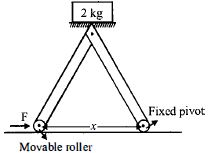 2017 Medium
- 176. Two particles \(A\) and \(B\) of equal mass \(M\) are moving with the same speed \(v\) as shown in the figure . They collide completely inelastically and move as a single particle \(C\). The angle \(\theta \) that the path of \(C\) makes with the \(X-\) axis is given by
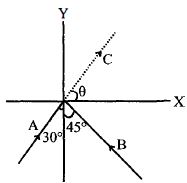 2017 Hard
- 177. A neutron moving with a speed \('v'\) makes a head on collision with a stationary hydrogen atom in ground state . The minimum kinetic energy of the neutron for which inelastic collision will take place is....\(eV\) 2016 Hard
- 178. A particle of mass \(M\) is moving in a circle of fixed radius \(R\) in such a way that its centripetal acceleration at time \(t\) is given by \(n^2Rt^2\) where \(n\) is a constant. The Power delivered to the particle by the force acting on it, is 2016 Medium
- 179. A point particle of mass, moves along the uniformly rough track \(PQR\) as shown in the figure. The coefficient of friction, between the particle and the rough track equals \(\mu\). The particle is released, from rest, from the point \(P\) and it comes to rest at a point \(R\). The energies, lost by the ball, over the parts, \(PQ\) and \(PR\), of the track, are equal to each other, and no energy is lost when particle changes direction from \(PQ\) to \(QR\). The values of the coefficient of friction \(\mu\) and the distance \(x(=QR)\) are, respecitvely close to
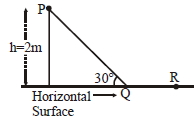 2016 Hard
- 180. person trying to lose weight by burning fat lifts a mass of \(10\ kg\) upto a height of \(1\ m\) \(1000\) times. Assume that the potential energy lost each time he lowers the mass is dissipated. How much fat will he use up considering the work done only when the weight is lifted up? Fat supplies \(3.8 \times 10^7\ J\) of energy per kg which is converted to mechanical energy with a \(20\%\) efficiency rate. Take \(g=9.8\) \(ms^{-2}\) 2016 Medium
- 181. Velocity-time graph for a body of mass \(10\, kg\) is shown in figure. Work-done on the body in first two seconds of the motion is ................ \(\mathrm{J}\)
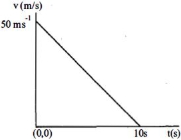 2016 Hard
- 182. A block of mass \(m = 10\,kg\) rests on a horizontal table. The coefficient of friction between the block and the table is \(0.05.\) When hit by a bullet of mass \(50\,g\) moving with speed \(v,\) that gets embedded in it, the block moves and comes to stop after moving a distance of \(2\,m\) on the table. If a freely falling object were to acquire speed \(\frac {v}{10}\) after being dropped from height \(H,\) then neglecting energy losses and taking \(g = 10\,ms^{-2},\) the value of \(H\) is close to ................. \(\mathrm{km}\) 2015 Hard
- 183. A particle is moving in a circle of radius \(r\) under the action of a force \(F\, = \alpha r^2\) which is directed towards centre of the circle. Total mechanical energy (kinetic energy + potential energy) of the particle is (take potential energy \(= 0\) for \(r\, = 0\)) 2015 Hard
- 184. A particle of mass \( m\) moving in the \(x\) direction with speed \(2v\) is hit by another particle of mass \(2m\) moving in the \(y\) direction with speed \(v\). If the collision is perfectly inelastic, the percentage loss in the energy during the collision is close to .............. \(\%\) 2015 Hard
- 185. A bullet looses \({\left( {\frac{1}{n}} \right)^{th}}\) of its velocity passing through one plank. The number of such planks that are required to stop the bullet can be 2014 Hard
- 186. A spring of unstretched length \(l\) has a mass \(m\) with one end fixed to a rigid support .Assuming spring to be made of a uniform wire, the kinetic energy possessed by it if its free end is pulled with uniform velocity \(v\) is 2014 Hard
- 187. Three masses \(m,\,2\,m\) and \(3\,m\) are moving in \(x-y\) plane with speed \(3\,u,\,2\,u\,\) and \(u\) respectively as shown in figure. The three masses collide at the same point at \(P\) and stick together. The velocity of resulting mass will be
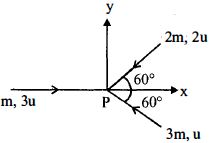 2014 Hard
- 188. When a rubber-band is stretched by a distance \(x\), it exerts restoring force of magnitude \(F=ax+bx^2\) where \(a\) and \(b\) areconstants. The work done in stretching the unstretched rubber-band by \(L\) is 2014 Medium
- 189. A projectile of mass \(M\) is fired so that the horizontal range is \(4\, km\). At the highest point the projectile explodes in two parts of masses \(M/4\) and \(3M/4\) respectively and the heavier part starts falling down vertically with zero initial speed. The horizontal range (distance from point of firing) of the lighter part is .................. \(\mathrm{km}\) 2013 Hard
- 190. A wind-10.Powered generator converts wind energy into electrical energy. Assume that the generator converts a fixed fraction of the wind energy intercepted by its blades into electrical energy. For wind speed \(v\), the electrical 10.Power output will be most likely proportional to 2013 Hard
- 191. This question has statement \(1\) and statement \(2\) . Of the four choices given after the statements, choose the one that best describes the two statements.
Statement \(- 1\): A point particle of mass m moving with speed \(u\) collides with stationary point particle of mass \(M\). If the maximum energy loss possible is given as \(f\) \(\left( {\frac{1}{2}m{v^2}} \right)\) then \( f = \left( {\frac{m}{{M + m}}} \right)\) Statement \(-2\): Maximum energy loss occurs when the particles get stuck together as a result of the collision. 2013 Medium
No questions on this page match these filters.