


All STD 12 - Electric potential and capacitance questions
Newest firstShowing 201–233 of 233 questions
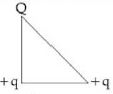
- 201. Three charges \(Q, +q\) and \(+q\) are placed at the vertices of a right -angle isosceles triangle as shown below. The net electrostatic energy of the configuration is zero, if the value of \(Q\) is
 2019 Hard
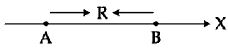
- 202. Two electric dipoles \(A, B\) with respective dipole moments \(\overrightarrow {{d_A}} = - 4\,qa\,\hat i\) and \(\overrightarrow {{d_B}} = 2\,qa\,\hat i\) are placed on the \(x-\) axis with a separation \(R\), as shown in the figure. The distance from \(A\) at which both of them produce the same potential is
 2019 Hard
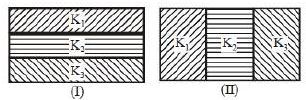
- 203. Two identical parallel plate capacitors, of capacitance \(C\) each, have plates of area \(A\), separated by a distance \(d\). The space between the plates of the two capacitors, is filled with three dielectrics, of equal thickness and dielectric constants \(K_1\) , \(K_2\) and \(K_3\) . The first capacitor is filled as shown in fig. \(I\), and the second one is filled as shown in fig. \(II\). If these two modified capacitors are charged by the same potential \(V\), the ratio of the energy stored in the two, would be ( \(E_1\) refers to capacitor \((I)\) and \(E_2\) to capacitor \((II)\))
 2019 Hard
- 204. Voltage rating of a parallel plate capacitor is \(500\,V\). Its dielectric can withstand a maximum electric field of \({10^6}\,\frac{V}{m}\). The plate area is \(10^{-4}\, m^2\) . What is the dielectric constant if the capacitance is \(15\, pF\) ? (given \({ \in _0} = 8.86 \times {10^{ - 12}}\,{C^2}\,/N{m^2}\)) 2019 Hard
- 205. A parallel plate capacitor of capacitance \(90\ pF\) is connected to a battery of \(emf\) \(20\ V\). If a dielectric material of dielectric constant \(K = \frac{5}{3}\) is inserted between the plates, the magnitude of the induced charge will be.......\(n \) \(C\) 2018 Medium
- 206. A parallel plate capacitor with area \(200\,cm^2\) and separation between the plates \(1.5\,cm\), is connected across a battery of \(emf\) \(V\). If the force of attraction between the plates is \(25\times10^{-6}\,N\), the value of \(V\) is approximately........\(V\) \(\left( {{\varepsilon _0} = 8.85 \times {{10}^{ - 12}}\,\frac{{{C^2}}}{{N{m^2}}}} \right)\) 2018 Hard
- 207. In the following circuit, the switch \(S\) is closed at \(t = 0.\) The charge on the capacitor \(C_1\) as a function of time will be given by \(\left( {{C_{eq}}\, = {\kern 1pt} \,\frac{{{C_1}{C_2}}}{{{C_1} + {C_2}}}} \right).\)
 2018 Hard
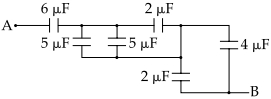
- 208. The equivalent capacitance between \(A\) and \(B\) in the circuit given below is.....\(μF\)
 2018 Hard
- 209. Three concentric metal shells \(A, B\) and \(C\) of respective radii \(a, b\) and \(c (a < b < c)\) have surface charge densities \(+\sigma,-\sigma\) and \(+\sigma\) respectively. The potential of shell \(B\) is 2018 Hard
- 210. A capacitance of \(2\ μF\) is required in an electrical circuit across a potential difference of \(1.0\ kV\). A large number of \(1\ μF\) capacitors are available which can withstand a potential difference of not more than \(300\ V\). The minimum number of capacitors required to achieve this is 2017 Medium
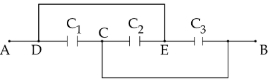
- 211. A combination of parallel plate capacitors is maintained at a certain potential difference When a \(3\, mm\) thick slab is introduced between all the plates, in order to maintain the same potential difference, the distance between the plates is increased by \(2.4\, mm\). Find the dielectric constant of the slab.
 2017 Hard
- 212. The energy stored in the electric field produced by a metal sphere is \(4.5\, J\). lf the sphere contains \(4\,\mu C\) charge, its radius will be.......\(mm\) : [Take : \(\frac{1}{{4\pi {\varepsilon _0}}} = 9 \times {10^9}\,N - {m^2}\,/{C^2}\, ]\) 2017 Hard
- 213. There is a uniform electrostatic field in a region. The potential at various points on a small sphere centred at \(P\), in the region, is found to vary between in the limits \(589.0\,V\) to \(589.8\, V\). What is the potential at a point on the sphere whose radius vector makes an angle of \(60^o\) with the direction of the field ?........\(V\) 2017 Hard
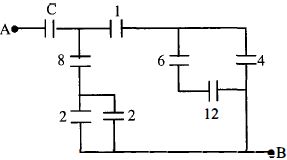
- 214. Figure shows a network of capacitors where the numbers indicates capacitances in micro Farad. The value of capacitance \(C\) if the equivalent capacitance between point \(A\) and \(B\) is to be \(1\,\mu F\) is
 2016 Hard
- 215. The potential (in volts ) of a charge distribution is given by \(V(z)\, = \,30 - 5{z^2}for\,\left| z \right| \le 1\,m\) \(V(z)\, = \,35 - 10\,\left| z \right|for\,\left| z \right| \ge 1\,m\) \(V(z)\) does not depend on \(x\) and \(y.\) If this potential is generated by a constant charge per unit volume \(\rho _0\) (in units of \(\varepsilon _0\) ) which is spread over a certain region, then choose the correct statement 2016 Hard
- 216. Three capacitors each of \(4\,\,\mu F\) are to be connected in such a way that the effective capacitance is \(6\,\,\mu F.\) This can be done by connecting thern 2016 Hard
- 217. Within a spherical charge distribution of charge density \(\rho \left( r \right)\), \(N\) equipotential surfaces of potential \({V_0},{V_0} + \Delta V,{V_0} + 2\Delta V,\)\(.....{V_0} + N\Delta V\left( {\Delta V > 0} \right),\) are drawn and have increasing radii \(r_0, r_1, r_2,......r_N\), respectively. If the difference in the radii of the surfaces is constant for all values of \(V_0\) and \(\Delta V\) then 2016 Hard
- 218. A uniformly charged solid sphere of radius \(R\) has potential \(V_0\) (measured with respect to \(\infty\)) on its surface. For this sphere the equipotential surfaces with potentials \(\frac{{3{V_0}}}{2},\;\frac{{5{V_0}}}{4},\;\frac{{3{V_0}}}{4}\) and \(\frac{{{V_0}}}{4}\) have rasius \(R_1,R_2,R_3\) and \(R_4\) respectively. Then 2015 Medium
- 219. An electric field \(\vec E\, = (25 \hat i + 30 \hat j)\,NC^{-1}\) exists in a region of space. If the potential at the origin is taken to be zero then the potential at \(x\, = 2\, m, y\, = 2\, m\) is......\(volt\) 2015 Medium
- 220. A parallel plate capacitor is made of two circular plates separated by a distance \(5\ mm\) and with a dielectric of dielectric constant \(2.2\) between them. When the electric field in the dielectric is \(3 \times 10^4\) \( Vm^{-1}\) the charge density of the positive plate will be close to 2014 Medium
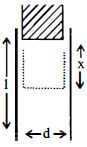
- 221. A parallel plate capacitor is made of two plates of length \(l\), width \(w\) and separated by distance \(d\). A dielectric slab ( dielectric constant \(K\)) that fits exactly between the plates is held near the edge of the plates. It is pulled into the capacitor by a force \(F = -\frac{{\partial U}}{{\partial x}}\) where \(U\) is the energy of the capacitor when dielectric is inside the capacitor up to distance \(x\) (See figure). If the charge on the capacitor is \(Q\) then the force on the dielectric when it is near the edge is
 2014 Hard
- 222. Assume that an electric field \(\vec E = 30{x^2}\hat i\) exists in space. Then the potential difference \(V_A-V_O\) where \(V_O\) is the potential at the origin and \(V_A\) the potential at \(x = 2\ m\) is....\(V\) 2014 Medium
- 223. The gap between the plates of a parallel plate capacitor of area \(A\) and distance between plates \(d\), is filled with a dielectric whose permittivity varies linearly from \({ \varepsilon _1}\) at one plate to \({ \varepsilon _2}\) at the other. The capacitance of capacitor is 2014 Hard
- 224. The space between the plates of a parallel plate capacitor is filled with a 'dielectric' whose 'dielectric constant' varies with distance as per the relation: \(K(x) = K_0 + \lambda x\) ( \(\lambda =\) constant) The capacitance \(C,\) of the capacitor, would be related to its vacuum capacitance \(C_0\) for the relation 2014 Hard
- 225. A parallel plate capacitor having a separation between the plates \(d\) , plate area \(A\) and material with dielectric constant \(K\) has capacitance \(C_0\). Now one-third of the material is replaced by another material with dielectric constant \(2K\), so that effectively there are two capacitors one with area \(\frac{1}{3}\,A\) , dielectric constant \(2K\) and another with area \(\frac{2}{3}\,A\) and dielectric constant \(K\). If the capacitance of this new capacitor is \(C\) then \(\frac{C}{{{C_0}}}\) is 2013 Hard
- 226. A point charge of magnitude \(+ 1\,\mu C\) is fixed at \((0, 0, 0) \). An isolated uncharged spherical conductor, is fixed with its center at \((4, 0, 0).\) The potential and the induced electric field at the centre of the sphere is 2013 Hard
- 227. charge \(Q\) is uniformly distributed over a long rod \(AB\) of length \(L\) as shown in the figure. The electric potential at the point \(O\) lying at distance \(L\) from the end \(A\) is
 2013 Medium
- 228. Consider a finite insulated, uncharged conductor placed near a finite positively charged conductor. The uncharged body must have a potential 2013 Hard
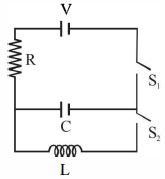
- 229. In an \(LCR \) circuit as shown below both switches are open initially. Now switch \(S_1\) is closed, \(S_2\) kept open. ( \(q\) is charge on the capacitor and \(\tau = RC\) is Capacitive time constant). Which of the following statement is correct?
 2013 Medium
- 230. This question has Statement \(-1\) and Statement \(-2\) Of the four choices given after the Statements, choose the one that best describes the two Statements Statement \(1\) : No work is required to be done to move a test charge between any two points on an equipotential surface Statement \(2\) : Electric lines of force at the equipotential surfaces are mutually perpendicular to each other 2013 Hard
- 231. Two capacitors \(C_1\) and \(C_2\) are charged to \(120\ V\) and \(200\ V\) respectively. It is found that connecting them together the potential on each one can be made zero. Then 2013 Medium
- 232. Two point dipoles of dipole moment \({\vec P_1}\) and \({\vec P_2}\) are at a distance \(x\) from each other and \({\vec P_1}\) || \({\vec P_2}\). The force between the dipoles is 2013 Medium
- 233. Two small equal point charges of magnitude \(q\) are suspended from a common point on the ceiling by insulating mass less strings of equal lengths. They come to equilibrium with each string making angle \(\theta \) from the vertical. If the mass of each charge is \(m,\) then the electrostatic potential at the centre of line joining them will be \(\left( {\frac{1}{{4\pi { \in _0}}} = k} \right).\) 2013 Hard
No questions on this page match these filters.