


All STD 12 - Nuclei questions
Newest firstShowing 101–135 of 135 questions
- 101. The half life period of radioactive element \({x}\) is same as the mean life time of another radioactive element \(y.\) Initially they have the same number of atoms. Then: 2021 Hard
- 102. The nuclear activity of a radioactive element becomes \(\left(\frac{1}{8}\right)^{\text {th }}\) of its initial value in \(30\, years.\) The half-life of radioactive element is \(....\,years.\) 2021 Medium
- 103. There are \(10^{10}\) radioactive nuclei in a given radioactive element, Its half-life time is \(1\, minute.\) How many nuclei will remain after \(30\, seconds?\) \((\sqrt{2}=1.414)\) 2021 Medium
- 104. Two radioactive substances \(X\) and \(Y\) originally have \(N _{1}\) and \(N _{2}\) nuclei respectively. Half life of \(X\) is half of the half life of \(Y\). After three half lives of \(Y\), number of nuclei of both are equal. The ratio \(\frac{ N _{1}}{ N _{2}}\) will be equal to 2021 Hard
- 105. A radioactive nucleus decays by two different processes. The half life for the first process is \(10\, s\) and that for the second is \(100 s\). the effective half life of the nucleus is close to\(.....sec\) 2020 Medium
- 106. Activities of three radioactive substances \(A , B\) and \(C\) are represented by the curves \(A, B\) and \(C,\) in the figure. Then their half-lives \(T _{\frac{1}{2}}( A ): T _{\frac{1}{2}}( B ): T _{\frac{1}{2}}( C )\) are in the ratio
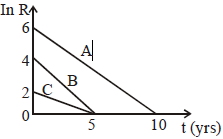 2020 Hard
- 107. Find the bindng energy per nucleon for \(\frac{50}{120}\, Sn\). Mass of proton \(m _{ P }=1.00783\, U ,\) mass of \(m _{ n }=1.00867\, U\) and \(mass\) of tin nucleus \(m _{ Sn }=119.902199\) \(U.\)\(......MeV\) (take \(1 U =931\, MeV )\) 2020 Medium
- 108. Given the masses of various atomic particles \(m _{ p }=1.0072 u , m _{ n }=1.0087 u\) \(m _{ e }=0.000548 u , m _{ v }=0, m _{ d }=2.0141 u\) where \(p \equiv\) proton, \(n \equiv\) neutron, \(e \equiv\) electron, \(\overline{ v } \equiv\) antineutrino and \(d \equiv\) deuteron. Which of the following process is allowed by momentum and energy conservation \(?\) 2020 Medium
- 109. In a radioactive material, fraction of active material remaining after time \(t\) is \(\frac{9}{16}\) The fraction that was remaining after \(\frac{t}{2}\) is 2020 Medium
- 110. In a reactor, \(2\, kg\) of \({ }_{92} U ^{235}\) fuel is fully used up in \(30\) days. The energy released per fission is \(200\, MeV.\) Given that the Avogadro number, \(N =6.023 \times 10^{26}\) per kilo mole and \(1\, eV =1.6 \times 10^{-19}\, J .\) The power output of the eactor is close to\(.....MW\) 2020 Medium
- 111. The activity of a radioactive sample falls from \(700 \;\mathrm{s}^{-1}\) to \(500\; \mathrm{s}^{-1}\) in \(30\;min\). Its half life is close to.........\(min\) 2020 Medium
- 112. The radius of \(R\) of a nucleus of mass number \(A\) can be estimated by the formula \(R =\left(1.3 \times 10^{-15}\right) A ^{1 / 3}\, m .\) It follows that the mass density of a nucleus is of the order of \(\left( M _{\text {prot. }} \cong M _{\text {neut. }}=1.67 \times 10^{-27} kg \right)\) 2020 Medium
- 113. You are given that Mass of \({ }_{3}^{7} Li =7.0160\, u\) Mass of \({ }_{2}^{4} He =4.0026\, u\) and Mass of \({ }_{1}^{1} H =1.0079\, u\) When \(20\, g\) of \({ }_{3}^{7} Li\) is converted into \({ }_{2}^{4} He\) by proton capture, the energy liberated, (in \(kWh\) ), is: [Mass of nudeon \(\left.=1\, GeV / c ^{2}\right]\) 2020 Medium
- 114. A sample of radioactive material \(A\), that has an activity of \(10\, mCi\, (1\, Ci = 3.7 \times 10^{10}\, decays/s)\), has twice the number of nuclei as another sample of different radioactive material \(B\) which has an activity of \(20\, mCi\). The correct choices for half-lives of \(A\) and \(B\) would then be respectively 2019 Hard
- 115. At a given instant, say \(t = 0,\) two radioactive substances \(A\) and \(B\) have equal activates. The ratio \(\frac{{{R_B}}}{{{R_A}}}\) of their activities. The ratio \(\frac{{{R_B}}}{{{R_A}}}\) of their activates after time \(t\) itself decays with time \(t\) as \(e^{-3t}.\) If the half-life of \(A\) is \(ln2,\) the half-life of \(B\) is 2019 Hard
- 116. Consider the nuclear fission \(Ne^{20} \to 2He^4 + C^{12}\) .Given that the binding energy / nucleon of \(Ne^{20}, He^4\) and \(C^{12}\) are, respectively, \(8.03\, MeV\), \(7.07\, MeV\), and \(7.86\, MeV\), identify the correct statement 2019 Medium
- 117. Half lives of two radioactive nuclei \(A\) and \(B\) are \(10\, minutes\) and \(20\, minutes\), respectively. If, initially a sample has equal number of nuclei, then after \(60\) \(minutes\) , the ratio of decayed numbers of nuclei \(A\) and \(B\) will be 2019 Hard
- 118. In a radioactive decay chain, the initial nucleus is \({}_{90}^{232}Th\). At the end there are \(6\,\,\alpha -\) particles and \(4\,\,\beta -\) particles with are emitted. If the end nucleus is \({}_Z^AX\,,\,A\) and \(Z\) are given by 2019 Medium
- 119. The ratio of mass densities of nuclei of \(^{40}Ca\) and \(^{16}O\) is close to 2019 Medium
- 120. Two radioactive materials \(A\) and \(B\) have decay constants \(10\,\lambda \) and \(\lambda \), respectively. If initially they have the same number of nuclei, then the ratio of the number of nuclei of a to that of \(B\) will be \(1/e\) after a time 2019 Medium
- 121. Two radioactive substances \(A\) and \(B\) have decay constants \(5\lambda \) and \(\lambda \) respectively. At \(t = 0\), a sample has the same number of the two nuclei. The time taken for the ratio of the number of nuclei to become \((\frac {1}{e})^2\) will be 2019 Medium
- 122. A solution containing active cobalt \({}_{27}^{60}Co\) having activity of \(0.8\,\mu Ci\) and decay constant \(\lambda \) is injected in an animal's body. If \(1 \,cm^3\) of blood is drawn from the animal's body after \(10\, hrs\) of injection, the activity found was \(300\, decays\) per minute. What is the volume of blood that is flowing in the body?..........\(litres\) ( \(ICi = 3.7 \times 10^{10}\) decay per second and at \(t = 10\, hrs\) \({e^{ - \lambda t}} = 0.84\) ) 2018 Hard
- 123. An unstable heavy nucleus at rest breaks into two nuclei which move away with velocities in the ratio of \(8:27\). The ratio of the radii of the nuclei (assumed to be spherical ) is 2018 Hard
- 124. At some instant, a radioactive sample \(S_1\) having an activity \(5\,\mu Ci\) has twice the number of nuclei as another sample \(S_2\) which has an activity of \(10\,\mu Ci.\) The halflives of \(S_1\) and \(S_2\) are 2018 Hard
- 125. A radioactive nucleus \(A\) with a half life \(T\), decays into a nucleus \(B.\) At \(t = 0\), there is no nucleus \(B\). At sometime \(t\), the ratio of the number of \(B\) to that of \(A\) is \(0.3\). Then, \(t\) is given by 2017 Hard
- 126. Imagine that a reactor converts all given mass into energy and that it operates at a power level of \(10^9\, watt\). The mass of the fuel consumed per hour in the reactor will be : (velocity of light, \(c\) is \(3\times10^8\, m/s\)) 2017 Medium
- 127. Half-lives of two radioactive elements \(A\) and \(B\) are \(20\) minutes and \(40\) minutes, respectively. Initially, the samples have equal number of nuclei. After \(80\) minutes, the ratio of decayed number of \(A\) and \(B\) nuclei will be 2016 Medium
- 128. Let \(N_{\beta}\) be the number of \(\beta \) particles emitted by \(1\) gram of \(Na^{24}\) radioactive nucler (half life \(= 15\, hrs\)) in \(7.5\, hours\), \(N_{\beta}\) is close to (Avogadro number \(= 6.023\times10^{23}\,/g.\, mole\)) 2015 Medium
- 129. A piece of bone of an animal from a ruin is found to have \(^{14}C\) activity of \(12\) disintegrations per minute per gm of its carbon content. The \(^{14}C\) activity of a living animal is \(16\) disintegrations per minute per gm. How long ago nearly did the animal die? ............\(years\) (Given halflife of \(^{14}C\) is \(t_{1/2} = 5760\,years\) ) 2014 Medium
- 130. A piece of wood from a recently cut tree shows \(20\,decays\) per minute. A wooden piece of same size placed in a museum ( obtained from a tree cut many years back) shows \(2\,decays\) per minute. If half life of \(C^{14}\) is \(5730\, years\), then age of the wooden piece placed in the museum is approximately ........... \(years\) 2014 Hard
- 131. A radioactive nuclei with decay constant \(0.5/s\) is being produced at a constant rate of \(100\, nuclei/s\). If at \(t\, = 0\) there were no nuclei, the time when there are \(50\, nuclei\) is 2014 Hard
- 132. Match List \(I\) (Wavelength range of electromagnetic spectrum) with List \(II\) (Method of production of these waves) and select the correct option from the options given below the lists
2014 MediumList \(I\) List \(II\) \((1)\) \(700\, nm\) to \(1\,mm\) \((i)\) Vibration of atoms and molecules \((2)\) \(1\,nm\) to \(400\, nm\) \((ii)\) Inner shell electrons in atoms moving from one energy level to a lower level \((3)\) \( < 10^{-3}\,nm\) \((iii)\) Radioactive decay of the nucleus \((4)\) \(1\,mm\) to \(0.1\,m\) \((iv)\) Magnetron valve - 133. From the following, the quantity ( constructed from the basic constants of nature), that has the dimensions, as well as correct order of magnitude, vis-a-vis typical atomic size, is 2013 Medium
- 134. The half-life of a radioactive element \(A\) is the same as the mean-life of another radioactive element \(B.\) Initially both substances have the same number of atoms, then 2013 Medium
- 135. When Uranium is bombarded with neutrons, it undergoes fission. The fission reaction can be written as \({}_{92}{U^{235}} + {}_0{n^1} \to {}_{56}B{a^{141}} + {}_{36}K{r^{92}} + 3x + Q{\rm{( energy)}}\) where three particles named \(x\) are produced and energy \(Q\) is released. What is the name of the particle \(x\) ? 2013 Medium
No questions on this page match these filters.