


All STD 12 - Atoms questions
Newest firstShowing 101–131 of 131 questions
- 101. The first member of the Balmer series of hydrogen atom has a wavelength of \(6561\; \mathring A\). The wavelength of the second member of the Balmer series (in \(nm\)) is 2020 Medium
- 102. The time period of revolution of electron in its ground state orbit in a hydrogen atom is \(1.6 \times 10^{-16} \;\mathrm{s}\). The frequency of revolution of the electron in its first excited state (in \(s^{-1}\) ) is: 2020 Hard
- 103. A hydrogen atom, initially in the ground state is excited by absorbing a photon of wavelength \(980\,\mathop A\limits^o \). The radius of the atom in the excited state, in terms of Bohr radius \(a_0,\) will be \((hc\,=\,12500\,eV-\mathop A\limits^o)\) 2019 Hard
- 104. A particle of mass \(m\) moves in a circular orbit in a central potential field \(U\left( r \right) = \frac{1}{2}k{r^2}\). If Bohr’s quantization conditions are applied, radii of possible orbits and energy levels vary with quantum number \(n\) as 2019 Hard
- 105. A particle \(P\) is formed due to a completely inelastic collision of particles \(x\) and \(y\) having de -Broglie wavelengths \({\lambda _x}\) and \({\lambda _y}\) respectively. If \(x\) and \(y\) were moving in opposite directions, then the de -Broglie wavelength of \(P\) is 2019 Medium
- 106. An excited \(He^+\) ion emits two photons in succession, with wavelengths \(108.5\, nm\) and \(30.4\, nm\), in making a transition to ground state. The quantum number \(n\), corresponding to its initial excited state is \(n=........\) (for photon of wavelength \(\lambda \), energy \(E = \frac{{1240\,eV}}{{\lambda \,(in\,nm)}}\)) 2019 Medium
- 107. Consider an electron in a hydrogen atom, revolving in its second excited state (having radius \(4.65\, \mathop A\limits^o \)). The de-Broglie wavelength of this electron is....\(\mathop A\limits^o \) 2019 Hard
- 108. In a hydrogen like atom, when an electron jumps from the \(M -\) shell to the \(L-\) shell the wavelength of emitted radiation is \(\lambda \). If an electron jumps from \(N-\) shell to the \(L-\) shell the wavelength of emitted radiation will be 2019 Medium
- 109. In \(Li^{++},\) electron in first Bohr orbit is excited to a level by a radiation of wavelength \(\lambda .\) When the ion gets deexcited to the ground state in all possible ways(including intermediate emission) a total of six spectral lines are observed. What is the value of \(\lambda \)?.....\(nm\) (Given: \(h = 6.63\times 10^{34}\,js; e = 3 \times 10^8\,ms^{-1}\) ) 2019 Hard
- 110. Radiation coming from transition \(n = 2\) to \(n = 1\) of hydrogen atoms fall of \(He^+\) ions in \(n = 1\) and \(n = 2\) states. The possible. Transition of helium ions as they absorb energy from the radiation is 2019 Hard
- 111. Taking the wavelength of first Balmer line in hydrogen spectrum (\( n = 3\) to \(n = 2\) ) as \(660\,nm ,\) the wavelength of the \(2^{nd}\) Balmer line ( \(n =4\) to \(n = 2\) ) will be....\(nm\) 2019 Hard
- 112. The electron in a hydrogen atom first jumps from the third excited state to the second excited state and subsequently to the first excited state. The ratio of the respective wavelengths, \(\lambda _1/\lambda _2\), of the photons emitted in this process is 2019 Hard
- 113. If the series limit frequency of the Lyman series is \(v_L\), then the series limit frequency of the \(P\)-fund series is 2018 Medium
- 114. Muon \((\mu ^{-1})\) is negatively charged \(\left( {\left| q \right| = \left| e \right|} \right)\) with a mass \(m_{\mu}\, = 200\,m_e\), where \(m_e\) is the mass of the electron and \(e\) is the electronic charge. If \(\mu ^{-1}\) is bound to a proton to form a hydrogen like atom, identify the correct statements \((A)\) Radius of the muonic orbit is \(200\) times smaller than that of the electron \((B)\) the speed of the \(\mu ^{-1}\) in the \(n^{th}\) orbit is \(\frac{1}{{200}}\) times that of the election in the \(n^{th}\) orbit \((C)\) The Ionization energy of muonic atom is \(200\) times more than that of an hydrogen atom \((D)\) The momentum of the muon in the \(n^{th}\) orbit is \(200\) times more than that of the electron 2018 Hard
- 115. The de-Broglie wavelength \(({\lambda _B})\) associated with the electron orbiting in the second excited state of hydrogen atom is related to that in the ground state \(({\lambda _G})\) by 2018 Medium
- 116. The energy required to remove the electron from a singly ionized Helium atom is \(2.2\, times\) the energy required to remove an electron from Helium atom . The total energy required to ionize the Helium atom completely is......\(eV\) 2018 Hard
- 117. According to Bohr's theory, the time averaged magnetic field at the centre (i.e. nucleus) of a hydrogen atom due to the motion of electrons in the \(n^{th}\) orbit is proportional to (\(n =\) principal quantum number) 2017 Medium
- 118. Some energy levels of a molecule are shown in the figure. The ratio of the wavelengths \(r\) =\(\frac{{{\lambda _1}}}{{{\lambda _2}}}\) is given by
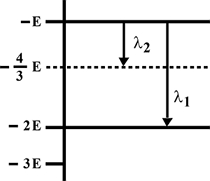 2017 Medium
- 119. The acceleration of an electron in the first orbit of the hydrogen atom \((z\, = 1)\) is 2017 Hard
- 120. A hydrogen atom makes a transition from \(n = 2\) to \(n = 1\) and emits a photon. This photon strikes a doubly ionized lithium atom \((z = 3)\) in excited state and completely removes the orbiting electron. The least quantum number for the excited state of the ion for the process is 2016 Hard
- 121. As an electron makes a transition from an excited state to the ground state of a hydrogen - like atom/ion: 2015 Medium
- 122. If one were to apply Bohr model to a particle of mass \('m'\) and charge \('q'\) moving in a plane under the influence of a magnetic field \('B',\) the energy of the charged particle in the \(n^{th}\) level will be 2015 Hard
- 123. The de-Broglie wavelength associated with the electron in the \(n\, = 4\) level is 2015 Medium
- 124. For \(LED's\) to emit light in visible region of electromagnetic light, it should have energy band gap in the range of 2014 Medium
- 125. Hydrogen \((_1H^1),\) Deuterium \((_1H^2)\),singly ionised Helium \((_2He^4)^+\) and doubly ionised lithium \({\left( {{}_3^6Li} \right)^{ + + }}\), all have one electron around the nucleus. Consider an electron transition from \(n = 2\) to \(n = 1\). If the wavelengths of emitted radiation are \(λ_1,λ_2,λ_3\) and \(λ_4\) respectively then approximately which one of the following is correct? 2014 Medium
- 126. Match List \(- I\) (Experiment performed) with List \(-II\) (Phenomena discovered/associated) and select the correct option from the options given the lists
2014 MediumList \(- I\) List \(- II\) \((1)\) Davisson and Genner \((i)\) Wave nature of electrons \((2)\) Millikan's oil drop experiment \((ii)\) Charge of an electron \((3)\) Rutherford experiment \((iii)\) Quantisation of energy levels \((4)\) Franck-Hertz experiment \((iv)\) Existence of nucleus - 127. The radiation corresponding to \(3 \rightarrow 2\) transition ofhydrogen atom falls on a metal surface to produce photoelectrons. These electrons are made to enter a magnetic field of \(3 \times 10^{-4}\) \(T\) If the radius of the largest circular path followed by these electrons is \(10.0\ mm\), the work function of the metal is close to......\( eV\) 2014 Hard
- 128. A \(12.5\, eV\) electron beam is used to bombard gaseous hydrogen at room temperature. It will emit 2013 Hard
- 129. In a hydrogen like atom electron make transition from an energy level with quantum number \(n\) to another with quantum number \((n- 1)\). If \(n > > 1\), the frequency ofradiation emitted is proportional to 2013 Medium
- 130. In the Bohr 's model of hydrogen-like atom the force between the nucleus and the electron is modified as \(F = \frac{{{e^2}}}{{4\pi {\varepsilon _0}}}\left( {\frac{1}{{{r^2}}} + \frac{\beta }{{{r^3}}}} \right)\), where \(\beta \) is a constant. For this atom, the radius of the \(n^{th}\) orbit in terms of the Bohr radius \(\left( {{a_0} = \,\frac{{{\varepsilon _0}{h^2}}}{{m\pi {e^2}}}} \right)\) is 2013 Hard
- 131. In the Bohr model an electron moves in a circular orbit around the proton . Considering the orbiting electron to be a circular current loop, the magnetic moment of the hydrogen atom; when the electron is in \(n^{th}\) excited state, is 2013 Hard
No questions on this page match these filters.