


All STD 11 - Gravitation questions
Newest firstShowing 151–179 of 179 questions
- 151. A spaceship orbits around a planet at a height of \(20\,km\) from its surface. Assuming that only gravitational field of the plant acts on the spaceship. What will be the number of complete revolutions made by the spaceship in \(24\,hours\) around the plane? [Given: Mass of plane \(= 8 \times 10^{22}\,kg,\) Radius of planet \(= 2\times 10^6\,m,\) Gravitational constant \(G = 6.67\times 10^{-11}\,Mn^2/kg^2\) ] 2019 Hard
- 152. A straight rod of length \(L\) extends from \(x = a\) to \(x = L + a\). The gravitational force it exerts on a point mass \(‘m’\) at \(x = 0\), if the mass per unit length of the rod is \(A + Bx^2\), is given by 2019 Hard
- 153. A test particle is moving in a circular orbit in the gravitational field produced by a mass density \(\rho \left( r \right) = \frac{K}{{{r^2}}}\). Identify the correct relation between the radius \(R\) of the particle’s orbit and its period \(T\) 2019 Hard
- 154. Four identical particles of mass \(M\) are located at the corners of a square of side \(‘a’\). What should be their speed if each of them revolves under the influence of other’s gravitational field in a circular orbit circumscribing the square?
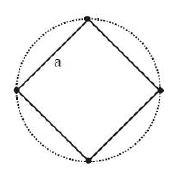 2019 Hard
- 155. If the angular momentum of a planet of mass \(m\), moving a round the Sun in a circular orbit its \(L\), about the center of the Sun, its areal velocity is 2019 Easy
- 156. The energy required to take a satellite to a height \(‘h’\) above Earth surface (radius of Earth \(= 6.4 \times 10^3\,km\) ) is \(E_1\) and kinetic energy required for the satellite to be in a circular orbit at this height is \(E_2.\) The value of \(h\) for which \(E_1\) and \(E_2\) are equal is 2019 Hard
- 157. The mass and the diameter of a planet are three times the respective values for the Earth. The period of oscillation of a simple pendulum on the Earth is \(2\,s\). The period of oscillation of the same pendulum on the planet would be 2019 Hard
- 158. The ratio of the weights of a body on the Earth's surface to that on the surface of a planet is \(9 : 4\). The mass of the planet is \(\frac{1}{9}^{th}\) of that of the Earth. If \('R'\) is the radius of the Earth, what is the radius of the planet ? (Take the planets to have the same mass density) 2019 Medium
- 159. The value of acceleration due to gravity at Earth’s surface is \(9.8\, m\,s^{-2}\). The altitude above its surface at which the acceleration due to gravity decreases to \(4.9\, m\,s^{-2}\), is close to: (Radius of earth \(= 6.4\times10^6\, m\)) 2019 Medium
- 160. Two satellites, \(A\) and \(B,\) have masses \(m\) and \(2\,m\) respectively. \(A\) is in a circular orbit of radius \(R,\) and \(B\) is in a circular orbit of radius \(2R\) around the earth. The ratio of their kinetic energies, \(K.E._A / K.E._B ,\) is 2019 Medium
- 161. Two stars of masses \(3\times10^{31}\, kg\) each, and at distance \(2\times10^{11}\, m\) rotate in a plane about their common centre of mass \(O. A\) meteorite passes through \(O\) moving perpendicular to the star’s rotation plane. In order to escape from the gravitational field of this double star, the minimum speed that meteorite should have at \(O\) is : (Take Gravitational constant \(G = 6.67\times10^{-11}\, Nm^2\, kg^{-2}\)) 2019 Medium
- 162. A body of mass \(m\) is moving in a circular orbit of radius \(R\) about a planet of mass \(M\). At some instant, it splits into two equal masses. The first mass moves in a circular orbit of radius \(\frac{R}{2}\) , and the other mass, in a circular orbit of radius \(\frac{3R}{2}\). The difference between the final and initial total energies is 2018 Hard
- 163. Suppose that the angular velocity of rotation of earth is increased. Then, as a consequence. 2018 Medium
- 164. Take the mean distance of the moon and the sun from the earth to be \(0.4 \times 10^6\,km\) and \(150 \times 10^6\,km\) respectively. Their masses are \(8 \times 10^{22}\, kg\) and \(2 \times 10^{30}\, kg\) respectively. The radius of the earth is \(6400\, km\). Let \(\Delta {F_1}\) be the difference in the forces exerted by the moon at the nearest and farthest points on the earth and \(\Delta {F_2}\) be the difference in the force exerted by the sun at the nearest and farthest points on the earth. Then, the number closest to \(\frac{{\Delta {F_1}}}{{\Delta {F_2}}}\) is 2018 Hard
- 165. The relative uncertainty in the period of a sateilite orbiting around the earth is \(10^{-2}\). If the relative uncertainty in the radius of the orbit is negligible, the relative uncertainty in the mass of the earth is 2018 Medium
- 166. If the Earth has no rotational motion, the weight of a person on the equator is \(W\). Determine the speed with which the earth would have to rotate about its axis so that the person at the equator will weight \(\frac{3}{4}\,W\) . Radius of the Earth is \(6400\, km\) and \(g = 10\, m/s^2\) 2017 Medium
- 167. An astronaut of mass \(m\) is working on a satellite or biting the earth at a distance \(h\) from the earth's surface. The radius of the earth is \(R\), while its mass is \(M\). The gravitational pull \(F_G\) on the astronaut is 2016 Medium
- 168. Figure shows elliptical path \(abcd\) of a planet around the sun \(S\) such that the area of triangle \(csa\) is \(\frac {1}{4}\) the area of the ellipse. (See figure) With \(db\) as the semimajor axis, and \(ca\) as the semiminor axis. If \(t_1\) is the time taken for planet to go over path \(abc\) and \(t_2\) for path taken over \(cda\) then
 2016 Hard
- 169. A very long (length \(L\) ) cylindrical galaxy is made of uniformly distributed mass and has radius \(R(R < < L).\) A star outside the galaxy is orbiting the galaxy in a plane perpendicular to the galaxy and passing through its centre. If the time period of star is \(T\) and its distance from the galaxy's axis is \(r,\) then 2015 Medium
- 170. From a solid sphere of mass \(M\) and radius \(R\), a spherical portion of radius \(R/2\) is removed, as shown in the figure. Taking gravitational potential \(V = 0\) at \(r = \infty\), the potential at the centre of the cavity thus formed is
( \(G =\) gravitational constant)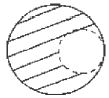 2015 Hard
- 171. Four particles, each of mass \(M\) and equidistant from each other, move along a circle of radius \(R\) under the action of their mutual gravitational attraction. The speed of each particle is 2014 Hard
- 172. From a sphere of mass \(M\) and radius \(R\), a smaller sphere of radius \(\frac{R}{2}\) is carved out such that the cavity made in the original sphere is between its centre and the periphery (See figure) . For the configuration in the figure where the distance between the centre of the original sphere and the removed sphere is \(3R\), the gravitational force between the two sphere is
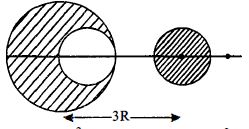 2014 Hard
- 173. India's Mangalyan was sent to the Mars by launching it into a transfer orbit \(EOM\) around the sun . It leaves the earth at \(E\) and meets Mars at \(M\) . If the semi-major axis of Earth's orbit is \(a_e = 1.5 \times 10^{11}\, m\), that of Mars orbit \(a_m= 2.28 \times 10^{11}\, m\), taken Kepler's laws give the estimate of time for Mangalyan to reach Mars from Earth to be close to ........ \(days\).
 2014 Hard
- 174. The gravitational field in a region is given by \(\overrightarrow g = 5\,N/kg\hat i\, + \,12\,N/kg\hat j\). The change in the gravitational potential energy of a particle of mass \(1\, kg\) when it is taken from the origin to a point \((7\, m, - 3\, m)\) is ....... \(J\) 2014 Medium
- 175. Two hypothetical planets of masses \(m_1\) and \(m_2\) are at rest when they are infinite distance apart. Because of the gravitational force they move towards each other along the line joining their centres . What is their speed when their separation is \('d'\) ? (Speed of \(m_1\) is \(v_1\) and that of \(m_2\) is \(v_2\) )
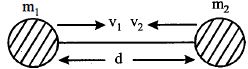 2014 Hard
- 176. The change in the value of acceleration of earth towards sun, when the moon comes from the position of solar eclipse to the position on the other side of earth in line with sun is: (mass of the moon \(= 7.36 \times 10^{22}\,kg,\) radius of the moon's orbit \(= 3 .8 \times 10^8\,m\) ). 2013 Hard
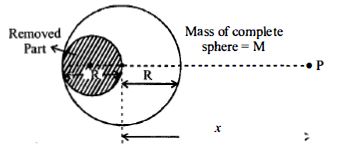
- 177. The gravitational field, due to the 'left over part' of a uniform sphere (from which a part as shown, has been 'removed out'), at a very far off point , \(P\), located as shown, would be (nearly)
 2013 Hard
- 178. The gravitational field in a region is given by \(\vec E\) \(=(5\,N / kg)\, \hat i + (12\,N / kg)\,\hat j\) If the potential at the origin is taken to be zero, then the ratio of the potential at the points \((12\,m, 0)\) and \((0, 5\,m)\) is 2013 Hard
- 179. What is the minimum energy required to launch a satellite of mass \(m\) from the surface of a planet of mass \(M\) and radius \(R\) in a circular orbit at an altitude of \(2R\)? 2013 Medium
No questions on this page match these filters.