


All STD 11 - System of particles and rotational motion questions
Newest firstShowing 201–250 of 369 questions
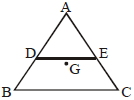
- 201. \(ABC\) is a plane lamina of the shape of an equilateral triagnle. \(D,\) \(E\) are mid points of \(AB\), \(AC\) and \(G\) is the centroid of the lamina. Moment of inertia of the lamina about an axis passing through \(G\) and perpendicular to the plane \(ABC\) is \(I _{0} .\) If part \(ADE\) is removed, the moment of inertia of the remaining part about the same axis is \(\frac{ NI _{0}}{16}\) where \(N\) is an integer. Value of \(N\) is
 2020 Hard
- 202. \(ABC\) is a plane lamina of the shape of an equilateral triagnle. \(D,\) \(E\) are mid points of \(AB\), \(AC\) and \(G\) is the centroid of the lamina. Moment of inertia of the lamina about an axis passing through \(G\) and perpendicular to the plane \(ABC\) is \(I _{0} .\) If part \(ADE\) is removed, the moment of inertia of the remaining part about the same axis is \(\frac{ NI _{0}}{16}\) where \(N\) is an integer. Value of \(N\) is 2020 Hard
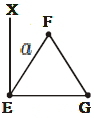
- 203. An massless equilateral triangle \(EFG\) of side \('a'\) (As shown in figure) has three particles of mass \(m\) situated at its vertices. The moment of intertia of the system about the line \(EX\) perpendicular to \(EG\) in the plane of \(EFG\) is \(\frac{ N }{20}\, ma ^{2}\) where \(N\) is an integer. The value of \(N\) is
 2020 Medium
- 204. An massless equilateral triangle \(EFG\) of side \('a'\) (As shown in figure) has three particles of mass \(m\) situated at its vertices. The moment of intertia of the system about the line \(EX\) perpendicular to \(EG\) in the plane of \(EFG\) is \(\frac{ N }{20}\, ma ^{2}\) where \(N\) is an integer. The value of \(N\) is 2020 Medium
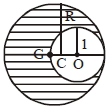
- 205. As shown in figure, when a spherical cavity (centred at \(\mathrm{O})\) of radius \(1\) is cut out of a uniform sphere of radius \(\mathrm{R} \text { (centred at } \mathrm{C}),\) the centre of mass of remaining (shaded) part of sphere is at \(G\), i.e, on the surface of the cavity. \(\mathrm{R}\) can be detemined by the equation
 2020 Hard
- 206. As shown in figure, when a spherical cavity (centred at \(\mathrm{O})\) of radius \(1\) is cut out of a uniform sphere of radius \(\mathrm{R} \text { (centred at } \mathrm{C}),\) the centre of mass of remaining (shaded) part of sphere is at \(G\), i.e, on the surface of the cavity. \(\mathrm{R}\) can be detemined by the equation 2020 Hard
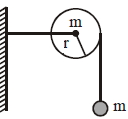
- 207. As shown in the figure, a bob of mass \(\mathrm{m}\) is tied by a massless string whose other end portion is wound on a fly wheel (disc) of radius \(\mathrm{r}\) and mass \(m\). When released from rest the bob starts falling vertically. When it has covered a distance of \(h\). the angular speed of the wheel will be
 2020 Medium
- 208. As shown in the figure, a bob of mass \(\mathrm{m}\) is tied by a massless string whose other end portion is wound on a fly wheel (disc) of radius \(\mathrm{r}\) and mass \(m\). When released from rest the bob starts falling vertically. When it has covered a distance of \(h\). the angular speed of the wheel will be 2020 Medium
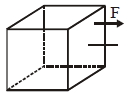
- 209. Consider a uniform cubical box of side \(a\) on a rough floor that is to be moved by applying minimum possible force \(F\) at a point \(b\) above its centre of mass (see figure). If the coefficient of friction is \(\mu=0.4,\) the maximum possible value of \(100 \times \frac{b}{a}\) for a box not to topple before moving is
 2020 Hard
- 210. Consider a uniform cubical box of side \(a\) on a rough floor that is to be moved by applying minimum possible force \(F\) at a point \(b\) above its centre of mass (see figure). If the coefficient of friction is \(\mu=0.4,\) the maximum possible value of \(100 \times \frac{b}{a}\) for a box not to topple before moving is 2020 Hard
- 211. Consider a uniform rod of mass \(\mathrm{M}=4 \mathrm{m}\) and length \(\ell\) pivoted about its centre. A mass \(m\) moving with velocity \(v\) making angle \(\theta=\frac{\pi}{4}\) to the rod's long axis collides with one end of the rod and sticks to it. The angular speed of the rod-mass system just after the collision is 2020 Hard
- 212. Consider a uniform rod of mass \(\mathrm{M}=4 \mathrm{m}\) and length \(\ell\) pivoted about its centre. A mass \(m\) moving with velocity \(v\) making angle \(\theta=\frac{\pi}{4}\) to the rod's long axis collides with one end of the rod and sticks to it. The angular speed of the rod-mass system just after the collision is 2020 Hard
- 213. Consider two uniform discs of the same thickness and different radii \(R _{1}= R\) and \(R _{2}=\alpha R\) made of the same material. If the ratio of their moments of inertia \(I_{1}\) and \(I_{2}\), respectively, about their axes is \(I _{1}: I _{2}=1: 16\) then the value of \(\alpha\) is 2020 Hard
- 214. Consider two uniform discs of the same thickness and different radii \(R _{1}= R\) and \(R _{2}=\alpha R\) made of the same material. If the ratio of their moments of inertia \(I_{1}\) and \(I_{2}\), respectively, about their axes is \(I _{1}: I _{2}=1: 16\) then the value of \(\alpha\) is 2020 Hard
- 215. For a uniform rectangular sheet shown in the figure, the ratio of moments of inertia about the axes perpendicular to the sheet and passing through \(O\) (the centre of mass) and \(O ^{\prime}(\) corner point \()\) is
 2020 Hard
- 216. For a uniform rectangular sheet shown in the figure, the ratio of moments of inertia about the axes perpendicular to the sheet and passing through \(O\) (the centre of mass) and \(O ^{\prime}(\) corner point \()\) is 2020 Hard
- 217. Mass per unit area of a circular disc of radius \(\mathrm{a}\) depends on the distance \(\mathrm{r}\) from its centre as \(\sigma(\mathrm{r})=\mathrm{A}+\mathrm{Br} .\) The moment of inertia of the disc about the the axis, perpendicular to the plane and passing through its centre is 2020 Hard
- 218. Mass per unit area of a circular disc of radius \(\mathrm{a}\) depends on the distance \(\mathrm{r}\) from its centre as \(\sigma(\mathrm{r})=\mathrm{A}+\mathrm{Br} .\) The moment of inertia of the disc about the the axis, perpendicular to the plane and passing through its centre is 2020 Hard
- 219. Moment of inertia of a cylinder of mass \(M,\) length \(L\) and radius \(R\) about an axis passing through its centre and perpendicular to the axis of the cylinder is \(I = M \left(\frac{ R ^{2}}{4}+\frac{ L ^{2}}{12}\right) .\) If such a cylinder is to be made for a given mass of material, the ratio \(\frac LR\) for it to have minimum possible \(I\) is 2020 Hard
- 220. Moment of inertia of a cylinder of mass \(M,\) length \(L\) and radius \(R\) about an axis passing through its centre and perpendicular to the axis of the cylinder is \(I = M \left(\frac{ R ^{2}}{4}+\frac{ L ^{2}}{12}\right) .\) If such a cylinder is to be made for a given mass of material, the ratio \(\frac LR\) for it to have minimum possible \(I\) is 2020 Hard
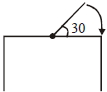
- 221. One end of a straight uniform \(1\; \mathrm{m}\) long bar is pivoted on horizontal table. It is released from rest when it makes an angle \(30^{\circ}\) from the horizontal (see figure). Its angular speed when it hits the table is given as \(\sqrt{\mathrm{n}}\; \mathrm{s}^{-1},\) where \(\mathrm{n}\) is an integer. The value of \(n\) is
 2020 Medium
- 222. One end of a straight uniform \(1\; \mathrm{m}\) long bar is pivoted on horizontal table. It is released from rest when it makes an angle \(30^{\circ}\) from the horizontal (see figure). Its angular speed when it hits the table is given as \(\sqrt{\mathrm{n}}\; \mathrm{s}^{-1},\) where \(\mathrm{n}\) is an integer. The value of \(n\) is 2020 Medium
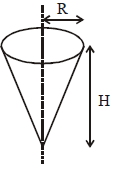
- 223. Shown in the figure is a hollow icecream cone (it is open at the top). If its mass is \(M,\) radius of its top, \(R\) and height, \(H\), then its moment of inertia about its axis is
 2020 Hard
- 224. Shown in the figure is a hollow icecream cone (it is open at the top). If its mass is \(M,\) radius of its top, \(R\) and height, \(H\), then its moment of inertia about its axis is 2020 Hard
- 225. Shown in the figure is rigid and uniform one meter long rod \(AB\) held in horizontal position by two strings tied to its ends and attached to the ceiling. The rod is of mass \('m'\) and has another weight of mass \(2m\) hung at a distance of \(75\, cm\) from \(A\). The tension in the string at \(A\) is\(....mg\)
 2020 Hard
- 226. Shown in the figure is rigid and uniform one meter long rod \(AB\) held in horizontal position by two strings tied to its ends and attached to the ceiling. The rod is of mass \('m'\) and has another weight of mass \(2m\) hung at a distance of \(75\, cm\) from \(A\). The tension in the string at \(A\) is\(....mg\) 2020 Hard
- 227. The centre of mass of a solid hemisphere of radius \(8\, cm\) is \(X \,cm\) from the centre of the flat surface. Then value of \(x\) is\(......\) 2020 Medium
- 228. The centre of mass of a solid hemisphere of radius \(8\, cm\) is \(X \,cm\) from the centre of the flat surface. Then value of \(x\) is\(......\) 2020 Medium
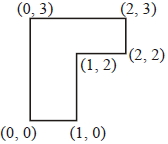
- 229. The coordinates of centre of mass of a uniform flag shaped lamina (thin flat plate) of mass \(4\;kg\). (The coordinates of the same are shown in figure) are
 2020 Medium
- 230. The coordinates of centre of mass of a uniform flag shaped lamina (thin flat plate) of mass \(4\;kg\). (The coordinates of the same are shown in figure) are 2020 Medium
- 231. The linear mass density of a thin rod \(A B\) of length \(L\) varies from \(A\) to \(B\) as \(\lambda( x )=\lambda_{0}\left(1+\frac{ x }{ L }\right),\) where \(x\) is the distance from A. If \(M\) is the mass of the rod then its moment of inertia about an axis passing through \(A\) and perpendicular to the rod is\(......ML^{2}\) 2020 Hard
- 232. The linear mass density of a thin rod \(A B\) of length \(L\) varies from \(A\) to \(B\) as \(\lambda( x )=\lambda_{0}\left(1+\frac{ x }{ L }\right),\) where \(x\) is the distance from A. If \(M\) is the mass of the rod then its moment of inertia about an axis passing through \(A\) and perpendicular to the rod is\(......ML^{2}\) 2020 Hard
- 233. The radius of gyration of a uniform rod of length \(l,\) about an axis passing through a point \(\frac{l}{4}\) away from the centre of the rod, and perpendicular to it, is 2020 Medium
- 234. The radius of gyration of a uniform rod of length \(l,\) about an axis passing through a point \(\frac{l}{4}\) away from the centre of the rod, and perpendicular to it, is 2020 Medium
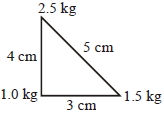
- 235. Three point particles of masses \(1.0\; \mathrm{kg} .1 .5 \;\mathrm{kg}\) and \(2.5\; kg\) are placed at three comers of a right angle triangle of sides \(4.0\; \mathrm{cm}, 3.0 \;\mathrm{cm}\) and \(5.0\; \mathrm{cm}\) as shown in the figure. The center of mass of the system is at a point
 2020 Medium
- 236. Three point particles of masses \(1.0\; \mathrm{kg} .1 .5 \;\mathrm{kg}\) and \(2.5\; kg\) are placed at three comers of a right angle triangle of sides \(4.0\; \mathrm{cm}, 3.0 \;\mathrm{cm}\) and \(5.0\; \mathrm{cm}\) as shown in the figure. The center of mass of the system is at a point 2020 Medium
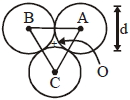
- 237. Three solid spheres each of mass \(\mathrm{m}\) and diameter \(d\) are stuck together such that the lines connecting the centres form an equilateral triangle of side of length \(d\). The ratio \(\mathrm{I}_{0} / \mathrm{I}_{\mathrm{A}}\) of moment of inertia \(\mathrm{I}_{0}\) of the system about an axis passing the centroid and about center of any of the spheres \(\mathrm{I}_{\mathrm{A}}\) and perpendicular to the plane of the triangle is
 2020 Hard
- 238. Three solid spheres each of mass \(\mathrm{m}\) and diameter \(d\) are stuck together such that the lines connecting the centres form an equilateral triangle of side of length \(d\). The ratio \(\mathrm{I}_{0} / \mathrm{I}_{\mathrm{A}}\) of moment of inertia \(\mathrm{I}_{0}\) of the system about an axis passing the centroid and about center of any of the spheres \(\mathrm{I}_{\mathrm{A}}\) and perpendicular to the plane of the triangle is 2020 Hard
- 239. Two uniform circular discs are rotating independently in the same direction around their common axis passing through their centres. The moment of inertia and angular velocity of the first disc are \(0.1 \;kg - m ^{2}\) and \(10\; rad \,s^{-1}\) respectively while those for the second one are \(0.2 \;kg - m ^{2}\) and \(5\; rad \,s ^{-1}\) respectively. At some instant they get stuck together and start rotating as a single system about their common axis with some angular speed. The Kinetic energy of the combined system is ...........\(J\) 2020 Hard
- 240. Two uniform circular discs are rotating independently in the same direction around their common axis passing through their centres. The moment of inertia and angular velocity of the first disc are \(0.1 \;kg - m ^{2}\) and \(10\; rad \,s^{-1}\) respectively while those for the second one are \(0.2 \;kg - m ^{2}\) and \(5\; rad \,s ^{-1}\) respectively. At some instant they get stuck together and start rotating as a single system about their common axis with some angular speed. The Kinetic energy of the combined system is ...........\(J\) 2020 Hard
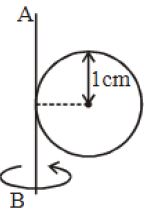
- 241. \(5\,g\) and radius \(1\,cm\) is fixed to a thin stick \(AB\) of negligible mass as shown in the figure. The system is initially at rest. The constant torque, that will make the system rotate about \(AB\) at \(25\) rotations per second in \(5\,s\) is close to
 2019 Medium
- 242. \(5\,g\) and radius \(1\,cm\) is fixed to a thin stick \(AB\) of negligible mass as shown in the figure. The system is initially at rest. The constant torque, that will make the system rotate about \(AB\) at \(25\) rotations per second in \(5\,s\) is close to 2019 Medium
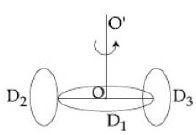
- 243. A circular disc \(D_1\) of mass \(M\) and radius \(R\) has two identical discs \(D_2\) and \(D_3\) of the same mass \(M\) and radius \(R\) attached rigidly as its opposite ends (see figure). The moment of inertia of the system about the axis \(OO\)’, passing through the centre of \(D_1\) as shown in the figure, will
 2019 Hard
- 244. A circular disc \(D_1\) of mass \(M\) and radius \(R\) has two identical discs \(D_2\) and \(D_3\) of the same mass \(M\) and radius \(R\) attached rigidly as its opposite ends (see figure). The moment of inertia of the system about the axis \(OO\)’, passing through the centre of \(D_1\) as shown in the figure, will 2019 Hard
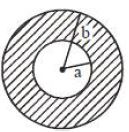
- 245. A circular disc of radius \(b\) has a hole of radius \(a\) at its centre (see figure). If the mass per unit area of the disc varies as \(\left( {\frac{{{\sigma _0}}}{r}} \right)\), then the radius of gyration of the disc about its axis passing through the centre is
 2019 Hard
- 246. A circular disc of radius \(b\) has a hole of radius \(a\) at its centre (see figure). If the mass per unit area of the disc varies as \(\left( {\frac{{{\sigma _0}}}{r}} \right)\), then the radius of gyration of the disc about its axis passing through the centre is 2019 Hard
- 247. A homogeneous solid cylindrical roller of radius \(R\) and mass \(M\) is pulled on a cricket pitch by a horizontal force. Assuming rolling without slipping, angular acceleration of the cylinder is 2019 Hard
- 248. A homogeneous solid cylindrical roller of radius \(R\) and mass \(M\) is pulled on a cricket pitch by a horizontal force. Assuming rolling without slipping, angular acceleration of the cylinder is 2019 Hard
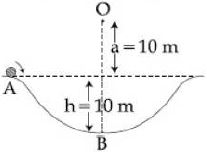
- 249. A particle of mass \(20\,g\) is released with an initial velocity \(5\,m/s\) along the curve from the point \(A,\) as shown in the figure. The point \(A\) is at height \(h\) from point \(B.\) The particle slides along the frictionless surface. When the particle reaches point \(B,\) its angular momentum about \(O\) will be ......... \(kg - m^2/s\). [Take \(g = 10\,m/s^2\) ]
 2019 Medium
- 250. A particle of mass \(20\,g\) is released with an initial velocity \(5\,m/s\) along the curve from the point \(A,\) as shown in the figure. The point \(A\) is at height \(h\) from point \(B.\) The particle slides along the frictionless surface. When the particle reaches point \(B,\) its angular momentum about \(O\) will be ......... \(kg - m^2/s\). [Take \(g = 10\,m/s^2\) ] 2019 Medium
No questions on this page match these filters.