


Questions
Newest firstShowing 51–54 of 54 questions
- 51. A parallel plate capacitor is made of two plates of length \(l\), width \(w\) and separated by distance \(d\). A dielectric slab ( dielectric constant \(K\)) that fits exactly between the plates is held near the edge of the plates. It is pulled into the capacitor by a force \(F = -\frac{{\partial U}}{{\partial x}}\) where \(U\) is the energy of the capacitor when dielectric is inside the capacitor up to distance \(x\) (See figure). If the charge on the capacitor is \(Q\) then the force on the dielectric when it is near the edge is
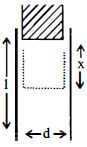 2014 Hard
- 52. The gap between the plates of a parallel plate capacitor of area \(A\) and distance between plates \(d\), is filled with a dielectric whose permittivity varies linearly from \({ \varepsilon _1}\) at one plate to \({ \varepsilon _2}\) at the other. The capacitance of capacitor is 2014 Hard
- 53. The space between the plates of a parallel plate capacitor is filled with a 'dielectric' whose 'dielectric constant' varies with distance as per the relation: \(K(x) = K_0 + \lambda x\) ( \(\lambda =\) constant) The capacitance \(C,\) of the capacitor, would be related to its vacuum capacitance \(C_0\) for the relation 2014 Hard
- 54. A parallel plate capacitor having a separation between the plates \(d\) , plate area \(A\) and material with dielectric constant \(K\) has capacitance \(C_0\). Now one-third of the material is replaced by another material with dielectric constant \(2K\), so that effectively there are two capacitors one with area \(\frac{1}{3}\,A\) , dielectric constant \(2K\) and another with area \(\frac{2}{3}\,A\) and dielectric constant \(K\). If the capacitance of this new capacitor is \(C\) then \(\frac{C}{{{C_0}}}\) is 2013 Hard
No questions on this page match these filters.